★★★★★
At Manchester’s Aviva Studios, Nederlands Dans Theater and Complicite have delivered a work of staggering beauty and urgency with Figures in Extinction — a trilogy weaving dance, theatre, and multimedia into a profound meditation on loss, transformation, and the fragile illusion of human dominion.
Directed by Crystal Pite and Simon McBurney, this was not merely a performance but an existential reckoning, forcing us to confront the devastation of our world and the impermanence of our place within it, while probing the enduring psychological debate of “nature versus nurture”.
This symphony of movement unfolded across three distinct yet interconnected acts, progressing from a requiem for lost species to a scathing critique of human detachment, before culminating in a meditation on mortality itself.
The List
The first act, The List, played like a visual eulogy. A documentary-style voiceover recited the names of extinct species as dancers embodied the movements of elephants, birds, and amphibians with haunting precision. Their bodies flailed, disintegrated, and reformed, capturing both the resilience and inevitable fragility of nature. As the list of species lengthened, their names blurred together, the pace accelerating until silence fell, punctuated only by the dancers’ collapse.
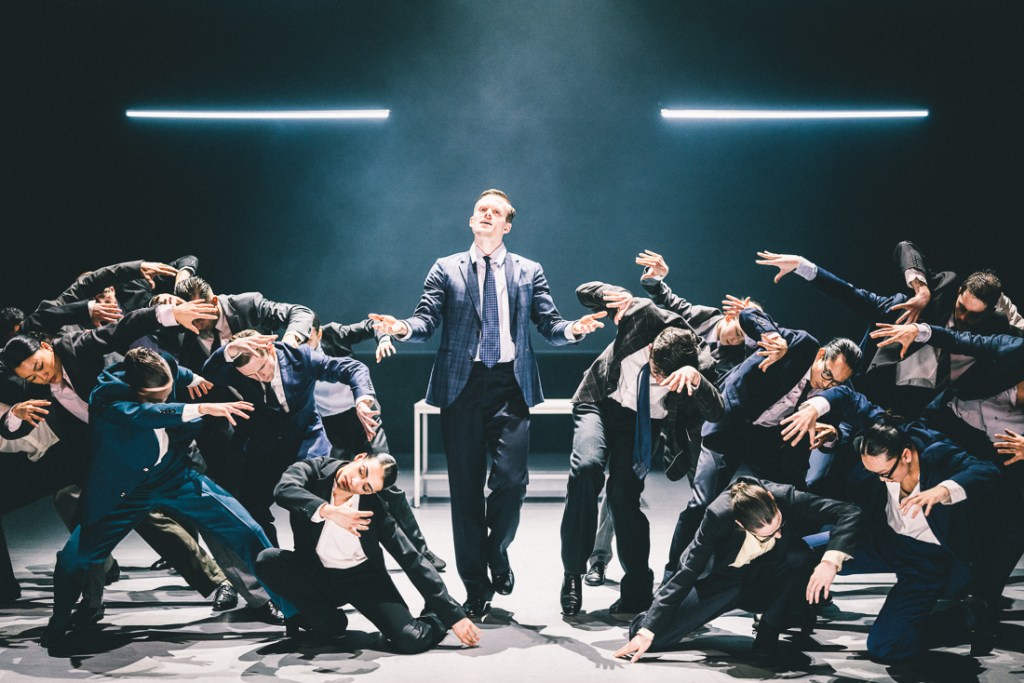
A climate change denier then strode onto the stage, his presence disturbingly familiar, embodying the wilful ignorance that hastens planetary destruction. The arrival of “humanity” in the form of businessmen—exaggerated, obliviously triumphant—provided a bitter counterpoint, their self-importance almost comical. At one moment, a dancer grotesquely parodied political rhetoric, mocking the empty platitudes of climate summits. Meanwhile, a younger generation—adorned in pastel rave attire, moving frantically but aimlessly—suggested a culture caught between grief and escapism, dancing at the edge of the abyss.
But Then You Come to the Humans
The second act, But Then You Come to the Humans, turned its gaze inward, shifting from planetary ruin to the internal wastelands of contemporary existence. Examining human relationships, disconnection, and the digital age, the piece was a sensory overload of live projections, abstract soundscapes, and fragmented movement. McBurney’s theatrical instincts shone here: dancers mirrored the frenetic pace of digital culture, their bodies fractured by a soundscape of disjointed TikTok loops and automated call-centre voices.
A childlike voice exclaimed, “She moved!”—as though marvelling at an animal in a zoo—a stark reminder that in the era of algorithmic control, human agency has become a spectacle to be observed rather than experienced. Drawing from Iain McGilchrist’s The Master and His Emissary, the piece explored the divided brain—left hemisphere logic versus right hemisphere creativity—translated into movement as a literal, physical split: on one side, dancers locked in rigid, mechanical repetition; on the other, fluid spontaneity. Moments like dancers endlessly attempting to reach a human operator in an AI-dominated world provoked uneasy laughter. It was satire, but only just—the absurdity of reality was already embedded within it like in a Black Mirror episode.
Requiem
Finally, Requiem returned us to the body—to decay, to death, to the inexorable pull of time. Here, movement became elegiac, stripping away the verbal commentary that underscored the first two acts. The five stages of grief unfolded through dance, each transition marked by shifts in light and texture. A dying woman’s breath, magnified and drawn out, set the tempo, while the ghostly reappearance of the tiger skeleton from the first act tied the trilogy’s themes into a cycle of extinction and rebirth.
Puppetry, handled with eerie delicacy by five dancers, imbued the skeletal remains with an uncanny vitality, forcing the audience to confront the paradox of presence in absence. Snippets of Mozart’s Lacrimosa drifted through the theatre, its mournful strains underscoring the weight of what had been lost. And yet, even in this requiem, there was a whisper of renewal. The closing tableau—figures rising, shrouded but stirring—suggested not triumphant resurrection, but reluctant continuity.
What elevated Figures in Extinction beyond mere polemic was its structural elegance—each motif returned in altered form, creating the impression of a symphony composed in movement. Tom Visser’s lighting, at times stark and clinical, at others soft and otherworldly, sculpted the dancers into living fossils, artefacts of a present that already feels like the past. Benjamin Grant’s sound design oscillated between the sweeping and the granular, amplifying both the epic scope and intimate terror of human fragility.
If there was a flaw in Figures in Extinction, it lay in its ambition. The density of its references, the economy of the dead, the psychology of grief risked overwhelming the audience, demanding not just attention but active interrogation. But perhaps that was the point. In a world of constant distraction, to sit in the dark and witness our own dissolution—to be implicated in it—is a rare and necessary act of reckoning.
This was not just an extraordinary performance; it was a philosophical inquiry into extinction—not only of species, but of meaning, of connection, of self. It was theatre as confrontation, as dirge, as desperate plea. Urgent, harrowing, and impossible to forget, Figures in Extinction is a masterwork of contemporary performance—a danse macabre not just with the past, but with the ghosts of our possible futures.
Photo: © Rahi Rezvani
Figures in Extinction runs at Aviva Studios (The Hall) until February 22 and tours Europe until July 6.

 JADAR
JADAR 