★★★☆☆
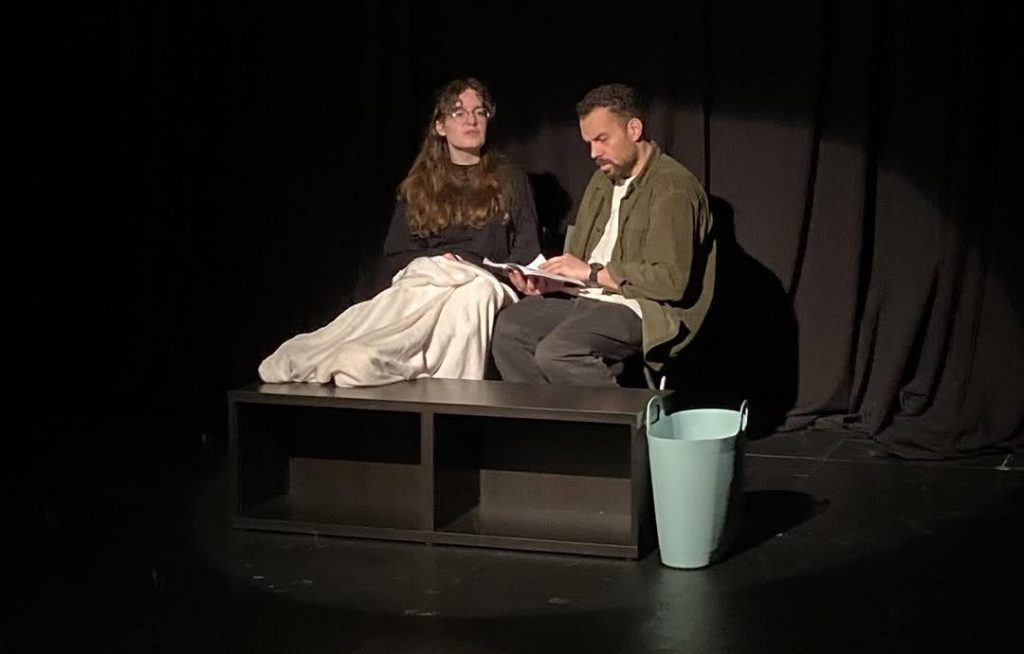
Constellations is a play which, if you love to overthink, or analyse every possible scenario, allows you to do just that. It is a two-hander with Claire Cole playing Mariane and Aiden Crawford playing Roland in a romantic exploration of the multiverse theory. Directed by Emily Tandy and produced by Bria Cotton, the play follows a simple enough narrative: there’s a boy who is a beekeeper, a girl who analyses cosmic radiation data at the University of Sussex.
The two meet, they get on, they don’t get on, they kiss, they don’t kiss, they love, they leave… All what can happen (and doesn’t happen) to a relationship is shown to the audience. Claire and Aiden play the multiple scenarios really well, with the light denoting to the audience when the scene has ‘restarted’.
This cloning of scenes is pretty effective when the scenes feel distinct from each other. There’s a scene where Mariane spirals over a cancer diagnosis after reading forums online which then restarts and is enacted out in Sign Language. The audience, even if not fluent in sign language, can still pick up on what’s being communicated as it played out similarly just moments before. This heightens the emotion of the play.
The play becomes less effective when the same scene is played out by both characters which lessens the emotional impact of the scene. An example is the scene where an affair admitted, a few from Mariane and a few from Roland. There are some differences which give you insight to the characters as Mariane seems to be a person who cheats over a period of time, then admits. Roland cheats just once, and it was just last week. Both cheat with co-workers and both begin the scene with a fraught text miscommunication.
This scene doesn’t do much to toy the narrative along. That said, the play is about the multiple world effect where there isn’t a single narrative. Knowing this, the audience becomes unsure of the characters and what their actions’ impacts are. But how does the story carry on if it keeps exploring but never confirming? On the other hand, the repetition of dialogue has a warming effect, where we as an audience know what is being said but the thrill of different outcomes can feel quite exciting.
This can be the beauty of the play’s idea and also self-awareness of itself. There’s a meet-up scene played out 2-4 different ways, the proposals played out 3-4 different ways, an affair played out similarly. The idea that we explore a relationship’s infiniteness seems magical yet daunting: the question always remains, do they stay or do they leave this relationship? Does the play need to communicate something more than just the fact it can restart?
There are some beautiful lines which take on almost a religious quality, where Mariane soothes Roland with her terminal diagnosis, saying “You will have all the time you have, no more, no less”. Some of the dialogue balances the timely quality with the reality of the relationship, and other times it reveals the fraught nature of the relationship anyway which is losing time Mariane is terminally ill or is not.
The proposal scene(s) are the most effective in using the restart quality. We see Roland propose 3-4 different ways, some he loses his speech, some he performs his love for Mariane via bee metaphors. Mariane rejects two proposals, accepts one, and two are sort-of left unanswered. When the action is resolutely performed by one character and another responds is where the need for action to carry is less, and I understand the characters better, their intentions and reactions. There was a better sense of narrative in this scene as the audience knew a proposal can be rejected, accepted, delayed, and that helped to allow the repetition to have an impact on the story’s trajectory.
Constellations runs at The Kings Arms, Salford until February 23.
Photo: Proxemics

 JADAR
JADAR 