★★★★☆
Inspired by Henri Murger’s Scenes de la Vie de Boheme ,which in turn had its own stage productions before Puccini’s famous opera, La bohème became one of the most well-renowned and influential operas of all time, inspiring musical classics such as Moulin Rouge and Rent- some motifs being amusingly similar to their predecessor.
Ellen Kent’s production of Madame Butterfly last year was my first introduction to opera, and my favourite opera production to-date, so La Bohème had a lot to live up to!
Kent’s La Bohème, an operatic staple to Manchester Opera House, transports the audience into the impoverished world of artistic and amorous bohemians in 1830s Paris. During Christmas, the lives of lonely poet Rodolfo (Davit Sumbadze), painter Marcello (Lurie Gisca), musician Shaunard (Vitalii Cebotari), and philosopher Colline (Valeriu Cojocaru), change forever when the angelic seamstress Mimi (Elena Dee) and lusty singer Musetta (Viktoriia Melnyk) arrive. However, the consequences of poverty creep through the cracks as Mimi sickens in another tragically dark opera spectacular.
The show started a little bumpy, with some initial vocal projection issues here and there across acts 1 and 2- not particularly egregious but noticeable in what should be impactful ensemble numbers. This, along with two startling back-stage bangs and some missed surtitle translations, were minor flaws but distractions none-the-less.
Act 1 was a jovial yet slowly-paced 35 minutes introduction to the bohemians in their shabby art-filled apartment. The lighthearted banter and wordplay among the bohemians is one of the show’s highlights, as is the endearing (albeit quickly sparked) relationship between Rodolfo and Mimi. Their romance is filled with frivolous metaphors, candle motifs, and gorgeously flowery imagery, despite the handful of dated, infantilising comments.
Sumbadze’s performance as Rodolfo was so raw and vulnerable; there were moments of cheeky wit and coyness, yet his genuine chemistry with Dee’s Mimi was palpable – their duets and arias being the show’s stand-out performances. Dee’s Mimi was filled with the same tenderness and emotion, worried about hurting Rodolfo yet desperate for his love with this exquisitely tragic pining in her voice throughout their scenes together.
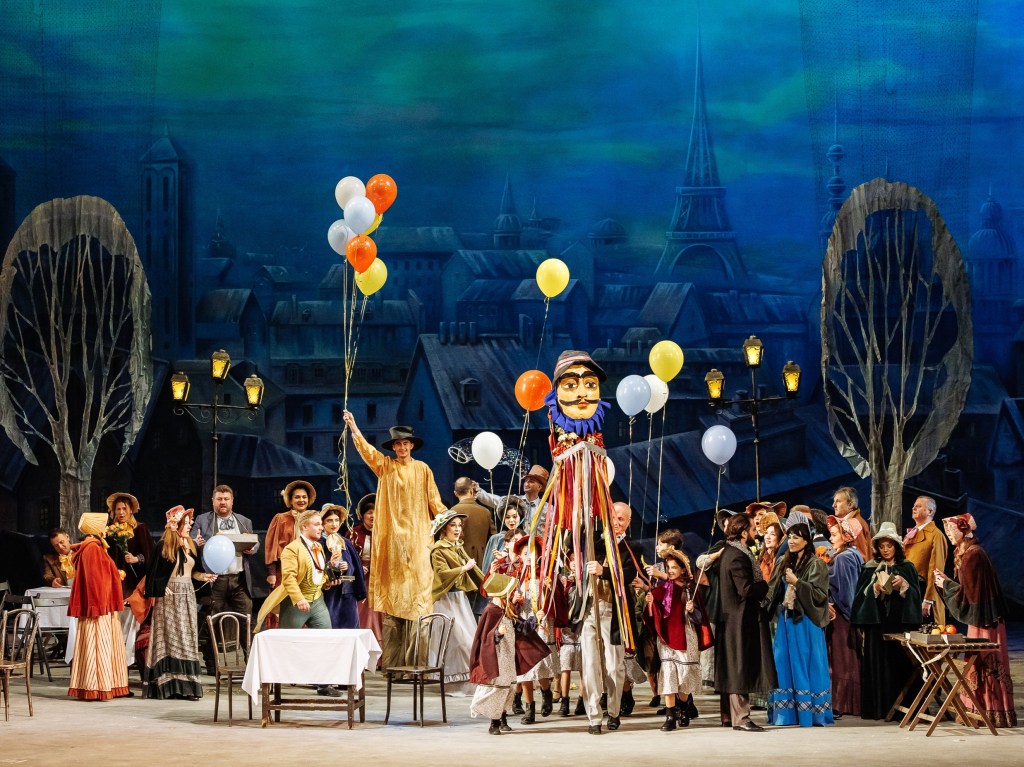
The first set is a little drab, with antiquated cardboard cut-out houses and a washy watercolour Parisian backdrop and pale blue lighting. However, the array of canvases, a smoke chuffing chimney pot, a hat-wearing skeleton, and a desk of scattered papers added splashes of liveliness. It’s perhaps an intentional juxtaposition between the melancholy Parisian backdrop and the invigorated bohemian lives, but a little lacklustre in its execution, as were the jarring mini-intervals for fairly simple set changes.
Act 2 is far more engaging as budding love melts away the melancholic winter. Warmly lit hues decorate the stage along with vibrant ribbons, an array of festival-goers and Café Momus patrons, and an admittedly haunting paper-mâché face on a pole that lingered silently in the background. The scenery initially garnered awe from the audience but the novelty faded with most props remaining rather static and underused despite the scene’s impactful character introductions and festive grandeur.
A parade of children (and an adult dressed as a child) promptly march in with two soldiers making for a cute display, followed by a whimsical but weird Parpignol the toy-maker bit, and then by one of the biggest stars of the show.
Crufts champion Miep, who was the cutest Hungarian Pumi, stole the stage with his little tricks – a hard feat during an incredible solo from Musetta (Melnyk). While the dog’s appearance feels a little gimmicky and does distract us from the ensuing drama, you’ll never hear me complain about a dog on set, especially when they wave to the audience in their curtain call ‘bow-wows’!
Despite the dog, Melnyk’s versatile and jaw-dropping soprano vocals were awe-inspiring and tender. Her acting was equally engaging, fluctuating between her lusty, mischievous persona, and her warm emotional centre with ease. Her duet with Marcello (Gisca) – an incredible baritone – where Rodolfo and Mimi say their goodbyes were simply stunning.
The final set was an icy tollgate that (again) initially took my breath away with the gorgeous snow effect, until it was snubbed by hilariously large clumps of snow, the loud whirring of the machine, and moments where I pondered whether the actors were going to choke on the snow during their powerful numbers. Snickering and stifled laughter followed, even into the next (and most tragic) act, where little droplets of snow fell unintentionally. Another awkward moment had an actor staring at the wall for several minutes before his cue in the show’s final minutes.
Despite these flaws, the ending was simply astonishing; the tenderness of the artists, the nuance and thoughtfulness of Musetta, and the raw intensity of Rodolfo’s screams (the only spoken dialogue of the show) – all making for a heart-wrenchingly tragic finale. The setting was the same yet the joviality from act one melted away with the weight of the company’s grief.
Curtain calls were followed by a touching tribute to Ukraine, the audience standing in unity as the company sang the Ukrainian National Anthem.
While there were a variety of clunky creative decisions, I was ultimately won over by the story’s mixture of witty humour and poignant tragedy, its punchy yet touching score, and the cast’s abundant chemistry and talent. Like with Kent’s Madama Butterfly, the plot is so endearingly tragic and impactful, even with its tonal hiccups and staging blunders.
Ellen Kent is at Opera House Manchester until February 23, and tours the UK until May 13, with La Bohème, La Traviata, and Madama Butterfly.
 JADAR
JADAR 