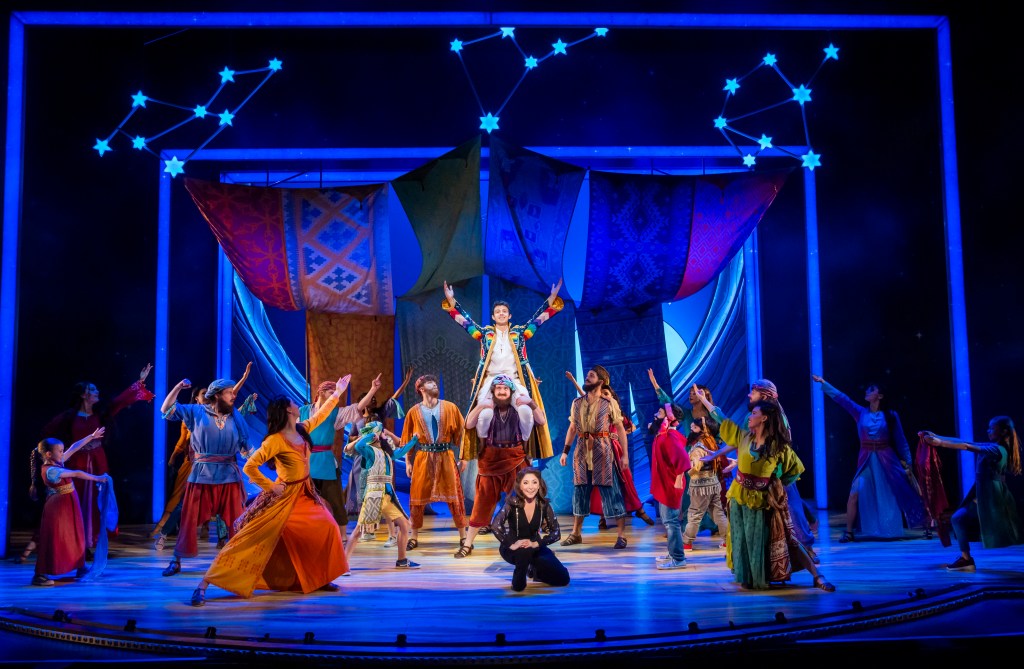
A long time ago, not so long after the Bible was first published, Joseph and the Amazing Technicolor Dreamcoat was performed as a school concert at Colet Court, London. Described as an utter masterpiece, this Andrew Lloyd Webber and Time Rice musical has been around for generations, inspiring a rich love of musical theatre across the world. The current production, directed by Laurence Connor, with choreography by Joann M. Hunter, attempts to modernise a well-known story that recounts the tale of Joseph from the Book of Genesis.
Joseph, one of twelve brothers, is sold as a slave in ancient Egypt. He escapes certain death with his special ability to interpret dreams and ends up saving Egypt from doom. When adapting a story from the Bible, it is important to make it both impactful and relevant for today. Unfortunately, I found the attempts to modernise the story to fall flat and instead arise discussions around race, femininity, and ethical portrayals of kids on stage.
One of the main issues that can arise in a sung-through musical is it can rarely allow for any variation in character, making the emotions fall flat. This show was well-timed and focused so heavily on their action and movement that the acting and characters became robotic. The first act of the show felt like a grand spectacle of musical theatre; it was flashy and loud.
Every song became a major dance number, with dozens of costume changes, set adjustments, and an influx of characters running in and out of the space. However, each song felt detached from the others – there was the Can-can in ‘Those Canaan Days’, country-style line dancing, and American cheerleaders in ‘Go, Go, Go Joseph’.
The costuming, design and dancing did not fit the lyrics, music or overarching narrative. Each number felt like it was trying to outdo the other, but when every number becomes a big one, the story becomes muddled, and all emotions are lost. The songs were adjusted to be more upbeat, particularly ‘One More Angel in Heaven’, which was watered down by the fast-paced and upbeat atmosphere on stage. The show rarely slowed down, losing touch with the emotional journey intended.
There were jaw-dropping pieces of set, including two large camel puppets that were controlled in front of us. The first act was remarkably well-designed, with beautiful lighting fixtures, and a set that felt like I had stepped into a children’s book. It established the ensemble to be both remarkably talented vocally and well-versed in every kind of dance. However, across the second act, I felt like less interesting choices were being made, and the initial spectacle fell short.
The piece itself cannot be blamed for its writing or lyrics, but the intention to perform and produce a show that blatantly discusses the superiority of Israel reflects itself poorly in our current socio-political atmosphere. The show had an overarching theme that can only be described as White saviourism in an already White-washed show (literally – Middle-Eastern characters played by White actors) that used outdated designs that came across as cultural appropriation rather than appreciation. It felt like a large majority of the show was swept up into how to be fun, add in technical aspects, and what more can be added as opposed to understanding the story being told as a warning for the mistreatment of others based on prejudice.
Continuing on my evaluation of the performance itself, the Narrator, played by Christina Bianco, had a remarkably difficult job. Her role was never-ending and physically intense, as she rarely left the stage and played dozens of roles. There were moments I found her character to be distracting, and it felt like there was little direction or guidance given to her in the scenes. Bianco had an outstanding voice and vibrato, but I felt like her character was not involved in the story as intended. She would make grand gestures to mark a change in environment or storytelling, but there were no adjustments made on stage meaning that she looked unsupported by the musical.
Joe McElderry, who played the pharaoh, had the exact energy needed for this show but left an aura of confusion. He is a very talented performer and made the stage his own, however, for the programme to describe the importance of an Elvis-inspired musical number, I found that his voice and affliction did not compliment this style. McElderry has a lovely diction, beautiful vocals and a stunning stage presence, but his casting was confusing as he was not overtly Elvis except in attire. It seemed that he had been cast as the Pharoah, alongside Donny Osmond and Jason Donovan in other cities, purely because they have all previously played Joseph.
Much to my dismay, a theme has arisen within my critiques of modern theatre, and this show has let me down once again. The second act is where my opinion on the show was adjusted. The female ensemble was remarkable, and I often found myself gravitating to watching them perform high-energy dances while hitting incredibly high notes. Their talent cannot be overstated. However, they were let down with the direction and style of the show. The direction given to them was less than complimentary as these women were given increasingly sexualised movements and choreography, including loud moaning, portrayals of sex poses, and even a character peeking under the skirt of the pharaoh and becoming ‘aroused’ on stage. This was deeply disturbing as these actions on stage were taking place with female children onstage. And yes, it is that deep. This show was made to be performed for kids, with kids. The hyper-sexualiation and exploitation of the female body is ingrained into our culture from such a young age; it was an utter shame to see this show do the same.
This brings me onto my next point: the show did not feel like it knew if it was for children or for adults. I felt at times infantilised as an audience member and simultaneously like I was watching something for mature audiences.
However, a highlight of the performance was the children performers. The kids on stage were not any older than eleven, and their youthful spirits were infectious. It was heart-warming to watch the adult performers interact with these youngsters – these were the moments I felt overjoyed watching.
The music and band was seamless, providing a truly rich addition to the show. John Rigby was this production’s conductor and musical director: it was a treat to be able to watch portions of his conduction. There was even a moment that he conducted the audience to time our clapping correctly. The music was excellent, remarkably well-played and energetic.
Adam Filipe, who played Joseph, had an infectious energy. He stood out in this production, and the songs I enjoyed the most were his solo moments on stage. He has a beautiful voice and a remarkable grasp on his breath control. I imagine Filipe will have a long career as a performer. We were treated to Daniel Bowskill (usually Levi & Ensemble) as Simeon, who gave a remarkable performance. He stood out as you could tell he was a performer that cared both for his scenes and also everyone around him on the stage.
The performers were all remarkable, expertly singing incredibly difficult harmonies while doing some of the hardest moves in musical theatre.
Joseph and the Amazing Technicolor Dreamcoat is a well-known and deeply beloved story. This contemporary rendition, which pulled elements from American culture, reflects poorly in a modern-day setting, retelling an uncomfortable story with both racist and sexist roots. It was an overwhelming spectacle that left audiences confused rather than appreciative. However, the vocal and physical abilities of its performers were a complete marvel.
Joseph and the Amazing Technicolour Dreamcoat runs at Opera House Manchester until March 9 and tours the UK until August 10.
Photo: © Tristram Kenton
 JADAR
JADAR 