★★★★☆
Since its first performance in 1791, The Magic Flute (Die Zauberflöte) has stunned audiences with its soaring melodies, Mozart’s variety of grand orchestral scores, and the singspiel’s surprisingly upbeat tone in the face of dark supernatural themes. Opera North’s production (first performed in 2019) offers an equally bizarre yet stunning interpretation of the stirring classic. For the most part, it’s a visual and melodic treat and a refreshingly upbeat and untragic tale despite its dark themes. Yet it admittedly has its fair share of creative and narrative flaws.
The show follows Prince Tamino (Trystan Llýr Griffiths) as he finds himself lost in a mysterious world with ferocious monsters and strange magical forces. With bird-catcher Papageno (Emyyr Wyn Jones) at his side, Tamino is sent by the Queen of the Night (Anna Dennis) to rescue her daughter, Pamina (Soraya Mafi), from the ‘evil’ Sarastro (Justin Hopkins).
My primary issue with the opera was the unnecessary framing of the mystical world within that of a little girl’s dream. The concept felt largely thrown together with moments where the little girl wandered around the set in a little yellow robe observing the scene and constantly reminding us of a dream – a tired trope that really lowers the stakes of the Prince’s endeavours.
I also can’t say I ever dreamed of mystical spirit worlds and misogynistic masonic zealots when I was a kid but each to their own!
The dream aside, the show intriguingly opens in media res, with the Prince somehow transported to this strange world and suddenly being attacked by a giant tentacle monster (brown tentacles spookily reaching from either side of the stage).
Soon arrive the three ladies (Charlie Drummond, Katie Sharpe, Hazel Croft) saving him with their… samurai lightsabres?… and wearing costumes that evoked some strange combination of the Silent Hill‘s blood-soaked nurses and The Handmaid’s Tale‘s handmaidens – perhaps fitting with the shared themes of patriarchal oppression. Their appearance was fun and charming despite the odd theming and added to the absurdity of this world, but I do wish there were more of these wild creative choices in this show and modern opera in general.
Equally fun was Papageno’s costume, with wild hair, beak hat and layers of bags, nets and panflutes.
Yet, having seeing the bewildering and gorgeously Lion King-esque costuming, giant visuals and puppetry of the 2008 Met production, I am left wondering why this show didn’t try dipping more into the bizarro aspects of this world and its inexplicable wonders.
For instance, while I appreciated that the large door set pieces weren’t static, they ultimately felt a little bland even for the palatial/temple set and some of the projection effects from the flute would have been better on less rigid surfaces. Additionally, one spectacle that fell a little short was the final ‘showdown’ between Sarastro and the Queen. Everything built to this grand fight but she was swiftly dealt with as a swirling projection of the sun rose on the set and she was sent spiralling melodramatically off the stage.
However, I did enjoy some of the projection effects, the rooty woodland tree backdrop, the transparent screens, and the screen of projected fire and water engulfing our hero and his glowing magic flute (despite the lack of motion or physical flute-playing during these scenes). I was just left craving more of these magical and ostentatious moments.
I was admittedly a little baffled by the choice to stick with so many of the show’s original misogynistic themes. The original opera is rooted in masonic and misogynist ideals, with Sarastro and his men representing the sun, rationality and purity, while the Queen and women are dark, animalistic, irrational. Sarastro’s society of red Handmaid’s Tale-esque, militaristic uniform-wearing men and women becomes a little repetitive but is interestingly cult-like and symbolic, yet these tyrannical themes are barely explored.
At one point, the show seems to muddy the waters of both sides, seemingly suggesting neither side is right, but by the end, the main protagonists fully embrace Sarastro’s lifestyle, scrapping the nuance it could have had as a modern-day interpretation, but I understand changing things is tricky with classical shows like this.
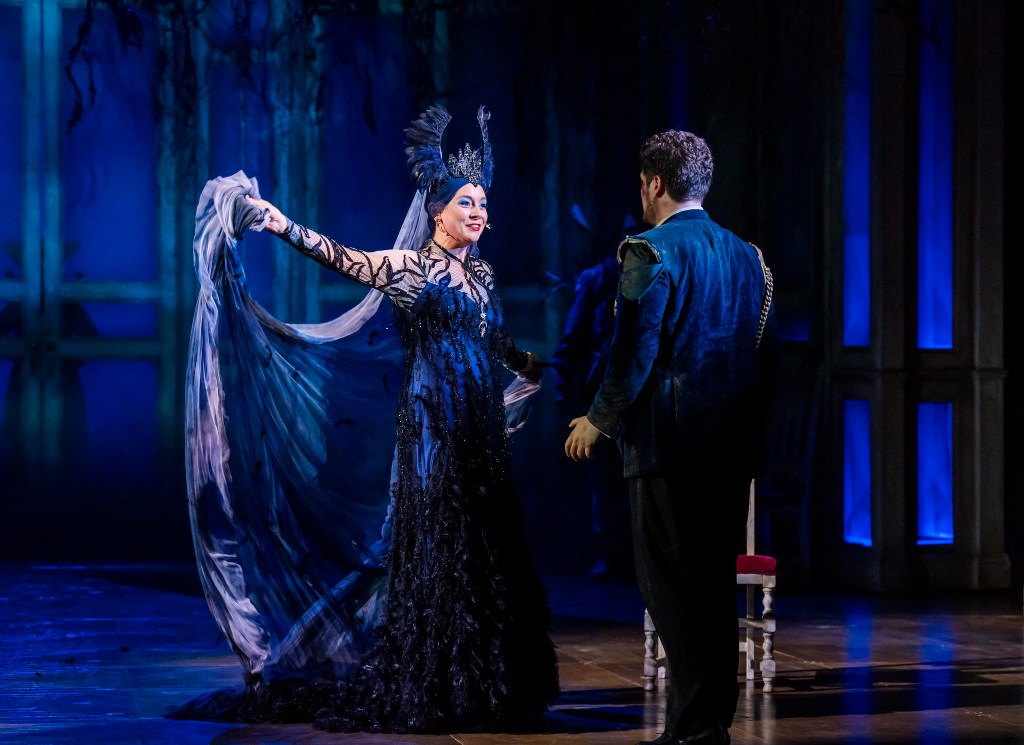
Regardless, stand-out performances came from the gloriously flamboyant and glitzy Queen of the Night played by Anna Dennis, with her delectably soaring vocals during the famous aria ‘Der Hölle Rache’. Her lavish bejewelled dress, its gorgeous black veil, and raven-winged horn-shaped headdress were awe-inspiring. Her soprano vocals and dark attire animalistic headdress were an intriguing contrast to the incredible low notes of her opposition, the gentle yet dictatorial Sarastro (played by Justin Hopkins).
The chemistry and luscious harmonies between Trystan Llýr Griffiths (Tamino) and Soraya Mafi (Pamina) were incredible, as was the humourous charm and wit from both Emyyr Wyn Jones (Papageno) and Pasquale Orchard (Papagena) during their brief flirtations and the later whimsical whirlwind of their ‘Pa-pa-pa’ duet.
I was also wildly impressed by the show’s accessibility features, with subtitles for spoken word and songs and a pair of BSL interpreters (Sarah Cox and Craig Painting) that translated each word, song and musical note with passion and enthusiasm. There was the odd moment where they were left waiting for a queue between scene changes or while certain characters were silent, but all in all they was a fascinating and welcome addition to the show and led to some funny interactions between the characters and themselves.
Ultimately, Opera North’s The Magic Flute is an entertaining and witty tale filled with incredible melodic performances, a timeless story of good and evil, but it also struggles in its creative direction and nuance with a mixture of brilliant and slightly lacklustre design and narrative elements that could benefit from a little tweaking. However, its jovial tone and absurd sci-fi fantasy elements make it the most unique opera I’ve seen to date and an incredible journey into a supernatural world albeit one with misogynist priests. It’s a magical experience regardless of its flaws.
The Magic Flute tours the UK until March 29.
© Tristram Kenton
 JADAR
JADAR 