★★☆☆☆
Like many people, I’ve known and loved the legend of the Flying Dutchman for years now, having been exposed to it countless times in pop culture, from Pirates of the Caribbean to SpongeBob. Therefore, the premise of an operatic version of the tale (German with English titles), wholly focusing on his plight and loneliness caught my attention… So, did Opera North’s new production of Wagner’s The Flying Dutchman (Der Fliegende Holländer) have me hook-line-and-sinker, or was its creative vision as cursed as the Dutchman himself?
Based on the myth of the mysterious ghost ship, The Flying Dutchman follows a stranger (Robert Hayward) cursed to the seas, only returning to land every seven years to seek a lover that may break his affliction. After meeting the influential Daland (Clive Bayley), he offers him riches for refuge and his daughter Senta’s (Layla Claire) hand in marriage. While Erik (Edgaras Montvidas) admires Senta, her secret obsession with the Dutchman legend makes her instantly empathise with her cursed fiancé.
Unfortunately, the show wasn’t plain sailing and my interest in the mythological elements were soon extinguished. While lots of operas have strong themes of tragedy and self-pity, this one completely prioritises these sentiments over a well-paced story progression, often feeling tedious and bloated. It takes 10 minutes of staring at projected ocean waves before the show begins, and two 50 minutes acts (without an interval) for the Dutchman and Senta to meet, leaving a brief 25 minutes for the “main climax” in act three. There are no side plots or other fleshed-out characters elongating the acts, just the Dutchman’s melodramatic self-loathing and Senta’s weird lusty obsession with his eternal damnation. How joyous.
The show’s saving grace is its swelling and impactful orchestral music. Richard Wagner’s score is so varied with adventurous and swashbuckling motifs evoking crashing waves and windy beaches, contrasted exquisitely with passionate or melancholic arias. Sadly, some of Wagner’s operatic numbers were less impressive, some droning and rambling for far too long, and others just lacking any real gravitas, although this was not the case for every number.
Layla Claire breathed new life into her numbers as Senta and performed with an intriguingly dark, lusty and empathetic take on the character. Edgaras Montvidas was a sublime Erik, with touching vocals, and an incredible yet fiery chemistry with the obsessive Senta. Their duets were particularly interesting numbers, but Claire’s rendition of the Dutchman’s song was particularly enchanting. Robert Hayward was an incredibly tender Dutchman. While few moments allowed his role to feel as impending as I had imagined, he had the perfect balance of mysterious swagger and tormented self-loathing. The ensemble numbers were few and far between but each revitalised their scenes with jovial women prodding at Senta’s crush, men dreaming of returning home, and the Home Office terrified of the mighty (sadly invisible) Dutchman crew.
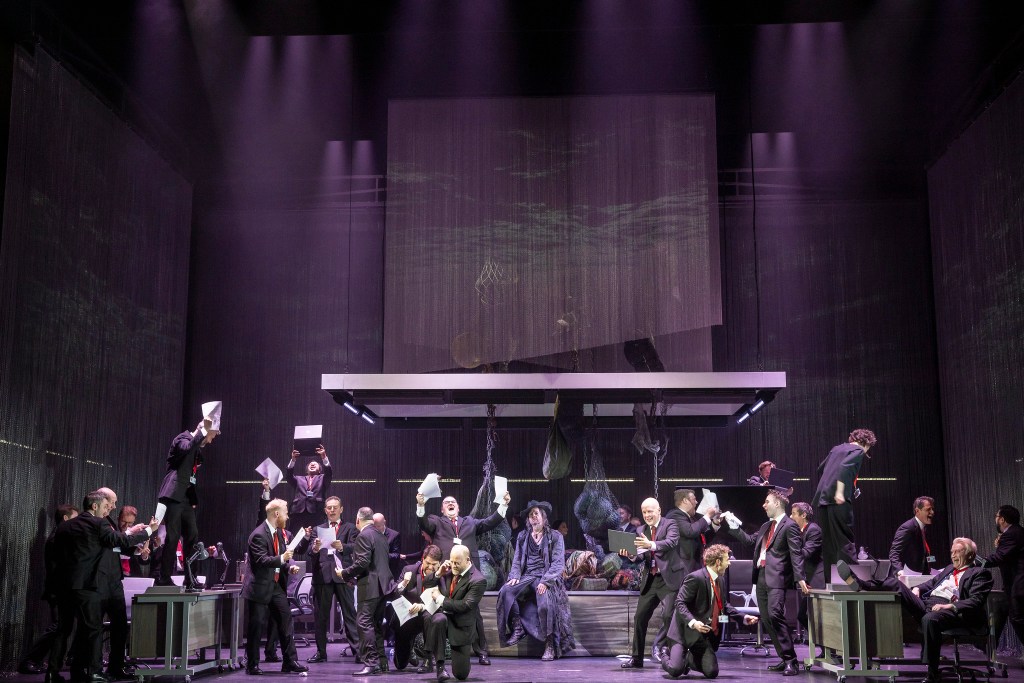
Despite appreciating the attempt to revitalise an old opera, the new creative direction lacked any semblance of cohesion, mixing modern and ancient aesthetics in an effort to draw tenuous parallels to immigration and recontextualise Daland’s ship as the Home Pffice/“ship of state”. Tech jargon and computers litter the stage yet they sing old sea-shanties in their Trumpian attire, and the ancient seaman apparently has an online bank account?
The show’s oceanic intro was paired with a touching yet contextless refugee account. Obvious similarities between the cursed and homeless Dutchman and a heartbroken refugee immerge but are not fleshed out enough to make a real splash. Instead, the added context only complicates our interpretation of the show, its message, and its overall aesthetic. While it could be an intriguing interpretation with more substance, as it is, the modernisation takes away a lot of the original story’s momentum (and creepiness), and never takes the initiative to become a clear, bold, or new interpretation.
The set was frustratingly static and bland despite the grandiose score, ebbing wave projections and the many ship references with silver chains, office desks, and a naval net amalgamation. I often found myself searching in vain for something interesting to look at during some of the longer numbers.
The costuming was even more chaotic with modern black suits and red lanyards for the “home-office” crew-members, horribly contrasting the traditional Dutchman’s look with his aged mouldy trench-coat and hat. Senta’s costume could only be described as “vampiric cowgirl chic” with black denim shorts and tights, a rocky top, platform boots and a cascading black outer skirt. By this point, I was past questioning the show’s aesthetic, thematic and periodic discord. I prayed for a dramatic finale or something to tie the lose creative threads together neatly but, like the Dutchman, I found my prayers (and a multitude of questions) unanswered.
We never see the Dutchman’s corpse-like crew, nor his impending boat, or any boat aside for that matter (aside from a boat-shaped bar bunged into act three). The sting of his damnation, the gravity of Senta putting her soul on the line for the stranger are never felt, and the lack of “Satanic” sights or imposing moments undercut the endearing score and nightmarish mythos.
Instead, I found myself giggling through the final act as the Dutchman stroked the chain “sails” waiting in the back for his queue, crawled awkwardly off-stage, or even when the ensemble gather around Senta before she “poofs” away.
Despite its engaging premise, The Flying Dutchman struggles to keep itself afloat, constantly oscillating between modern and ancient contexts with clunky and incoherent creative decisions, a hefty run-time, and a tragically static set. Wagner’s score and Opera North’s ensemble have their shining moments but fail to save this sinking ship of a show.
Photo: James Glossop
The Flying Dutchman tours the UK until March 28.
 JADAR
JADAR 