★★★☆☆
The House Party is a modern reimagining of August Strindberg’s Miss Julie, which explores the complicated relationship between class, gender, and power.
The play is produced by Headlong Theatre in collaboration with Chichester Festival Theatre and in association with Frantic Assembly and written by Laura Lomas and directed by Holly Race Roughan. Movement direction comes from Scott Graham with intimacy direction by Haruka Kuroda.
This riveting new play is a naturalistic drama that uses contemporary dance to explore privilege and desire through the lens of class, race and gender. The show follows Julie and Christine, best friends, on the fateful night of Julie’s 18th birthday. The original text focused on the frustration and pride between different social classes—discussing how power plays a role between both class and gender.
The House Party carried on similar themes but a few moments of symbolism were muddled in the spectacle of this show. The show had a lot happening all at once ,with discussions of mental health, sex, alcohol, youth, violence, love, suicide, animal abuse, class discussions, racial tension, misogyny all taking place during the ruse of a party.
Usually, when I look at pieces of theatre with so many critiques and themes popping up, I want to urge playwrights to narrow down their topic selection, but I did not feel this way for this story.
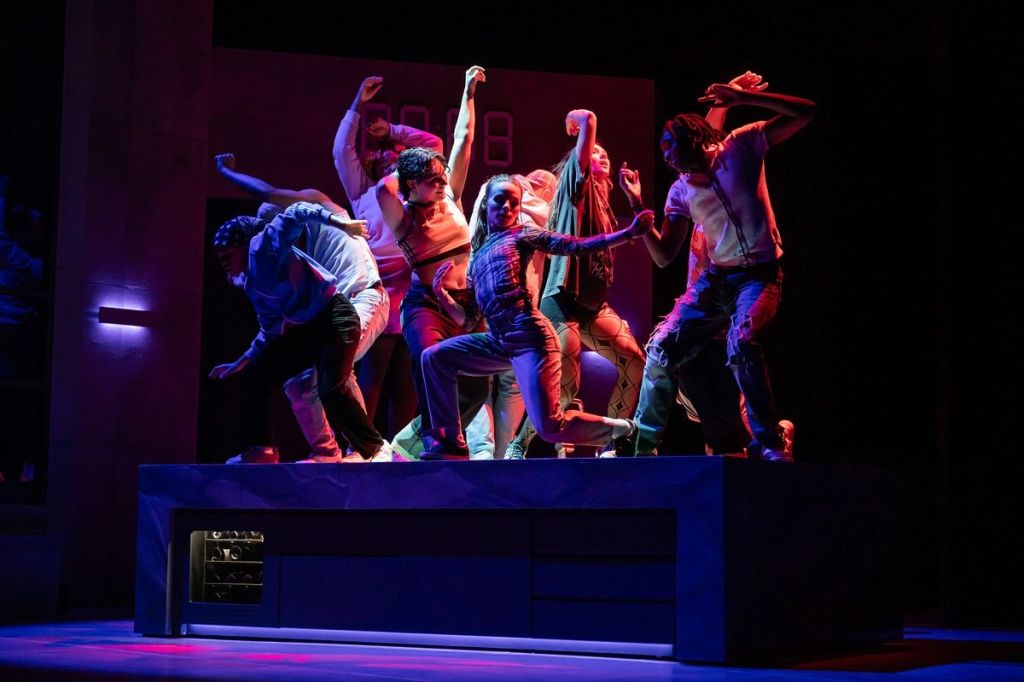
There were two main actions taking place throughout this play that split the narrative in half – the incredibly naturalistic drama taking place between Christine, Julie and Jon and the incredibly talented dance ensemble. For the most part, the dance ensemble was a stunning addition to the narrative acting as the concept of the “the house party” itself. There is no doubt every dancer was very talented. I was blown away by the almost seamless interjection of the contemporary dance sequences.
However, there were a few moments this interjection faltered. I believe the disconnect was made when the piece attempted to connect to younger audiences. One particularly isolated moment is when Young Christine was dancing on stage after the main events of that evening. The use of cold lighting while ‘when the party’s over’ by Billie Eilish played loudly was too on the nose for me. The modern dance this performer was doing felt out of place and, unfortunately, uncomfortable. The acting and performances were so raw; it was jarring to add in pieces of modern dance without explanation and, in The House Party, these moments did not work every time. Using Billie Eilish, as well, felt off-putting and isolated audience members, opposite to the intention to connect.
That being said, when the dance ensemble were dancing together, acting as the symbolism of the house and inner turmoil of Julie, is when these moments really shined through. The set design was fantastic—displaying a beautiful kitchen with multiple levels, entrances, and hidden features, including a working faucet. There was also a large floor to ceiling window at the back of the stage that was backlit to display particularly harrowing moments. This beautiful set design allowed the performers to jump, dance, and move freely throughout the space, creating an almost maze-like floorplan. I was remarkably impressed by the layout and felt that the director used the space well. Loren Elstein (set designer) did a phenomenal job creating such an excellent space.
Excellence in design is truly a continued standard for Headlong Theatre. In addition to the stage design, the lighting design was magnificent. The lighting did an excellent job extending the emotional arc and intensity of this story. During the strong moments where the dance ensemble loudly took up the space, the dancing was truly highlighted by the flashing and creative use of lights. Co-lighting designers Joshua Pharo and Joseph Hornsby provided a truly exceptional standard of lighting design.
Every actor was on point in every moment. In an emotional narrative there were only a few moments that felt forced or uncomfortable, particularly when Jon was crying, but I also felt that his sudden onset crying could have been an intentional display of his psychopathic tendencies. The cast had a particularly disruptive audience that they tackled masterfully, every moment, every thought and every action existed solely within the world of the play. It was a true rarity to see such phenomenal talent.
Looking at the arcs of each character – the narrative is rounded off nicely as it left audiences with multiple takeaways. Jon’s narrative was intriguing. His misogyny felt misplaced, especially in his relationship to Christine where he doesn’t show these traits. This overtone felt almost unexplored and not thoroughly followed through or critiqued. However, Tom Lewis (Gentleman Jack) was a terribly charming performer. He did an excellent job portraying a deeply upsetting character, forcing the audience to fall for his character before breaking our hearts slowly throughout the second half.
Christine had an interesting narrative but, frankly, an upsetting one. I think the script was deeply honest to Christine and her decisions, creating an honest but unsettling character arc. Not to mention Sesley Hope (Bridgerton) was a phenomenal performer. Her raw performance felt so authentic, I wanted to run onto that stage and hug her. Hope is a performer to keep your eye on.
Finally, we look at the somehow charismatic Julie, played by the one and only Synnøve Karlsen (Miss Austen). Karlsen portrayed a young character that goes through horrific turmoil during the duration of this show, and ends up killing a dog and attempting suicide. Her display of a mental breakdown also felt eerily authentic, making me both scared and saddened. I was blown away by her performance. I think Julie’s narrative is difficult to empathise with, but the shame and disgust she felt in the face of her mistakes is incredibly honest and authentic. Karlsen approached her character with love and tender care which made the entire narrative more compelling, she is another performer to continue to watch.
At the end of the show, I felt overwhelmed by the influx of social critiques and conflict of narrative. The House Party displayed the complexity of young adulthood well—there are so many thoughts, emotions and annoyances that play into every decision made as a young person, the audience was shown a very realistic portrayal of these anxieties. The story is intense and overwhelming at parts, making the digestion of the piece difficult.
I think this show is a particularly interesting case study of multimedia theatre and how music and dance can be used successfully in naturalistic shows. The shining stars of this piece were the dedicated performers who did not slip, even for a moment. The House Party is a fascinating piece of contemporary theatre that should be seen, celebrated, and critiqued.
The House Party runs at HOME (Theatre 1) until March 29 and tours the UK until May 10.
Photo: Ikin Yum
 JADAR
JADAR 