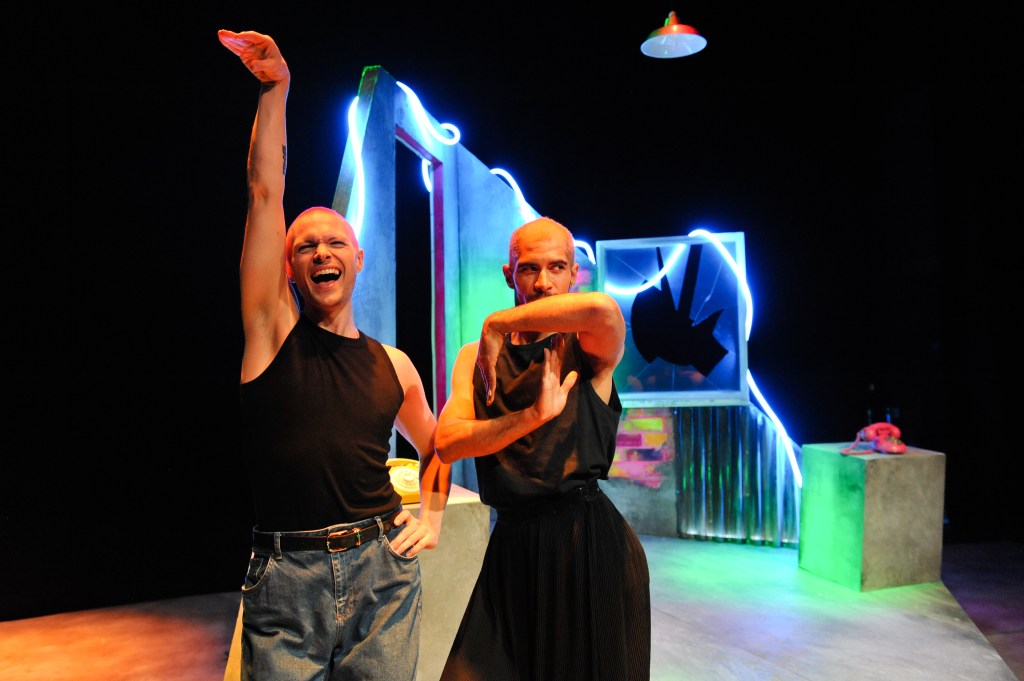
Landing back in their hometown, Nathaniel J Hall (It’s A Sin) is touring with his brand-new show, Toxic. Marketed as a “laugh-a-minute” play that is equally hilarious and heartbreaking, Toxic is sure to keep audiences engaged through enticing political commentary about stigma and stereotypes.
This evocative semi-autobiographical piece follows two characters as they “meet, fall in love and f*ck it up.” This roaring new piece is about pride, shame, and guilt, admirably attempting to tackle emotional suppression, discuss abusive relationships and representations of prejudice.
Set in 2017, this piece follows two gay characters living and surviving in Manchester’s rave scene. One of which is HIV+ and hindered by shame (The Playwright), while the other is his supportive nonbinary partner (The Performer). The play opens with a charming duologue directly addressing the audience (after a blaring remix of ‘Toxic’ by Britney Spears). At this moment they claim that this story is true, and it could be “his. Or his. Or theirs.”
The design and visuals of this production were breathtaking. I was impressed by the stage design, by Lu Herbert; the stage had a slanted room with a broken window and a door frame with a singular LED string light illuminating their faces. The setting was highly innovative, but it felt like there was no extended reason to have this exact setting. I felt like the story could remain the same without the set as I was confused at its use, especially with the established visual storytelling.
The visuals plastered onto the raised stage were beautiful, displaying text messages, videos, dialogue and photos. I was mesmerized by the technical capacity of this show. The projection designer, ././ dede (Dee Dixon), should be highly praised for her creative brilliance. In a similar capacity, Tracey Gibbs had a nearly flawless lighting design that developed the world beautifully. I was in awe of the lighting choices used to develop emotion and atmosphere. SHAR (Charlotte Barber), the sound designer and composer, developed an exceptional rave soundtrack. I was impressed by her audio design and felt it exasperated the consistent suppression of emotion.
Perhaps allowing for a universality in the writing are the unnamed actors who call themselves The Playwright and The Performer. The Playwright is a gay man living with undetectable HIV working and writing in Manchester and The Performer is a young dance teacher with a love for rave culture. Nathaniel J Hall played The Playwright in a guttural look into his previous relationship and its failings. Hall’s performance was eloquent, carefully portraying a heartbreaking story from his life. Hall’s dedication to honesty in an autobiographical piece was noted and authentic; no small feat for any artist.
Josh-Susan Enright played “The Performer” in a truly captivating manner. One scene that caught me off-guard was when the young couple sat in a restaurant and Enright shared stories from their childhood before excitedly asking Hall to get married. Enright’s performance in this scene was breathtaking, honest and incredibly touching. I was moved by this scene and the utter brilliance in how Enright brought these stories to life.
Unfortunately, this singular moment was the only time either character came off as likeable. Both actors were portraying broken people with little to no development and empathy. Their backstories were underdeveloped and lacked clarity, with no connection to the original themes. I wanted to watch an emotional or mental development that caused conflict between the characters but instead felt like there was no chemistry that established their relationship.
The Performer had several moments where they were discriminated against, and The Playwright openly claimed these moments to not be racist. I was disappointed in the lack of development in these moments, and I felt like these major themes were brushed past, unprovoked and lackluster. I felt that the overall script structure needed development as a variety of moments fell flat and harshly chopped together, not allowing for a natural progression of narrative or their relationship.
The moments of physical theatre and movement worked seamlessly into the narrative, transporting audiences to the dancefloor of a club. The intimacy around sex was explored through the phallic imagery of a microphone, which was an interesting decision.
Understandably, I am not in the key demographic for this production. I came into this show with excitement to see a gay show as a queer woman but felt this viewpoint went undiscussed intentionally. There was a constant repetition of the following phrase, “It is not just my story. It could be his. Or his. Or theirs.” This was striking to me, as I was then coaxed to believe that this was a predominantly masc presenting show with experiences only relatable to the gay masculine experience, as opposed to a queer (or young adult) experience. It felt odd to only exclude the female pronoun, making it seem like the story could not relate to the female experience.
However, the piece was largely centred around abuse, not solely about the abuse faced in gay or masculine relationships. This did not sit right with me because of the constant use of Britney Spears as a guiding point, particularly The Performer’s relationship to her music, even inspiring the title of the show, Toxic. Due to the exclusion made, I felt it odd to discuss abuse without formally mentioning her mentally and emotionally abusive conservatorship. It felt like a woman’s story was used to catalyze a male presenting narrative forward without discussing it.
Further, in a large amount of modern media there has become a thin line between the ways in which we discuss abuse and toxicity. It is important that the correct terminology is used in order to open up the conversations around abuse. Let it be clear that this relationship was abusive. It was not toxic or full of love. To market a show to be about love and the end product represent lust can also create a sharp contrast in intention.
Finally, I find it necessary to discuss accessibility in this production. Not all theatre needs to be accessible – especially a show reliant on heavy tech and audio. However, this piece does strike me as inaccessible to people with PTSD, hypersensitivity and those triggered by seeing panic attacks on stage. I don’t imagine these issues can be adjusted, however, they don’t necessarily need to be. In terms of accessibility, the Lowry website, front of house information, the information provided on the Dibby Website, and press sheet had various timings, interval information and content warnings, causing confusion for myself and other audience members. Dibby Theatre is a phenomenal company that has spearheaded important projects across the United Kingdom. Unfortunately, this lack of clarity between websites and spoken context let me down.
Toxic is honest and visually striking but difficult to watch, absorb and feel. In a lot of dramatic pieces, this is expected and allows for audiences to develop their compassion. With development in characters and overall storyboarding, this piece could continue to develop into a breathtaking piece of modern theatre. Dibby Theatre deserves recognition for their production of this piece; I am excited to see what they do next.
Toxic runs at Lowry (Aldridge Studio) until April 19 and tours the UK until May 9.
Photo: Dawn Kilner

 JADAR
JADAR 