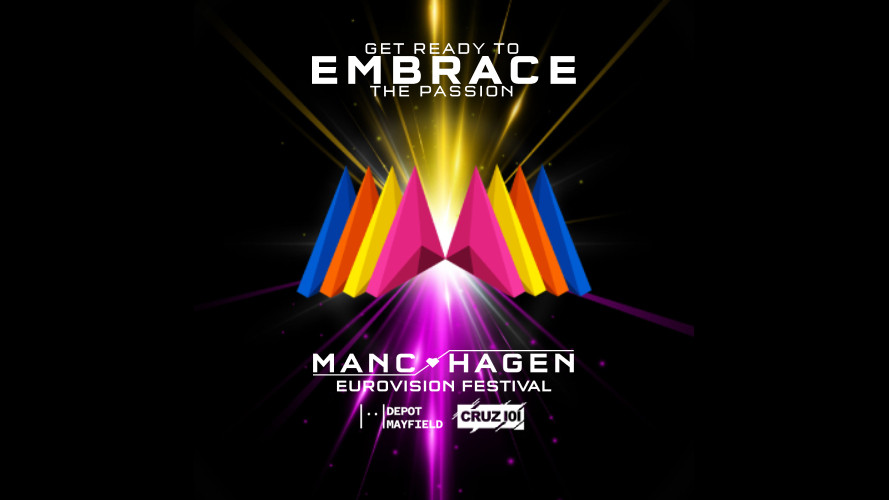
This year, the biggest Eurovision festival in the world came to Manchester. Aptly renamed MancHagen, it took place in various spots around the city, with the first concert at Cruz 101 and the second at Depot Mayfield. Ahead of both concerts, we had the pleasure of sitting down with some of the artists, which included previous competitors (including two winners), current competitors, and two artists from similar contests.
Niamh Kavanagh (Ireland in 1993: 1st)
The first artist I spoke to was Niamh Kavanagh, who won for Ireland, with ‘In Your Eyes’, way back in 1993, narrowly beating fellow redhead Sonia from the UK. I attended Eurovision in Liverpool as press, and the grand finale interval act was a tribute to Liverpool, with Eurovision fan favourites from recent years performing iconic songs by Liverpudlian artists. The medley ended with Scouse songstress Sonia performing her Eurovision hit ‘Better the Devil You Know’, with archive footage of her defeat shown. When I saw Sonia perform at Brit Fest, she spoke about her loss and joked, “I’m still bitter.”
I was not actually interviewing Niamh; it was just a casual chat. But one interesting thing that she told me is that during the 1993 contest, the UK and Irish delegations were kept apart, because it was during the Troubles, and the 1993 contest was held in Ireland (Niamh’s win was Ireland’s second of a record three consecutive wins).
Grant Knoche (American Song Contest – Texas in 2022: 4th)
My first interviewee was Grant Knoche, who came fourth representing Texas, with his song ‘MR. INDEPENDENT’, in the American Song Contest – a one-off US version of Eurovision, filmed in California.
Grant started dancing aged seven, playing piano and taught himself to sing aged nine, and taught himself to produce and write songs aged 11. He was even a member of Kidz Bop for a time. His parents had encouraged him to audition for American Idol multiple times but he did not feel that he was so suited to the show because he is not a “runs and belter singer”.
American Song Contest approached him to represent Texas, and he could not pass on the opportunity. Grant admitted that not all Americans know of Eurovision, but he was aware of it, and he was familiar with winners such Duncan Laurence (the Netherlands in 2019) and Måneskin (Italy in 2021). The next day, I asked him if this liminality is similar to Kylie Minogue, who famously never achieved anywhere near the level of success in North America than she did around the world – and he concurred.
He was drawn to the show because it is song-oriented, not singer-oriented, in that the artist sings the same song multiple times. Grant hopes that they do further seasons of American Song Contest, or that the US can join Eurovision (I joked that Europe probably do not want the US in Eurovision right now!).
Some notable artists competed on ASC – including Macy Gray (who I interviewed backstage a few years ago), Jewel, and Michael Bolton – which put a lot of pressure on Grant, an up-and-coming artist. He enjoyed representing Texas, especially as a pop, not a country, act.
Whilst Grant did not compete on Eurovision proper, he very much feels like a part of the Eurovision family, especially because so many Eurovision fans and content creators have embraced him.
Justs (Latvia in 2016: 15th)
Justs represented Latvia in Sweden in 2015, where he placed 15th, with ‘Heartbeat’, which was written by Aminata, who came 6th the previous year, in Austria, with ‘Love Injected.’ Justs said that the song was Aminata’s idea; he was busking on the streets back then but Aminata found him and believed in him. “Right time, right place,” he said.
Whilst it has been almost a decade since Justs competed on Eurovision, he still feels like part of the family. He has been to countless Eurovision events and met scores of fans and supporters. He really appreciates that he is still asked to perform at events all these years later; this is his second of three events this year.
Justs would go back to Eurovision especially because he loves the competition aspect because artists have to prove themselves, which he finds both thrilling and scary.
Since 2015, the Latvian entry has been chosen on Supernova, with Aminata and Justs winning the first and second seasons respectively. Justs competed on Supernova again in 2023 and 2025, with the songs ‘Strangers’ and ‘Fit Right’ respectively, each time making it to the semi-finals.
Lindsay Dracass (UK in 2001: 15th)
My third and final interviewee of day one was Lindsay Dracass, who, following her win at A Song for Europe, represented the UK in Denmark in 2001, with ‘No Dream Impossible’, where she came 15th.
Lindsay said Eurovision was probably less popular in the UK back them but it has always been super popular in mainland Europe.
“Sweden take how many months to pick their artist? You know what I mean,” she said.
“Which is why they win so much,” I said.
“Exactly – ’cause they’re on it, aren’t they? Like a car bonnet.”
Lindsay said that all the rehearsing meant that she did not get chance to experience all the fun of Eurovision. She said that the artists these days will be under a lot of pressure because the production and promotional sides are so much more intense these days.
“We didn’t have fire flames. We didn’t have like a big trumpet onstage,” she laughed.
However, Eurovision in 2001 was performed in a stadium, with a whopping 35,000 people in attendance. Whilst this was a bit scary for Lindsay, who was merely 16 years old, she told herself, “I’m from Sheffield; I’m made of steel; I’ll just go and do it.”
Whilst the UK has the second highest number of wins, we have performed pretty terribly this century. We last won in 1997. It was a real shock when Sam Ryder, who Lindsay calls “the saviour”, took us to number two, with ‘SPACEMAN’, in 2022, prompting us to host the contest the following year, what with the war in Ukraine.
“Sam is so beautiful, in and out, and he connected with everybody, didn’t he? So I think, if we could get that again, that would be great,” Lindsay said.
“But why don’t we go back to the audience voting, maybe? I think we should trust, like they do in Sweden. So, I just think, maybe put it in our hands a little bit. Pick four songs and four artists, and let’s see what happens, maybe.”
Kaj (Sweden in 2025)
My first interviewee of day two was Kaj, a Swedish-speaking Finnish group made up of Kevin Holmström, Axel Åhman, and Jakob Norrgård. Following their win at Melodifestivalen 2025, with the most votes in the history of the competition, they are set to represent Sweden in Switzerland this year, with ‘Bara Bada Bastu’. At the time of writing, they are the favourites to win the contest, with a 39% chance of winning (more than double the runner-up: Austria’s JJ is at 15% with ‘Wasted Love’), according to EurovisionWorld.com.
One member of Kaj admitted to feeling the pressure about the odds, especially because “it could be a record win”. Currently, Sweden and Ireland are drawn as the countries with the highest number of wins (seven), but Ireland has not won since 1996, and Sweden has won thrice since 2012, with their most recent win being just two years ago, right here in the UK (Loreen won again with ‘Tattoo’) – so one can expect Sweden to soon overtake Ireland, and it might just happen this year.
Conversely, another member said, “I’m a bit nervous that I’m not that nervous,” because there is so much to do before Eurovision, from pre-parties to their tour, but they anticipate getting nervous when they see the stadium.
The third member added, “Even if we are number one right now in the betting order, you have to stay cool, you have to stay calm. Anything can happen. It’s a competition. We have a couple of weeks left before the Eurovision Song Contest. But the pressure is rising, but that’s part of the competition also – I kind-of like it.”
Sweden often sings in English but Kaj are thrilled to be singing in Swedish, especially because they come from a Swedish-speaking minority in Finland.
I asked the members to tell me their favourite Swedish songs in Eurovision history. They told me ‘Diggi-Loo Diggi-Ley’ by Harreys (winner in 1984), ‘Euphoria’ by Loreen (winner in 2012), and another artist and song but I cannot work out what they’re saying!
Kyle Alessandro (Norway in 2025)
My favourite male artist this year is 19-year-old Kyle Alessandro, who is representing Norway with ‘Lighter’.
I told Kyle that I had just the other day watched his Instagram live with Gojo [Australia] and JJ [Austria].
Kyle told me that the 2025 competitors are “a little family already,” expanding, “Gojo is my uncle. JJ is my brother who’s just like two years older than me that punches me and stuff. Then you have Sissal [Denmark], [who] is maybe the aunt, the fun aunt. Then you have Justyna [Steczkowska – Poland], the mother.”
“She is mother!” I said (Justyna was stood right next to us, looking as fabulous as ever).
“Maybe Erika [Vikman – Finland] is the fun sister but also the aunty. Miriana Conte [Malta] is the fun sister, a hundred percent.”
“But you said she’s your crush [on your Instagram live],” I reminded Kyle.
“That’s incest, isn’t it?” Kyle laughed. “She actually wrote me a WhatsApp saying that I’m her crush too – but she has a girlfriend, so…
“And then Kaj, I think they would be like my big brothers, maybe – not uncles! My big Swedish brothers.”
I asked Kyle what it is like to be performing on the biggest stage in the world “at your young age.” “Engaged?!” he asked (I talk too quickly!).
Kyle said that he is excited.
“I don’t even know how to say it in none of the languages I know but… very safe. I feel very safe because my country voted me, and the way they did also, like I think there was almost 200 points between me and the second place. It felt like, ‘Okay. They want me to go. I’ll go. I’ll do this for them!’”
Whilst Norway’s three previous wins have been folk songs, ‘Lighter’ is a dance-oriented modernised folk song.
I ended by asking Kyle his favourite Eurovision song of all time, and he proceeded to sing Dami Im’s ‘Sound of Silence’ (Australia 2016: 2nd).
J KBello (Benidorm Fest 2025: 3rd)
J KBello attempted to represent Spain this year, with ‘V.I.P.’, by competing in Benidorm Fest, where he placed third, narrowly winning the professional jury vote and coming third in the public vote.
J KBello described ‘V.I.P.’ as, “When you see a person [for] the first time, and you say, ‘Wow.’ The conversation without words, only with eyes. When you stay in a club, the low lights. It’s this first love, without words. And you think what kind of things you can do with the other person,” he explained, prompting us both to laugh.
J KBello finds it “unbelievable” and “amazing” that people from other countries are listening to his music.
He’s not sure if he will do Benidorm Fest again: he will not close the door but he is focused on his music and concerts in Spain, but also hopefully something in Latin America.
J KBello told me that his biggest inspiration as a young person was Michael Jackson but now his inspirations are Bruno Mars, The Weeknd, [Beyli?], Lady Gaga, Rihanna.”
I, of course, asked him if he likes Shakira (my favourite artist).
“Yeah, of course,” he said, before singing, “Le-do-lo-le-lo-le!”
He told me that Jennifer Lopez is his crush.
“She is very sexy. But she’s like old,” I said. “She’s like older than my mum.”
“Ah, I don’t care,” he laughed.
I asked J KBello who he is rooting for. He said that he is so happy for Melody, who is representing Spain with ‘Esa Diva’.
“I like also the Netherlands – ‘C’est La Vie’ [Claude] but I’m going with Melody, ‘Esa Diva’. And Kyle, I like Kyle [Alessandro] so much. He speaks Spanish [he’s half-Spanish]. He dances. In Spain, when I sing my song, Spain and other countries compare us because he dance, I dance.”
Linda Martin (Ireland in 1984: 2nd and 1992: 1st)
Linda Martin first represented Ireland in 1984, with ‘Terminal 3’, where she placed second. She competed again in 1992, with ‘Why Me?”, ultimately winning the competition, giving Johnny Logan his third win (he won twice himself and wrote both of her songs).
Ireland won again the following year (with Niamh Kavanagh), becoming the fourth country to win twice on the trot. Their 1994 win (‘Rock ‘n’ Roll Kids’ by Paul Harrington and Charlie McGettigan) made them the first country to win three years in a row and the first to win the competition six times in total. Whilst they fared quite poorly in 1995, with ‘Dreamin’ by Eddie Friel (14th), an Irish singer won for Norway (Fionnuala Sherry, the vocalist of Secret Garden, who won with ‘Nocturn’). Ireland won again in 1996, giving them a record seventh win (Sweden achieved their seventh win in 2023).
Safe to say, Linda Evans kickstarted the Irish domination of the Eurovision song Contest.
Whilst it has been over three decades since Linda won Eurovision, she is still very much a part of the family.
“I love it, and I think when you embrace it, they keep bringing you back and back. So I’m still working in Europe, then I get invitations to come along to conventions like this, and it’s just wonderful. I’m privileged, I really am,” she told me.
Whilst Linda did really well the first time around, she came back because she knew that she had it in her.
“I just wanted to because we were so close in ’84, and then Johnny [Logan], who’s a great friend, he just said, ‘I’m going to do another one for you.’ It took him a few years to do it, but he did it.”
“And he had three wins, didn’t he, including your song?” I said.
“King of Eurovision,” Linda proclaimed.
Whilst Ireland had great success in Eurovision in the 20th century, they have not done so well in the 21st century (much like the UK), with Bambie Thug last year giving them their best result since 2000, with their song ‘Doomsday Blue’, which came sixth. I asked Linda if the excitement is coming back to Ireland.
“I think so because they like Emmy. I know that because you get the feedback. And her song’s really uptempo, it’s [a] happy song, and she’s lovely,” Linda said.
“I just wish Ireland would start writing the ballads again because that’s how we won – with Charlie [McGettigan, who won in 1994 with Paul Harrington], with Niamh [Kavanagh – 1993], with Eimear [1996], even ‘Secret Garden’ with Fionnuala [Norway 1994]. I just feel, that’s our little quirk. The Europeans can do the pop songs, and with fabulous recording, you know, real ‘boom boom boom’. We can’t. So, I think we should go back to what we’re good at and do the ballads. I just genuinely think a beautiful ballad with a super singer.”
Linda admitted that she has not listened to any of the other countries’ entries this year. She came across Emmy’s song because she was doing something in the same TV studio where Eurosong 2025 was being filmed.
Nicki French (UK in 2000: 16th)
Several years after having a UK number five hit with a dance cover of Bonnie Tyler’s ‘Total Eclipse of the Heart’, Nicki French bounced back on the scene by representing the UK in Sweden in 2000 with ‘Don’t Play That Song Again’.
At the time, it was our worst ever result – remember, the UK had performed very well throughout the 20th century – but, as Nicki told us at the concert that night, number sixteen is not that bad for the UK these days!
Nicki told me that John Springate, who had produced her previous hit, told her the title of the song, and she instantly loved it, though it was “very marmite with people.” John then played her the track in his studio, and she was immediately on board. They then took the song to A Song For Europe (which reverted back to that title that year, after being renamed The Great British Song Contest throughout the latter half of the nineties – but it kept the format of the latter). It came second in the BBC Radio 2 semi-final and won the BBC One final.
On still being a part of the Eurovision family, Nicki said, “I love it. It’s my favourite time of the year. My favourite shows are Eurovision ones; I love them. I just love the fact that all these different people from different countries, they all get together, they all support each other, and certainly backstage, the artists do the same. It’s not just the fans; it’s the artists as well.
“I’ve always said in interviews that Eurovision does more for international relations than any politician has ever done. It’s just so encompassing, and it brings people together.
“And it’s wonderful, you look on Facebook at the moment, and various people have their top 10 and their bottom five, and so on – and one person’s top two or three is someone else’s bottom two or three. It’s wonderful. And yes, you get people saying, ‘Oh no, you haven’t a clue,’ but it never gets more than that; it never becomes rude because people accept that everyone’s got their own opinions.
“And I have opinions on certain ones this year, which I won’t be [saying]! But every year, I think, ‘Oh, I like that one; oh, I don’t like that one.’ But I still, whenever I sort-of introduce them or something, I’ll be nice to every single one. Although there have been a couple where I’ve said, ‘Yours is really my favourite!’”
Nicki’s favourites this year are the Netherlands (Claude – ‘C’est La Vie’) and, controversially, Israel (Yuval Raphael – ‘New Day Will Rise’) – even more controversially because of “her backstory” (she survived the Nova music festival massacre).
It’s all very moving,” Nicki said, comparing the way the song makes her feel to France’s song last year (Slimane – ‘Mon Amour’).
She then commented on the frontrunners: “Sweden – I don’t want to like it, but I do! You just know that people will be voting for it; the public will give that a lot,” she said, acknowledging that the juries might not love it quite as much as the public will.
“I think it’s quite an open one this year,” she said.
“There’s a lot of good songs,” I said.
“Well, there’s a lot of favourites as well,” she added.
I told Nicki that people are even liking the UK entry this year.
“Well, they’re definitely singing it, and they’re definitely doing it well. And they’re doing a lot of promotion. So, yeah, we can but hope,” Nicki responded.
We then spoke about the resurgence in popularity of Eurovision this decade.
“I think Sam Ryder’s had a lot to do with that. I think Sam brought the love for it back because he did so well. I think people thought, ‘Oh, oh, it’s cool to be a Eurovision fan!’ And everybody suddenly wanted to go to Liverpool. Everyone wanted to do this, that and the other. And I think he singlehandedly brought the enthusiasm back to the British public.
“And it’s starting to wane because the last few results haven’t been so good. But, you know, I think Remember Monday could well bring it back again, whether they do well or not. I think people can see that they can sing; they’re not relying on prerecorded backing vocals – I hate that so much. Eurovision has always been about live vocals. And they’re doing it properly. So, I think the juries, particularly, will definitely give them good points, and it remains to be seen whatever else happens. And they’ve already said they’re not looking to win, which is a bit defeatist, but hey ho. Why go into a competition if you’re not looking to win? However, they’re being realistic, I guess. But I do think it’s a very open contest this year, and I think it could surprise people; people could be surprised.”
Emmy (Ireland in 2025)
As aforementioned, Ireland and Sweden are joined as the countries with the highest number of Eurovision wins (seven), but Ireland have faired poorly this century and last won almost 30 years ago. However, they bounced back last year, and it seems that the country is finally taking Eurovision seriously again, with another fresh, unique banger.
Following her win at Eurosong 2025, Norwegian singer Emmy is representing Ireland with ‘Laika Party’. She is my favourite female this year – so my two favourite artists are both Norwegian!
Emmy said it is “amazing” and “a huge honour” to represent Ireland, who made her feel “so welcome” and voted for her to represent them, which “means so much.”
Whilst a Norwegian representing Ireland might seem odd, this is nothing new in Eurovision. Last year’s winner, Switzerland, previously won with Celine Dion (‘Ne partez pas sans moi’ in 1988), a Canadian. The UK last won in 1997 with Katrina and the Waves, a British band headed by Katrina Leskanich, an American, and one of our most popular entries, ‘Ooh Aah… Just a Little Bit’ (which came eighth in 1996), is by Gina G, an Australian.
As aforementioned, one of Norway’s three Eurovision wins was with Secret Garden, whose vocalist, Fionnuala Sherry, is Irish. I mentioned this to Emmy, who told me that this year marks 30 years since that win – making this year’s Irish entry (a reversal of 1995, in which a Norwegian is now representing Ireland) rather poetic.
I asked Emmy to tell me about her song, ‘Laika Party’, which is far deeper and richer than people realise.
“The song is about the little dog that was sent out [in]to space, all alone, and I thought her real story was so sad that I wanted to create a scenario where she gets to be happy and alive instead, because when I hear something sad, I like to talk about it, or write about it, to get the emotions out, or to create different scenarios, and better scenarios, than the real world.”
Emmy is, of course, referring to Laika, a Soviet space dog who was one of the first animals in space and the first to orbit the Earth. She died hours into the flight.
Emmy was at the press event with her brother, Erlend Guttulsrud Kristiansen, who she has collaborated on songwriting with from a young age.
“It’s amazing to have him with me,” she said. “We had this childhood dream of going to Eurovision together that we never ever thought would come true, and now, we’re on that stage together, and it just feels so surreal and just magical. It’s crazy. We’re so grateful.”
Indeed, Emmy has been trying to get on Eurovision for awhile. In 2021, she took part in Melodi Grand Prix 2021, the Norwegian national final for the Eurovision, with ‘Witch Woods’. She made it to the final but not the gold final.
She was then part of Norway’s Jury for Eurovision in 2023.
At Melodi Grand Prix 2024, she was a songwriter on ‘Woman Show’ by Mathilde SPZ, Chris Archer and Slam Dunk.
‘Laika Party’ had initially been submitted to Norway with the hope of competing on Melodi Grand Prix 2025, but had been rejected by Norwegian broadcaster NRK.
She was also a songwriter for ‘Ramtai’ by Citi Zēni, which finished 3rd at Supernova 2025, the Latvian National Final for Eurovision.
Emmy’s determination to get on Eurovision, alongside Nicki French criticising Remember Monday for saying that they do not care about winning, prompted me to ask Emmy if she is determined to win.
“Well, I have two goals for this Eurovision, and that is to make Ireland proud, and to to try to the best I can,” she said – a passive, roundabout “yes.”
Whilst Emmy feels pressure after Bambie Thug’s impressive result last year, she said, “The Irish people have been so supportive, and they’ve just said, like, ‘Do your thing; we are proud of you anyway,’ and that really means a lot. That kind of calms me down in that way.”
I wrapped the interview up by asking Emmy and Erlend their favourite Eurovision songs.
“I love so many but if I had to choose one, maybe ‘Run Away’ [by SunStroke Project along and Olia Tira] from Moldova,” said Emmy. The song came 22nd in 2010.
Erlend followed, “Georgia 2007, ‘Visionary Dream’, by Sopho [Khalvashi], with the swords onstage and everything.”
The song came 12th.
“I don’t even remember that act, but I was six years old,” said Emmy, prompting Erland to sing the song, reminding her.
After the “yellow carpet” (it’s Manchester!) and press event, Katie and I attended the Saturday concert, which featured all the artists we interviewed that day. It was, without a doubt, one of the best music events that I have had the pleasure of attending. MancHagen hopes to be back in Manchester next year.
The Eurovision Song Contest airs on BBC One and BBC iPlayer on May 13, 15 and 17.
 JADAR
JADAR 