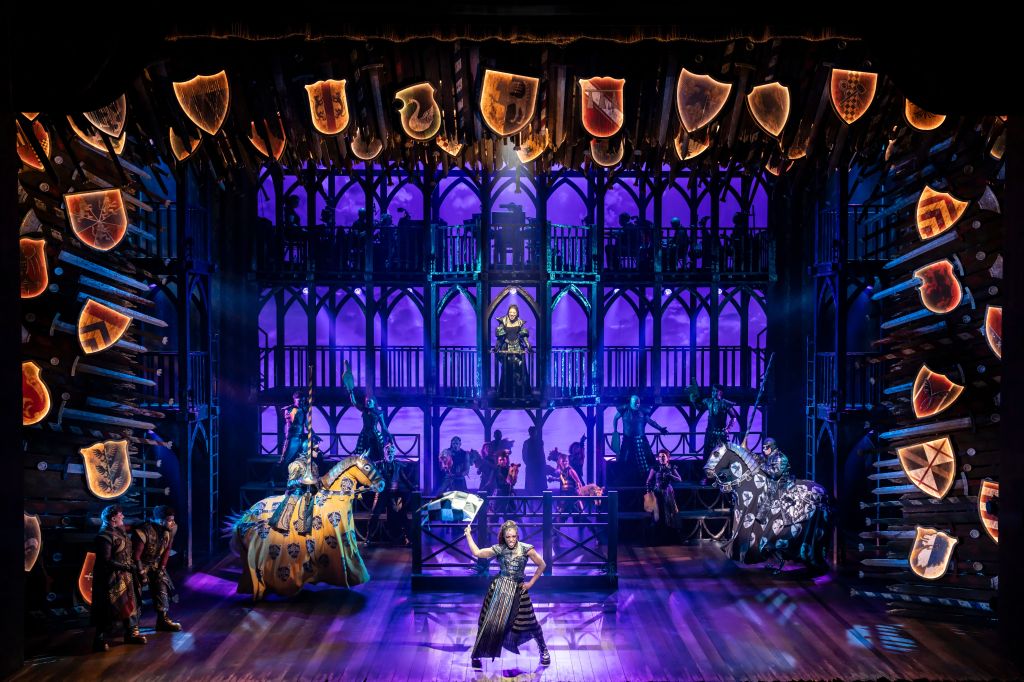
Stage musical adaptations of iconic films are a dime a dozen, as are jukebox musicals, because they are guaranteed money-makers. But to stand out, and stand the test of time, they have to offer something more than camp, crowd-pleasing nostalgia. A Knight’s Tale, a jukebox musical adaptation of the film of the same name (two in one!), stands out with its self-awareness and spectacular production.
A Knight’s Tale follows William Thatcher, a peasant squire who poses as a knight and competes in tournaments, winning accolades, acquiring friendships, and falling in love.
Whilst the film is noted for its anachronistic use of classic rock songs, the stage musical includes some more modern songs, including some pop songs. Moulin Rouge! did something similar, using the songs from the film (many of which were new-ish at the time) but also songs released since the release of the film. Through music, A Knight’s Tale is honouring the era in which the film was released (2001), whilst also speaking to the modern era (what with its queer representation and strong female characters) but being set centuries ago. It’s an interesting liminality.
Whilst this works in theory, it feels inconsistent in practice. Not everybody is going to realise that the musical is deliberately using songs from the era when the film came out to honour an iconic movie period. Going from classic rock, e.g. Bonnie Tyler, to cheesy pop, e.g. S Club 7, is a bit jarring. Some of the songs, however, work much better, such as a rearranged (rockier) Destiny’s Child’s ‘Survivor’, which closes Act 1 (to be fair, ‘Reach’ actually works pretty well).
At the open dress rehearsal for press, Oliver Tompsett told me that the self-aware show has unashamedly shoehorned songs into the show. For example, Chaucer says, “S Club 7. I’m as surprised as you are.” But it should lean more into this, because it sometimes feels like they just wanted to include ‘song x’ because it is guaranteed to get the crowd going or make them laugh (an unfortunate consequence of this is people laughing during emotional moments). Even in a jukebox musical, songs should guide the story, but here, some of the songs do nothing for the narrative.
It is refreshing, however, how the show does not take itself seriously at all. It is not trying to be ground-breaking. It’s pure camp-as-tits escapism. It’s sharp as a sword, witty, and sardonic. Though some of the comedy is perhaps a bit too provocative, especially for a show that one would imagine to be family-friendly. Early on, there’s a bunch of sexy, gyrating nuns, which is not only a lazy, overdone trope but also at best unnecessary and at worst offensive.
There’s quite a bit of cussing, sexual references, and the show opens with a fart joke, which feels cheap and immature, especially for what is otherwise such a good show – and great script by Brona C Titley. Shock comedy loses its impact when used excessively; tone it down a little and the provocative moments will be all the more impactful.
The show has heart but it is a bit lacking in emotion; it needs to work harder to make the audience feel invested and genuinely care. I’m an emotional person but I didn’t get the feels until William saw himself as a child, and later (spoiler) when he reunited with his father.
Unlike a lot of new musicals, the production has a huge budget. Tom Rogers’ set design is an extravagant extravaganza. There is a large static set piece with two levels, with the band on the top level. It’s a missed opportunity to not involve the band more, especially in a musical set in the Middle Ages. The band are up there because the show uses the pit as part of its stage (e.g. things coming up and people falling down!) but director Rachel Kavanaugh could have made it look like the band were shoved up there for a reason.
There is so much set, with pieces constantly coming on and off, as the audience are transported from one location to another. However, they could have gone bigger with the sequence in which William Thatcher travels from one country to another, rather than just a large hand-held flag and lighting creating the flag each time.
Other than that, Kavanaugh’s direction is wonderful; there’s a lot of set, and a lot going on, but the stage never feels cramped or too busy.
The most impressive part of the production is, without a doubt, the jousting. Jay Saighal told me that they are not allowed to reveal how they do it, and I am glad that they did not, because it is so unexpected and impressive (the first way is repeated a few times; it is done differently in the last battle).
Howard Hudson’s lighting is some of the best you will see onstage. It looks and feels magical. The starry night sky is dazzling (literally).
There is excellent sound design by Matt Peploe. The show sounds like a rock concert.
Like the musical itself, Gabriella Slades’ costumes combine the old and the new. Think sexy, rocky, colourful Middle Ages. Jocelyn’s gorgeous gown has slits at either side, exposing her legs, allowing her to celebrate her sexuality in a sexist society whilst also giving her more freedom to move around and dance. However, whilst there are several references to women experiencing sexism, the show never really shows it. I appreciate that the show is not trying to be deep but it is odd to make socio-political references but not do much with them.
Speaking of dance, Matt Cole’s choreography is electrifying, and the ensemble – who are very much an ensemble and do not get much chance to shine individually – slay every single routine.
The cast is led by Andrew Coshan as William Thatcher (poetic to cast a Kiwi as a character originally played by an Aussie – the late, great Heath Ledger). He’s charming, loveable and goofy, but charming and loveable because he is goofy, not in spite of it. He is not your traditional male hero, which is refreshing.
William is surrounded by a gang of misfits: Kate, an aggressive blacksmith (Emily Benjamin); Roland, a traditional sidekick (Emile Ruddock); and What, a genderqueer joker (Eva Scott). What’s gender is never explicitly mentioned; it just is – which feels even more progressive. It might be unintentional, but a non-binary character being called “What” could be a joke itself (and a dig at transphobes). They’re a terrific trio.
Meesha Turner is delightful as Jocelyn, a strong-minded and strong-willed damsel who is not in distress and does not need saving. Jay Saighal is smooth and suave as Prince Edward, and Giles Taylor shines as Williams’ Father, but both could do with a little more stage time.
West End legend Oliver Tompsett – who starred in the original cast of similar jukebox musical & Juliet at this very venue a few years ago (poetically, gala night was on “& Juliet Day”) – is absolutely delicious as the arrogant, villainous Count Adhemar. He’s a two-dimensional villain with no character development but Tompsett completely loses himself in the joy and thrill of playing such a fabulous asshole. Whilst it’s a strong cast period, you can tell that Tompsett is the one with the experience and acclaim; he sparkles whenever he is onstage, and his solos are mesmerising.
Max Bennett makes his musical theatre debut as Chaucer, who occasionally operates as a narrator (this could be expanded) and befriends the gang. In case you’re wondering, by Chaucer, I am referring to Geoffrey Chaucer, the author of The Canterbury Tales, which includes The Knight’s Tale – meta!
Whilst Bennett is new to musical theatre, he is clearly a successful, established actor; he oozes gravitas and demands attention whenever he is onstage (and not just because he is often butt naked).
Chaucer breaking the fourth wall is reminiscent of William Shakespeare (Oliver Tompsett) and Anne Hathaway (Casidy Janson) inserting themselves into the story in & Juliet, aka the best non-biographical jukebox musical of all time. A Knight’s Tale definitely wants to be the next & Juliet, and it seems to take some inspiration from it. In fact, the Act 2 opener is awfully reminiscent of & Juliet‘s grand finale…
But whilst there are a few similarities, A Knight’s Tale is very much its own show. It’s one of the best jukebox musicals out there (sure, the bar is low) and a guaranteed crowd-pleaser for music lovers, theatre lovers, and lovers of life. It’s two and a half hours of escapism and joy, which is exactly what we need right now.
A Knight’s Tale runs at Opera House Manchester until May 10.
 JADAR
JADAR 