★★★★☆
Whoever would have thought that Shakespeare and Radiohead would one day work together? Christine Jones, that’s who. She was listening to Hail to the Thief whilst working on a production of Hamlet in the early 2000s and found herself struck by the coincidences and similarities. Flashforward more than 20 years and Hamlet Hail to the Thief, a co-production by Factory International and the Royal Shakespeare Company, was born, with Radiohead’s Thom Yorke having reworked the critically acclaimed album into a deconstructed score that illuminates the text and is performed by live musicians.
Set in Denmark, the play depicts Prince Hamlet and his attempts to exact revenge against his uncle, Claudius, who has murdered Hamlet’s father in order to seize his throne and marry Hamlet’s mother. This production -was which co-created by Christine Jones, Steven Hoggett and Thom Yorke and directed by the former two – breathes new life into the already timeless play, giving it new relevance with musical commentary.
The Warehouse at Aviva Studios, home of Factory International, is one of the most versatile arts spaces. Every time I visit, it is completely unrecognisable, with this production having transformed the South Warehouse (literally just the bottom half of the Warehouse) into an arena.
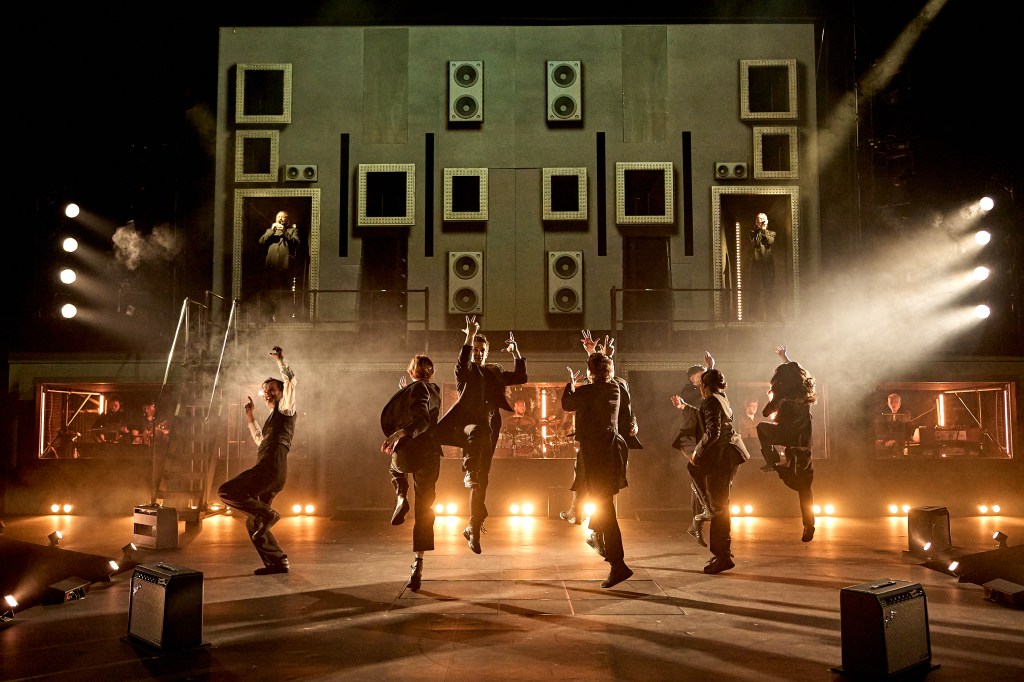
The production is a little immersive, with audiences forced to embark on a perilous journey upon entry. Those sat lower down must creep through winding passages whilst those sat higher up must climb steel staircases (Warehouse, indeed). The seating is bowl-like, entrapping the action, creating a feeling of claustrophobia and voyeurism. The arena feeling is heightened by the huge bank of speakers onstage, as if we are at a gig. Smoke fills the stage, reminiscent of fog, with a series of black suits suspended in the air, perhaps representing souls already lost, what with the play opening with the screeches of a ghost filling the battlements of the castle.
The bold and evocative scenography, by AMP featuring Sandra Tehrani, is enhanced with Jessica Hung Han Yun’s atmospheric lighting and Will Duke’s hellish projections, that are displayed on the back wall as well as the stage floor (the tiered seating allows all audience members to see the stage floor clearly). The band sit in closed-off rooms at the back of the stage. An oblong-shaped hole in the stage is used effectively for both Ophelia’s death and the grave scene, increasing the feeling of entrapment for the characters. They are lost souls, trapped in a vicious cycle of ruthless violence. They never really stood a chance.
Gareth Fry’s sound design is loud and powerful, and very much like a warehouse gig. Lisa Duncan’s costumes are hauntingly beautiful and Gothic.
Jess Williams’ choreography is as frenetic as one would expect for an alum of Frantic Assembly (co-creator and co-director Stephen Hoggett is the founder). The mix of talking and dancing is reminiscent of the Old Vic’s recent production of Oedipus, which was co-directed and choreographed by Hofesh Shechter. Oedipus’ choreography is some of the best I have seen onstage but the production felt like two shows in one, with the narrative and the dancing feeling disconnected. Here, though, the talking and dancing are fused together, with the performers doubling as actors and dancers.
Hamlet can run over four hours. Most productions trim it down to 2-3 hours. But Hamlet Hail to the Thief runs, radically, at only 1 hour 45 minutes, with much of that run time taken up by songs. This means that relatively little of the original text is used, which could be considered sacrilege, but the RSC’s involvement (and dramaturgy and textual consultancy by Ayanna Thompson, a Shakespeare Scholar-in-Residence at the Public Theatre in New York) suggests that much of Hamlet does not need to be seen to be understood.
Whilst much of the text is discarded, it still makes sense. If anything, it makes more sense, because there is not too much going on, thus there is not too much to consider; one is told and shown exactly what to pay attention to. The writers have stripped the play back to its bones, using songs not so much to tell the story but rather enhance and further the narrative. Where words fail, and all that.
We arguably do not get enough time with and development of some of the characters, making it difficult to completely care about some of them.
The omission of Fortinbras is an interesting choice. Fortinbras is a minor character but an important one; he literally closes the show – with his final lines suggesting a hopeful future for Denmark. Without this, the play ends as negatively, pessimistically and cynically as it began. Denmark is still rotten (which feels very pertinent right now).
A play with music, two singers (Ed Begley and Megan Hill) perform rearranged versions of songs from Hail to the Thief. The sound is fractured and fragmented, heightening the tension and deliberate discomfort. I believe Hamlet and Ophelia each sing a song later on, which feels a little inconsistent, but as they are the protagonists, the songs feel like sung soliloquies. Some of the songs work better than others buf they all sound wonderfully and heighten the drama and tension. Did Hamlet need to be made with Hail to the Thief? No – but it works.
Hamlet is a dream role for many male (and a few female) actors in the UK. It’s a tough role that requires gravitas and vulnerability. Hamlet must be likeable and sympathetic but frustrating and disagreeable. Samuel Blenkin’s performance is raw, rough and remarkable. He truly understands the character, and the text more broadly, allowing for a nuanced, multifaceted performance that is both awe-inspiring and uncomfortable to watch.
Ami Tredea adds agency and urgency to Ophelia, a tragic character who has had far too many sexist portrayals. She is a strong woman worn down, caught up in the crossfires of a war of men.
Claudia Harrison is similarly complex as Gertrude; she has married her husband’s brother not simply to hold on to power and luxury but, rather, for protection in a misogynistic society – and to ensure the ascension of her son, the rightful heir.
Paul Hilton is completely captivating as Claudius, even though he does not try to convince the audience to understand or support him. He is very much a villain, though not a cartoonish one; he’s an adept politician and a good leader, albeit a bad person. Hilton also portrays the ghost of Hamlet’s father via projected videos and voice recordings – he’s even more terrifying there.
Tom Peters makes for a convincing Polonius, a morally dubious character who, though flawed, is not deserving of his fate.
Brandon Grace is striking as Laertes – Polonius’ son and Ophelia’s brother – who represents impulsive action in contrast to Hamlet’s indecision. Foils are also seen with Alby Baldwin’s Horatio, whose rationality and loyalty are nicely contrasted with Hamlet’s emotional and erratic behaviour – but sadly Hamlet is beyond saving.
The original play also explores foils with the aforementioned Fortinbras, who embodies decisive revenge compared to Hamlet’s prolonged contemplation.
The incredible core cast is rounded off with James Cooney as Rosencrantz; Felipe Pachecho as Guildenstern; and Romaya Weaver as Gravedigger/ Player Queen / Bernarda.
Hamlet Hail to the Thief masterfully parallels two iconic pieces of art – which, though written centuries apart, coincidentally explore similar themes and ideas – in an adaptation that is fierce, fresh, frantic and frenetic.
Hamlet Hail to the Thief runs at Aviva Studios (South Warehouse), Manchester until May 18th, before transferring to the Royal Shakespeare theatre, Stratford-upon-Avon from June 4th to 18th.
Photo: Manuel Harlan
 JADAR
JADAR 