★★☆☆
Lee Mattinson’s Steel is an urgent, whirlwind of a play, packing themes such as hidden homosexuality, male bigotry, masculinity, post-industrialisation, grief and isolation, a quest and much more into 90 minutes. It desperately wants to leave an impression on the audience. Sadly, all I felt was disappointment.
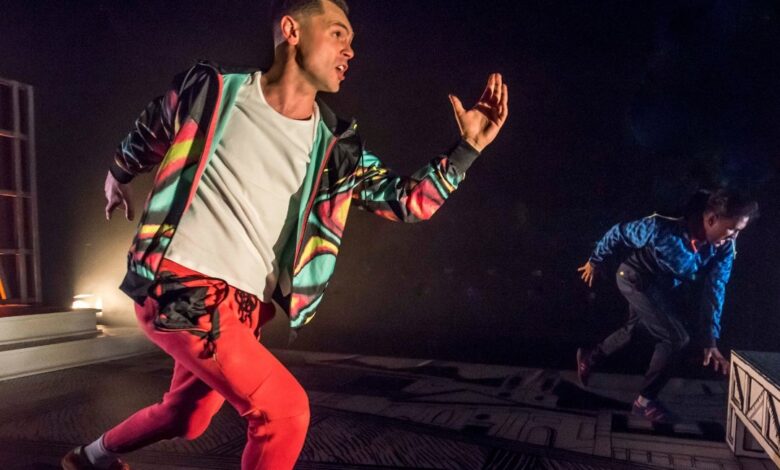
First performed at Theatre by the Lake in Keswick in October 2024, followed by a UK tour, Steel follows two friends, James and Kamran on a quest as James discovers he is heir to a mile of the British Railway System which Network Rail want back and will pay a million pounds for. This becomes an out for James: a million pounds could give him the escape from Workington he’s always wanted. But he only has 12 hours to find the document to claim his money. As James and Kamran journey around their hometown, we learn that something is not quite right between the two friends – something has happened that James refuses to talk about.
This sounds fun, right? I love a quest, and especially one that offers the opportunity to grow close to the characters. Sadly, Steel finds itself victim to trying to pack too much into the plot at once, while also relying on dialogue to tell us what’s happening, rather than showing us. I wanted to feel compelled and intrigued, but rather, all I felt was bored, as I struggled to stay focused on the different strands of plot. Liz
Stevenson’s direction is fast and urgent but incredibly tricky to keep up with the story. There are flashbacks that can easily be missed and way too many characters. Unfortunately, I was not gripped. This lack of focus may be a result of the minimal set. With a black and white line drawing of the town on the floor getting me excited for what’s to come, the two actors rarely engage with it.
The primary focus seems to be the neon clock flashing at every scene change, counting down the hours the boys have left to complete the quest. This is great work from Designer Simon Kenny as this physical staging keeps the pacing tight and fast-moving, but for me, as I struggled to be captured by the plot, the clock only served to make everything drag. I also didn’t see the purpose of the stage with the microphone. The set could have worked harder to help the story focus.
Yet, despite being disappointed in the staging, it was refreshing to have Northern representation in the theatre – even if the accents from the boys were a bit hit or miss. Mattinson grew up in Workington and the play does an excellent job of paying
a gentle homage to the place and its people and the representation of a post-industrial town. This setting was particularly special to me as someone who grew up in a small industrial town with little to no job prospects or future. I had to move to London to get the career I wanted so I did resonate a lot with James and could feel his spark when he gets offered the chance to leave through this inheritance.
Starring Jordan Tweedle as James and Suraj Shah as Kamran in his theatre debut, the boys were a delight to watch, with the star of the show, Shah. His seamless transition into playing multiple characters including a drag queen, James’s dad and many more was brilliant. However, despite the excellent acting, I was not convinced by the chemistry between the two – it felt forced and awkward.
Who is the audience of Steel? Sadly, I don’t think the show knows. The jokes range from a satire of the middle class (I loved the references to Waitrose and mushroom risotto) to humour around the kind of people you see in a Wetherspoons on a night
out, with Princess Diana name-dropped. Is this a play for disenfranchised teenage boys or the older generation who have grown up through a time of Maggie Thatcher and the closure of the mines? You should never have to explain your jokes to an audience, but sadly, Steel did.
While there were a lot of things unconvincing about Steel, there are some wonderful moments – the singing from the community choir at the end was particularly touching. I enjoyed the representation of feeling powerless in a small town with no job prospects until you finally realise just how much this town means to you. It wasn’t until I moved away that I realised the importance of where I grew up on my identity so while I won’t be returning to re-watch this show anytime soon, I thank the show for making me reflect on place and the impact it had in shaping me, as it shapes James and Kamran.
Photo: © Chris Payne
 JADAR
JADAR 