★★★☆☆
HER Production’s seventh Shakespearean Production at the Hope Mill Theatre, Macbeth, boasts a stellar all-female and non-binary cast, live singing and drumming, and is a wonderful retelling of a classic tale for feminists and Shakespeare enthusiasts alike.
HER Productions and Unseemly Women produce a new female-led Shakespearean production every year at rhe Hope Mill Theatre. Macbeth is directed by Amy Gavin and Hannah Ellis-Ryan.
An immediate highlight of this production was the costuming, designed by Zoey Barnes and Dulcie Good, and crafted by Holly Collins and Emma Wilcox. I specifically loved the outfit of the titular Macbeth (played by Elaine McNicol), who wore a red half-kilt, alongside black trousers and silver armour. Lady Macbeth began in a red dress that mimicked Macbeth’s kilt, and I heard an audience member behind me audibly gasp when she reemerged as queen, wearing a fabulous crown and shiny silver skirt. Her outfit shone in comparison to Macbeth’s black and gold attire, with a narrow silver tiara. The costumes of the characters felt rooted in 11th century Scottish context with a delightful contemporary twist, allowing them to feasibly seem like masculine military and nobility of the time, while also resonating with modern audience’s sensibilities.
Additionally, the sound design was wonderfully crafted, with a combination of live singing and drumming alongside atmospheric music underscoring the dialogue. I thought it was an extremely clever detail that the live drumming was performed by Banquo (Leila Uwimana) supplying more dramatic impetus to Macbeth’s delusions of knocking. The lighting design worked perfectly alongside the sound to amplify the dramatic and stylistic choices of the piece. The bold reds, golds and eerie blues, alongside foreboding haze perfectly set up the heightened mystery of the three witches and graphic violence of the battles. Yet both these design elements knew exactly when to pull back and allow stillness and silence to capture the audience. All of these elements coalesced to create an extremely well designed modern Shakespearean production.
The female-led ensemble involved many multi-talented performers – led by Elaine McNicol as Macbeth, and Frankie Lipman as Lady Macbeth. McNicol was a perfectly paranoid, frenetic and aching Macbeth, she commanded the stage and perfectly captured the whirlwind of emotions needed for such a prominent Shakespearean figure. Lipman brought an unexpected vulnerability to Lady Macbeth, and she reigned as a powerful presence due to her ability to emotionally manipulate from an entirely involved standpoint. I enjoyed the intimacy (intimacy coordination by Heather Carroll) shared between Lady Macbeth and Macbeth, with the moments of closeness and tenderness standing out amongst the brutal nature of their actions.
With an all-female and non-binary cast, I was intrigued as to how the topic of femininity would be tackled. They did not change any of the genders of the male cast, with the characters still fighting to be King rather than Queen. With the genderbending unspoken (much like with the all-male casts back in Shakespeare’s day), there is an interesting dynamic created by allowing these non-male actors to portray male characters entirely authentically. I loved how the play presented queer relationships without ever needing to acknowledge their queerness, because for all intents and purposes, these are the only relationships that exist in this non-male world. There were, however, some textual additions. When introducing Lady Macbeth, there were depictions of childbirth, and original poetry (by Hannah Ellis Ryan, Nikki Mailer & Amy Gavin) spoken by the Witches foregrounding her bodily relationship with womanhood and how she does not let that define her. There are also some interesting dramaturgical choices with Lady Macbeth, that recontextualise her narrative with the inclusion of a stillbirth, giving a lot of weight to her speech “how tender ’tis to love the babe that milks me:”.
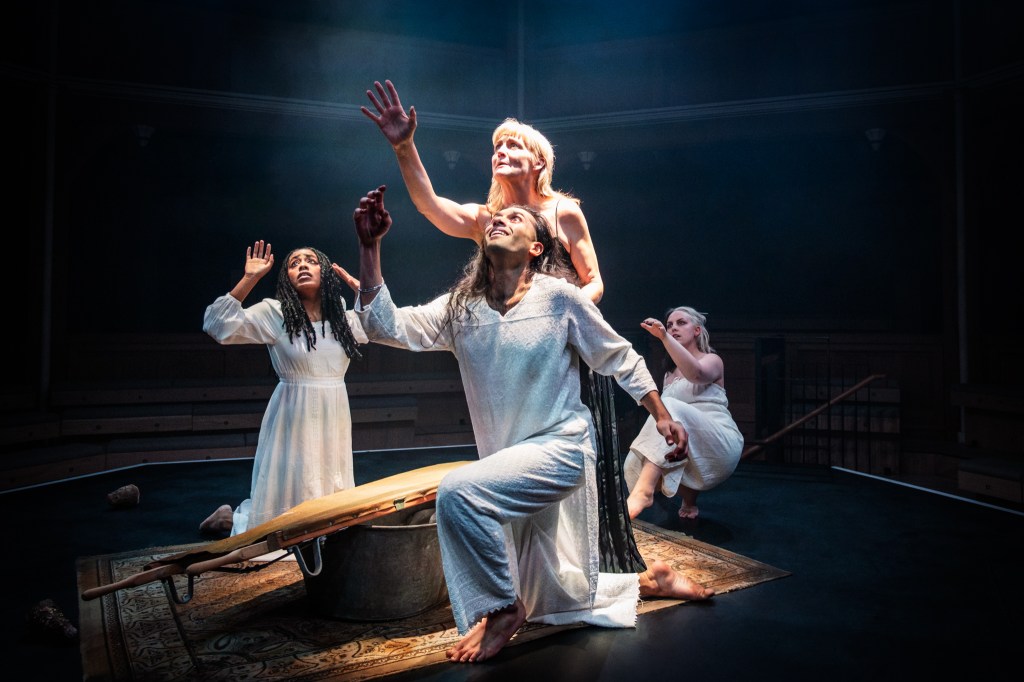
The Three Witches – played by Paryce Richards, Zoey Barnes and Pavanveer Sagoo – were a clear highlight of this production. Their synchronised breathing, unsettling head twitches and erratic choreography (movement directed by Yandass Ndlovu) grandly set up an otherworldly physical presence that was present throughout the piece. I enjoyed how the Witches were constantly onstage, taking on different personas throughout the play. This rendered them not only omnipotent but omnipresent, emphasising the power of the three weird sisters. I would particularly like to note the flexibility and electricity present in Paryce Richard’s performance as Witch I, she was delightfully creepy and a pleasure to watch.
While this show was filled with brilliant design and performances, I occasionally felt that it wasn’t entirely certain of the tone or genre it was going for. With many of the deaths, there were movement sequences in which the Witches orchestrated the character’s demise. However, I felt that the choreographed nature of the deaths of Banquo and Lady Macduff took away from their emotional resonance in the narrative. By conflating the political intrigue of the murders and genuine mysticism of the Witches, these stylistic sequences made the deaths feel caricatured rather than pertinent.
Additionally, I adored the inclusion of vocal soundscapes, live drumming and singing. The Act 2 opening was electric, with abstract choral movement and resounding drums – the exact amount of chaos and cacophony that a tragic tale such as Macbeth deserves. However, the collective movement sequence did not persist beyond that scene, as is true of the choral singing – each element was joyous yet fleeting. While these mediums enriched the scenes that they were in, I felt that their brief appearances left them feeling disjointed in relation to the overall structure of the piece. I admire the co-directors willingness to experiment with all of these elements, bringing new life to a classic Shakespearean tragedy. Yet I feel it would have been more impactful to distill the imagery and mediums to create a more cohesive theatrical language throughout the production.
HER Productions and Unseemly Women have crafted an extremely well-designed and inventive retelling of Macbeth, with a stellar cast and some experimental interventions into the text. I would love to see more female-led reimaginings of classics. HER Productions are a pioneering company to watch in the North West. Macbeth is a wonderful retelling of a classic tale for feminists and Shakespeare enthusiasts alike, and I am excited to see which Shakespearean tale they revamp next time!
Macbeth runns at Hope Mill Theatre until June 29th and tours the UK until July 3rd.
Photo: Lowri Burkinshaw
 JADAR
JADAR 