★★★★☆
Returning to the Bridge Theatre for the first time since its acclaimed 2019 run, Nicholas Hytner’s take on Shakespeare’s comedy classic is a whimsical assault on the senses – in all the best ways possible.
The production, featuring a stellar ensemble and inspired staging, is the best way to spend a hot summer’s evening (or afternoon, as I did). As its title suggests, Shakespeare’s comedy unfolds over a long summer night, following four lovers, a band of mischievous fairies and a theatre company knee-deep in rehearsals for a royal wedding. Each group of characters has their own story to fulfil and are largely kept from directly interacting as an ensemble until the play’s end but the main delight is watching these series of misadventures unfold.
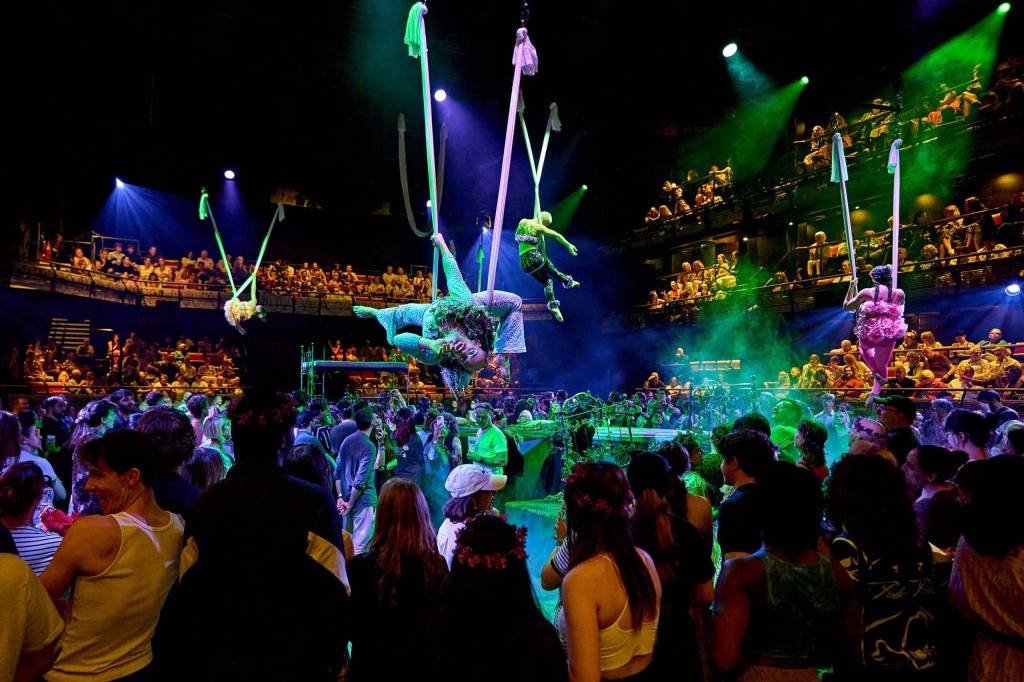
Although the play’s opening scenes in Athens are entertaining, it’s not until the four young lovers enter Shakespeare’s forest of fever dreams that the play comes alive. Escaping a forced marriage in Athens, Lysander and Hermia flee to an enchanted forest inhabited by fairies who revel in mischief. Here, the true scope of the Bridge Theatre is unlocked. After a relatively static first act, the theatre takes on a dream-like atmosphere where Shakespeare’s marriage of mythology and the marital bed enchants the audience.
Instead of a traditional stage, the cast performs on platforms which rise from the theatre’s floor, elevating the actors above the standing audience but also limiting the space they have to perform in. In a lesser production, this would have been a real challenge. Director Nicholas Hytner opted to stage the play in-the-round, meaning the cast has to work overtime to capture the audience’s attention even with the backs always turned to a portion of them. Though limiting, this actually gives Midsummer its greatest strengths. The set (Bunny Christie) is also dressed simply but effectively. Green lights (Bruno Poet) are used with decorative vines and foliage to create the forest’s hazy atmosphere while the sound design evokes a place seemingly familiar but also eerily different, adding to the feeling you’re entering somebody else’s fever dream.
The inspired staging truly allows the play to come alive, with characters leaping from platform to platform and climbing bed frames almost as if they’re children playing a game of make believe. Watching the cast perform with such energy and movement makes the source material almost of secondary importance as it’s just a delight to see the actors almost dancing around the auditorium, particularly when under the influence of the fairies’ mischievous goals.
Speaking of the fairies, they are truly the highlight of this production. Hytner has them descend from slings above the stage, performing acrobatics whilst pranking the mortals literally beneath them. As Puck, David Moorst is the ensemble’s standout. His sardonic voice, fourth-wall breaks and fluid movement are a delight to watch as he dances around the stage or twirls. As one of Shakespeare’s funniest and most accessible plays, getting the fairies right in Midsummer is a necessity for a successful production as they do a lot of the heavy lifting in both exposition and on-stage action. Even when an audience member has gotten a little confused by Shakespeare’s language, they can always rely on a brief appearance from a fairy as a visual signal to where the story is going next.
Costumed (Christina Cunningham) as to evoke a Pride march, the fairies’ presence also helps sell the modern updates made to the play. In this version, Titania (Sussanah Fielding) and Oberon (JJ Feild) have their roles reversed so it is Oberon who falls in love with Bottom (Emmanuel Akwafo), not Titania. The overt queer themes help recontextualise the play for a 21st century audience; the fairies mischief isn’t so much about playing pranks as it is aiding in a homosexual awakening. Akwafo’s Bottom naturally elicits several laughs from the audience. His interactions with Oberon are golden and Akwafo’s expressive mannerisms sell the situation’s absurdity even as the rabbit hole gets deeper.
This production is not without its faults though. Although some modernising aspects are to be expected – after all, it’s probably less common to perform Shakespeare as written in the 16th and 17th centuries than it is to set Macbeth in modern-day Uganda – at times they can become distracting and, in their worst cases, feel wholly unnecessary. The fairies and four lovers’ costumes suit the out-of-time setting and the design of the forest is fantastic, however the bright boiler suits of The Mechanicals feel out of place – as do the suits and, later, the bizarre World War II trench coats of Theseus and his soldiers. I’m not opposed to changing time periods or even blending them but in these moments the choices were so confusing the play ground to a halt, only to speed up whenever the fairies reappeared.
Modern music and dance numbers were also littered throughout. Although mostly bearable, some restraint should have been shown as again it just ground the play to an abrupt halt. Watching the ensemble dance to Dizzie Rascal was entertaining to begin with but didn’t feel wholly necessary in a production which had captivating leads and a creative approach to staging. These musical numbers also did get the audience standing in the pit involved – pulling them in as background players to the great big party that was unfolding on stage. It looked like fun for people who enjoy screaming “he’s behind you” in a pantomime and it did add an immersive element to the play but I for one was extremely glad I was safely in the stalls, spared from joining hands with strangers swaying from side-to-side like they wanted to buy the world a coke and furnish it with love.
A Midsummer Night’s Dream runs at Bright Theatre until August 20.
Photo: Manuel Harlan
 JADAR
JADAR 