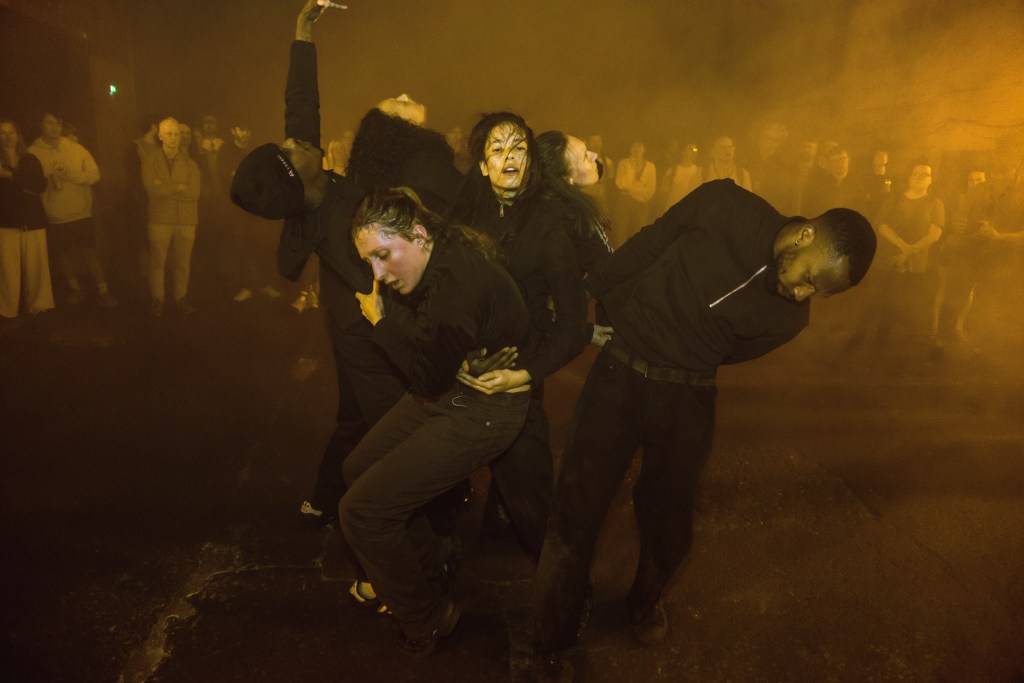
And Now I Know What Love Is is an immersive performance work blending choreography and sound – asking both the cast and audience to question their sense of belonging and love in a world of despair.
ANIKWLI was performed at an industrial space (Diecast) in the Northern Quarter. We walked in to red lights and metal fencing. We were soon engulfed in smoke and transported to a liminal world, à la purgatory. This is conventional for Blachaine, who draws inspiration from the rich urban landscapes of North West England, where he grew up (he’s from Preston).
The artist’s working-class origin is felt, and appreciated, but the piece, itself, does not feel particularly working-class. It’s arguably alienatingly avant-garde with its innovation and artistry. But who’s to say that working-class art cannot be avant-garde?
I spoke to a proudly working-class man who dismissed the notion that this piece is working-class. It’s definitely a piece more for The Guardian readers (they, of course, loved it, and they hate everything!). I went in blind and came out thinking that the piece was class commentary. It appeared to be a very bleak look at working-class life, devoid of happiness and joy. Yet, apparently, the piece is “searching for hope among desolation.” I’m not sure exactly what the piece was trying to say (or shout) but it sure did make me think. And think. And think. Perhaps that was the point. Perhaps I was thinking too deep into the nonexistent narrative when it is actually a different kind of deep.
But it’s hard to think about something when you cannot see it. There were many moments where I was too far back to see the performers, or blocked by toweringly tall people. I felt isolated in desolation – yet that was itself impactful, given the theme.
Sometimes, I would move away to abandon the intensity and claustrophobia, but then the action followed – which was rather brilliant actually; the action is intense and inescapable – like death. Other times, unable to see, I would just walk away and wait for the performance to come to me – which it did.
Immersive, the piece is performed by a company of dancers, who slowly swerve in and out of the audience. This was done more successfully in R.O.S.E. at the last Manchester International Festival; the dancers appeared out of nowhere and just carried on going, forcing audiences to piss off or get swallowed up into the action. R.O.S.E. was more exotic and ethereal, with a feeling of sci-fi.
Blachaine’s choreography begins static and gradually picks up pace before slowing down at the very end, as two performers stand beside a tree of life. He excellently captures the journey of life – and death.
The music (compositions and music direction by Blackhaine and Croww) goes on its own journey, always reflecting the movement. There is a guitarist on a balcony, which is a nice touch.
Emmanuel Biard’s lighting is a highlight of the piece, especially in the shipping container, one of the most visceral scenes, with two performers inside it and a spoken word artist on top of it.
AKIKWLI is ambitious, artistic, inventive, innovative, imaginative and immersive. Yet, I did not find it enjoyable. But I’m not sure that matters. I’m not sure it’s supposed to be enjoyed as much as it is appreciated. I’m unsure if it’s too clever for me or not as clever as it thinks it is. But I’m also unsure if it’s even trying to be clever. That summarises my thoughts on this piece though. I left feeling unsure what it all meant. But that’s life, innit?
Blackhaine: And Now I Know What Love Is runs at Diecast until July 19. Manchester International Festival runs until July 20.
Photo: Archie Finch
 JADAR
JADAR 