★★★★☆
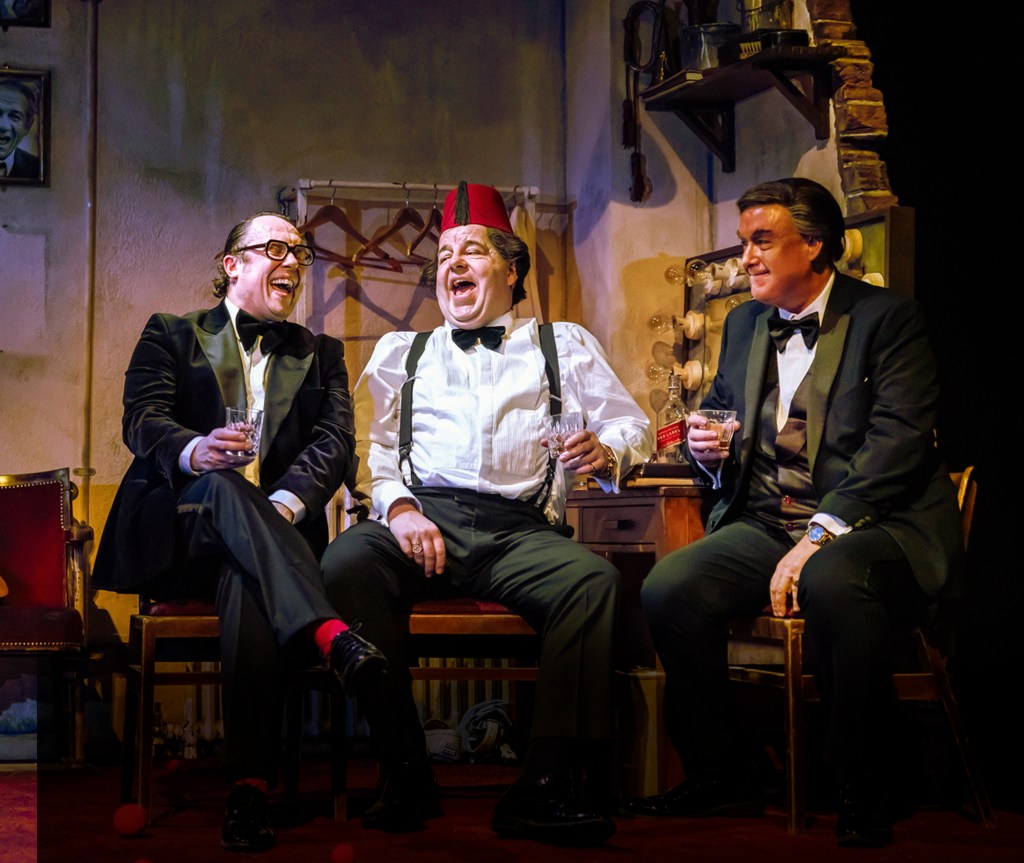
I’ll admit, I went in with some hesitation. Not having grown up in the UK, I didn’t really know much about Eric Morecambe, Tommy Cooper, or Bob Monkhouse—three names that clearly meant a lot to the rest of the audience. I was worried I’d be lost, like turning up at a reunion for people I’d never met. But to my relief, within just a few minutes, I wasn’t just catching up: I was completely captivated. Written by Paul Hendy, The Last Laugh imagines the three legendary comedians sharing a dressing room ahead of a performance. From that simple setup, a richly layered play unfolds: funny, fast-paced, and nostalgic, but also dark, reflective, and unexpectedly moving.
The jokes come thick and fast (there’s hardly a moment when the audience isn’t laughing) but the play offers far more than just a stream of gags. Through their playful teasing, sharp one-liners, and carefully timed physical comedy, the three characters gradually open up about the private battles behind their public personas. Mental health, traumas, addiction, loss, and the deep, often painful drive that pushes people towards the spotlight—it’s all there, beneath the punchlines.
Bob Golding captures Eric Morecambe’s warmth and wit effortlessly. His performance is magnetic, and even without prior familiarity, you quickly understand why Morecambe was so beloved. Damian Williams’s Tommy Cooper is an utter delight: chaotic, loud, unpredictable, yet also deeply vulnerable. And Simon Cartwright’s Bob Monkhouse, the smoothest and most polished of the trio, carries an emotional weight that creeps up on you. Together, they have genuine chemistry. It’s because each of the three comedians represents a unique archetype of comedy—Eric Morecambe’s affable playfulness, Tommy Cooper’s surreal absurdity, and Bob Monkhouse’s sharp charm—so bringing them together creates a perfectly balanced and unforgettable comedic trio. The banter never feels forced, and there’s a real sense of history between them, even though this meeting is fictional.
The three actors were nothing short of extraordinary. It was one of those rare performances where I completely forgot I was watching actors at all. They were so natural, so utterly convincing, that it genuinely felt like I was eavesdropping on three comedians in their dressing room as opposed to watching three actors on a stage. But what really stood out for me was how inclusive the script is. Yes, there are references that will land more powerfully with those who remember these men in their prime, but the writing never leans so heavily on nostalgia that it alienates others. Instead, it invites you in. The play doesn’t assume prior knowledge, it earns your affection. You end up falling for these characters as if you’d known them your whole life.
Lee Newby’s set design deserves a special mention. The backstage dressing room is detailed and intimate, a believable space where time seems to bend. There’s something liminal about it, almost dreamlike—like we’ve stepped into a place between life and legacy, where these figures can look back without the pressure of performance.
The structure is clever. As they prepare for their set, the comedians discuss material, timing, what jokes to avoid (nothing too blue!), and what they’re willing (or unwilling) to share with an audience. But in doing so, they reveal more than they intend. What begins as a comedy gradually transforms into something closer to a meditation on purpose, fame, regret, and mortality. The tone shifts slowly and naturally, which makes the darker moments all the more affecting.
Although it is not a musical per se, there are a few musical numbers thrown in. These brief performances don’t drive the plot but serve as little windows into the world these men once ruled: variety shows, vaudeville traditions, television specials. They add another texture to the evening without disrupting the flow.
In the second half of the evening, after a well-earned standing ovation, the cast returned—not in character, but as themselves—for a short panel discussion with the audience, led by Richard Hodder, the cover/understudy for all three actors. It was a lovely and generous touch. After getting to know the three comedians so intimately on stage, we now had the chance to get to know the actors behind them: their personal tributes, the inspirations that shaped their portrayals, their favourite comedic moments, and their thoughts on the evolving nature of humour itself. They spoke with warmth and insight about how different nations and generations respond to comedy—how, while laughter may be universal, the art of making someone laugh certainly isn’t.
We also heard about the play’s journey: its origins at the Edinburgh Fringe, its current run on the West End and Broadway, and exciting future plans, including early conversations about a film version already underway. It’s rare to see something that feels both fully formed and still bursting with potential. There’s something thrilling about witnessing a show this fresh, knowing it’s just the beginning. I might’ve been one of the first to laugh, but I’m certain that The Last Laugh is going to go far.
If I had any criticism, it is that the humour is so relentless—brilliant, but relentless—that some of the heavier moments pass a bit too quickly before the next joke rushes in, especially when the audience is still laughing at the previous joke. But that’s a minor point. The balance overall is impressive, and the writing respects the audience enough to let the subtext speak.
What The Last Laugh does so well is capture the bittersweet essence of comedy itself: the way it uplifts, distracts, and reveals all at once. Whether you’re a lifelong fan of these three men or, like me, a newcomer meeting them for the first time, there’s something here for everyone. I left the theatre thinking not just about how much I’d laughed, but about the people behind the laughter and how they’re remembered and revived.
This is much more than a tribute act. It’s a sharp, moving, and surprisingly emotional play that reminds us of the fine line between comedy and tragedy, and how often the two walk hand in hand; because sometimes you just have to laugh when life trips you up.
The Last Laugh runs at Opera House Manchester until August 2 and tours the UK until September 27.
Photo: Pamela Raith
 JADAR
JADAR 