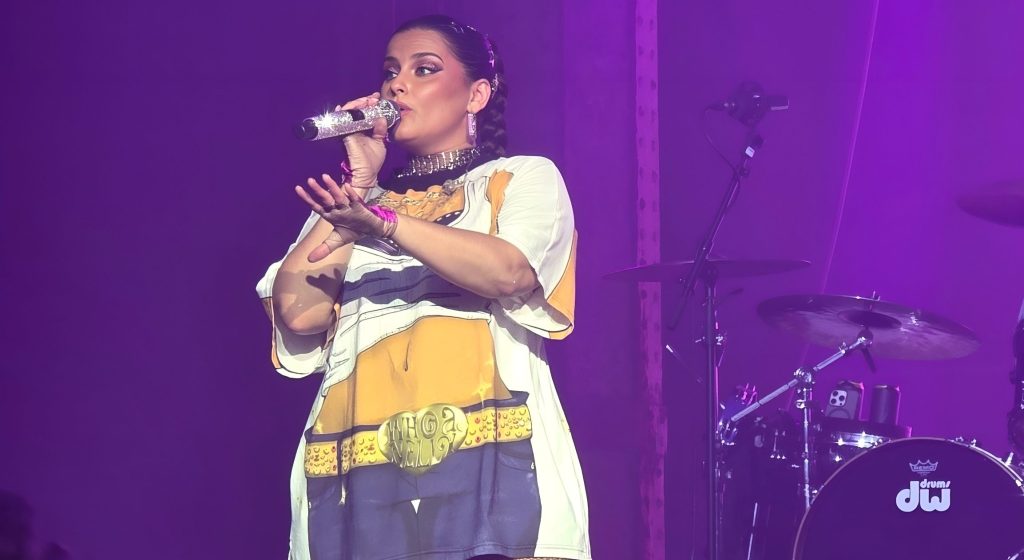
Celebrating 40 years since its inception, Manchester Pride went big this year. Alongside the Gay Village Party, there was a new event at Depot Mayfield and Freight Island. Mardi Gras, which is what Manchester Pride was known as in the 1990s, was headlined by Leigh-Anne on day 1 (co-headliner Billy Porter dropped out due to illness) and Olly Alexander and Nelly Furtado (who was announced the previous week) on day 2.
Whilst Gay Village Party usually consists of three stages (the Village Stage, Alan Turing Stage, and Indoor Arena), this year there were only the two smaller stage. They still had some great headliners in Samantha Mumba, B*Witched and Sister Sledge.
Mayfield Depot has six spaces: Depot, Ticket Hall, Concourse, Archive, The Platform, and Freight Island. Mardi Gras used Ticket Hall simply as a gateway, with Depot being used as the main stage. Concourse and Freight Island’s Garden Stage were spaces for various DJs. The indoor stage at Freight Island was mostly for fun, novelty and cabaret acts. Guests could flow freely between various spaces; it felt like its own little village, with four distinct neighbourhoods. There really was something for everyone.
Expanding out of the Gay Village was necessary because Manchester Pride outgrew the Village years ago. The Village is overwhelmingly, suffocatingly, claustrophobically packed during Pride, and the Village Stage is way too small; hundreds of people find themselves turned away every year.
However, the event was undersold, which is probably because of the high ticket cost (relative to the GVP and other regional Prides) and also because most people want to be in the Village for Pride (unless there is a huge act, such as Ariana Grande, who also played at Depot).
Concourse was almost always empty. The music seemed to be heavier and more electronic, which, though often popular with queer people, does not feel very Pride. Special guest DJ Paulette, who was announced alongside Nelly Furtado just over a week before the event, headlined Concourse on Sunday night, but I can’t imagine many people chose her over Olly Alexander.
The Garden Stage was busy at times – particularly during the electric set by Swagga Mcr, led by DJ Stacy Bee – but quiet during others. Sometimes there were lots of people outside for the vibes but nobody was dancing on the platform. This stage needs more lively, interactive DJs and houses such as Swagga Mcr.
We dipped in and out of Freight Island, catching glimpses of Charity Shop Sue, Queenz: Drag Me to the Disco, and Bongo’s Bingo. We briefly caught some of Fly Girls$’ set at Concourse, which seemed to be one of very few times that venue had more than just a handful of people. “Free Palestine” and “trans lives matter” were stylishly chanted by one of the performers, the former perhaps being a reference to Manchester Pride’s partnership with Booking.com – which is set to come to an end, after pressure and criticism.
Whilst the come-as-you-go, free-flowing atmosphere was lovely, the smaller crowds dented the vibe; it often felt like something was missing (people!).
Even the Main Stage was dead when we arrived on the Saturday, a few hours into the event, and still pretty quiet at a similar time the next day. It did, however, pick up, with more popular artists attracting more people. By the time Leigh-Anne took to the stage on the Saturday (10:30PM), most people had left for the Village. Billy Porter cancelling meant there was quite a dull period, though it was lovely being able to leave the main stage and chill outside.
The biggest crowds were of course for Olly Alexander and Nelly Furtado; I could be wrong but Olly’s crowd seemed busier, though Nelly was not on until 11PM, which was rather late. The line-up changed quite a bit in the week leading up to the event, with Nelly originally performing before Olly, then at 11:30PM, then at 11. However, having a live line-up on the app is a brilliant idea.
My friend Jsky, who performs on the main stage every year, once again ended his set with a proper Manc cover of ‘Pump Up the Jam’. He again brought out Sebastenelli for ‘Put It Pon Dem’, after bringing out Night Thomas early on in his set, but, sadly, the lights were not working properly at the beginning of his set.
The special guests kept coming, with Booty Luv bringing out their Big Brovaz bandmate Randy during a cover of Robin S. ‘Show Me Love’ (he performed a new rap verse).
Sonique arrived a little late, with co-host Rikki Beadle-Blair MBE (alongside Darren Pritchard, who curated the Saturday) joking that she was coming down from her helicopter. I had hoped, then, that Sonique would open with ‘Sky’, but alas, she did not. The energetic set was the perfect preview for her first-ever headlining tour (a 25th anniversary tour) in October.
There were a few cabaret and circus performers; I only caught Andi – who was pushed forward when Sonique was taking awhile; he once again performed his jaw-dropping upside-down striptease – and the end of Ghetto Fabulous Dance Party.
Whilst Gok Wan deejaying is a draw, his sets are a little heavy and electronic for my liking.
Leigh-Anne Pinnock offered an incredible performance; her singing and dancing are both incredible. Her solo music does not slap like Little Mix’s (or Jade’s!) but it is aurally pleasing, and she performed it very well. It was great to get a Little Mix medley – and I love that she mixes up which songs she is going to sing/
On Sunday, we made sure to get there in time for Tayce. Whilst she makes music, and has a new song out, her set consisted of them lip syncing to a Doja Cat medley. She was a complete and utter diva, complete with a Diana Ross-esque mane.
Louisa Johnson, one of the country’s most underrated and underappreciated voices, had a sizeable audience. The sound was not great all weekend but it seemed to be worse for her.
Special guest Big Freedia, who was originally scheduled to perform on the Saturday, was incredibly entertaining though sadly she did not perform any of the songs I listen to (which I think are more accessible and radio-friendly than the intense songs she performed), though she did end with Beyoncé’s ‘BREAK MY SOUL’, which samples her song ‘Explode’.
Special guest Tulisa’s audience was pretty stacked (as was the stage – she brought so many dancers with her!). She’s an excellent performer though her sets are often very similar.
Olly Alexander knows how to work a stage all by himself. Whilst he sang some of his post-Years & Years material, he knows that a festival audience (especially a Pride crowd) just wants the hits. I missed the top of his set as I was outside flirting (I think he would approve, to be fair), and I saw him earlier this year anyway. I arrived just in time for his controversial Eurovision song ‘Dizzy’ – it was great to see him perform the normal version as he had performed a slow version on tour.
I have been a Nelly Furtado fan since I was a kid. A mere couple of days before she was announced as a headliner, I had been thinking about how much I wanted to see her live. The Lord heard my prayer!
She looked and sounded amazing, and she had excellent stage presence. She sang all her biggest hits but sadly not her final UK chart hit, ‘Big Hoops (Bigger the Better)’.
In between acts, Sequinella (Saturday) and Monopoly Phonic (Sunday) played groovy sets to keep the crowd going (and to stop them from going).
The other Depot acts were DJ Mother, Black Betty, Kinky Afro, Louis III, Monopoly Phonic, K-Klass, Banksie, and Jodie Harsh.
The food and loo situation were much better than GVP. There are a few rubbish food vendors at GVP, and none at the Village Stage – which was a nightmare because if you left to get food, you probably would not make it back in again, because of the limited capacity. At Mardi Gras, guests had all the excellent vendors at Freight Island to choose from.
At GVP, there were never enough loos at the main stage, and last year’s set-up was a little unsafe. At Mardi Gras, though there seemed to be fewer loos, they were well distributed, with access to Freight Island’s indoor loos being a nice addition/
It was strange to not bill this year’s Pride as a 40th anniversary event, especially because they went big this year. I also found it funny to see a few Mardi Gras advertisements with no mention of Manchester Pride. I completely understand the necessity to commercialise Pride to ensure that it keeps going and to increase visibility and awareness – furthermore, the gays love music, so it is amazing to get so many amazing artists in one (safe) space – but the omission of Pride altogether in some adverts is not a good look (and, ironically, it did not help bring in more crowds!).
Mardi Gras was an ambitious, excellent concept and idea. This is the first year so it was experimental, and should they choose to continue it, the execution will surely be better next year, now that they know what did and what did not work.
Tickets ideally need to be cheaper – whilst some people do not want to be away from the Village, others do not want to part with that much money, especially when they can see some pretty great acts in the Village for a much smaller price.
The event should be downsized; they only need one of the indoor stages in Mayfield Depot, and possibly not even the largest room. Freight Island worked very well but the Garden Stage needs some better music; they need more lively acts like Swagga Mcr playing endless bops.
They need to announce a stronger headliner sooner. Nelly Furtado was announced too late to bring loads of new people in; many people had already booked tickets to GVP – and whilst you could upgrade your tickets, I’m sure plenty of people could not be bothered with the faff, or had already made plans with friends in the Village.
This was an innovative inaugural event; if Manchester Pride make the changes outlined in this review, the sophomore event will be much slicker and busier (and cheaper!).
Photo: Jay Darcy @ JaDar
 JADAR
JADAR 