30 years after the debut of Rupert Street Lonely Hearts Club – which was set in London but premiered in Manchester – Jonathan Harvey has rewritten the play and relocated it to contemporary Manchester, renaming it Canal St Lonely Hearts Club. The play has been produced by Qweerdog, who had asked a hesitant Harvey to update and reset the play; directed by Stewart Campbell; and performed at the queer-led Hope Mill Theatre. Canal Street is, of course, the main strip of Manchester’s Gay Village.
The play is about two brothers – one gay, one straight – who had a falling out a few years before and are tentatively becoming friends again. A sitcom, of sorts, it is all set in the straight brother Shaun’s (James Sprague) flat on Canal Street. The gay brother, Marti (Cameron McKendrick), lives in Didsbury but spends a lot of time at Shaun’s, what with its proximity to all of the gay clubs. It’s a bit odd that Shaun lives in the Gay Village, and we never learn much about how or why Marti lives in Didsbury (which is to Manchester what Islington is to London).
The show opens with the brothers and one of Shaun’s friends, George (Riah Amelle), who is also friends with Shaun’s girlfriend. George is a well-spoken teacher, presumably from a well-to-do background – but again, it seems a bit odd that a posh straight (at first) female teacher would live on Canal Street.
We soon meet Shaun’s mentally unwell neighbour, Clarine (Lucy Hilton-Jones), who has various personalities and identities; George, who does not even own a TV, believes Clarine when she tells her that she is a reality TV star from Married at First Sight Australia.
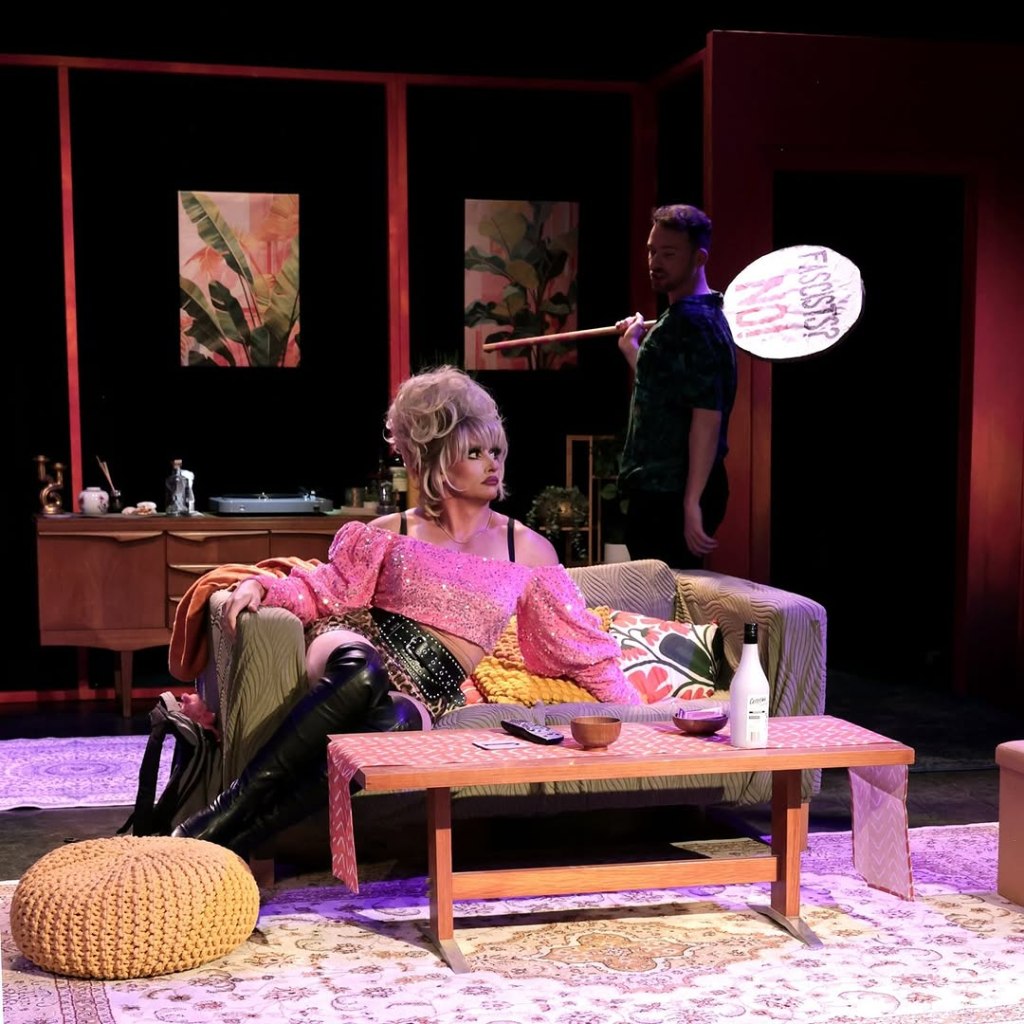
The cast is rounded off with Nick Collier (aka drag queen Ella Vaday) as Marti’s friend, Dean, himself a drag queen (though we only see him in drag for his first appearance).
All five characters are incredibly distinct, and each has their own problems going on, related, in part, to loneliness, yet, sadly, their relationships with each other are not particularly healthy.
The episodic play is made up of a series of vignettes; lights and music are slickly used to signify the passing of time. Chris Osborn’s lighting design is intimate but also captures the intensity of some moments of the play, signifying how one’s home can be a place of security but also secrecy.
Caitlin Mills’ design is luscious; she has completely transformed the black box space into a rather pretty flat. The set does not have walls; Mills has used the real walls at either side of the stage as the flat’s walls, complete with framed paintings, and the back of the set simply has frames to represent walls, with framed paintings hanging down from chains. The flat is thus surrounded by darkness, removing the outside world from the audience’s consciousness; our focus is forced inside these four walls. It feels very “behind closed doors”.
The play is a real rollercoaster though utterly enjoyable until the ending. There is a shock reveal and then something horrifying happens. It feels a bit out of the blue, so either it was not foreshadowed or suggested strongly enough, or I just did not pick up on it (or perhaps the point was to shock and then force us to look back and reflect). It then all happens so quickly, which successfully creates intensity, but it would have ben easier to digest and process had it been drawn out a little more.
The play is largely a character study, and the complex characters are wonderfully acted by a passionate queer cast who have clearly studied their characters and thought deeply about their motivations.
McKendrick’s portrayal of Marti is incredibly multifaceted, and his breakdown is heartbreaking. Marti can be insufferable and unlikeable but his bravado is, quite clearly, a front to hide his insecurities and trauma – which is quite common amongst gay men.
There is clear resentment towards Shaun, who ostensibly seems like a lovely guy – and, interestingly, is much more progressive than the two gay characters – and we eventually learn why; it’s devastating.
Sprague, similarly, conveys complexity in Shaun, a man who is trying his best despite his previous mistakes, which are unforgivable, but there is real anger behind the chilled facade that he has constructed.
Amelle manages to make the at-times grating George likeable and funny. George does not get on too well with either Marti or Clarine; even when she’s being ostensibly nice, you can see the frustration in Amelle’s eyes.
Collier is hilarious as the outrageous Dean, who works in McDonalds by day and does drag by night. The character deserves more stage time, and it would be great to learn more about his background, but Collier absorbed attention every time he was onstage (and not just because he’s gorgeous!).
Dean is “anti-woke” whilst Marti is politically apathetic, in contrast to the progressive straight characters. In reality, the vast majority of queer people are progressive, though some older white gays do exhibit some more conservative views and can be critical of “woke” culture and ideology (forgetting that it is wokeness that got them rights, but let’s not get into that). Of course, this play was written 30 years ago, so this might be reflective of where white gays were at then (the characters would be in their 60s now), but it does not feel particularly right for today – especially for a drag queen to espouse such harmful rhetoric.
Hilton-Jones’ portrayal of Clarine is absolutely electric; the subtleties and nuances she instills in this intense, grandiose character deserve great praise.
It’s certainly a sympathetic portrayal though some have criticised the writing for a perceived flippant portrayal of mental illness and a “playing it for laughs” approach. Whilst Clarine does provide some comedic relief, this is reflective of reality, in which we have historically mocked, and sometimes still do mock, people with mental illnesses and disorders. Clarine is also, undeniably, though generally unintentionally, funny.
There is, however, a disconnect between the historical context and today. This is a flaw in updating a play which is quite specific to its then-contemporary context. It seems strange that somebody so mentally unwell would be living alone in a flat on Canal Street. The historical context, however, is ‘Care in the community’, a Tory policy which refers to providing health and social care services to people in their own homes and local environments rather than in institutions, with the goal of supporting independence and well-being. Clarine, then, was an institutionalised woman suddenly fending for herself in the big bad world. I can imagine it felt very current 30 years ago, but today, with our better understanding of mental illness, it feels off.
There are also some historic references, such as Marti’s love of Bette Davis, and characters writing letters and sending emails, which feel a bit out of place and outdated. Sure, some young millennial gays love Old Hollywood icons, but using more relevant references could have worked more nicely and, in fact, been funnier.
Canal St Lonely Hearts Club might not feel as groundbreaking as Rupert Street Lonely Hearts Club did 30 years ago, and some of its references and its handling of mental illness feel like those from a 30-year-old play – yet the themes remain relevant. As someone who was not even born when the play premiered, I am grateful that I got to see an innovative iteration of an iconic play which brought queer stories (and trauma) into the mainstream only a few years after the implementation of Section 28.
Canal St Lonely Hearts Club runs at Hope Mill Theatre until September 14.
Photo: Shay Rowan

 JADAR
JADAR 