★★★★☆
Death On The Nile has finally docked at the Lowry for the first stop of its UK tour, promising a night of enthralling mystery with a healthy dose of Poirot’s killer dad jokes, a drop-dead gorgeous set, and an ending that will have you sphinxing outside the box!
Agatha Christie first published Death On The Nile in 1937, becoming her 17th installation in the story of the famous Belgian (not French!) detective Hercule Poirot. She was again inspired by her own travels, this time taking influence from her adventure on the Steam Ship Sudan. Since its publication, there have been numerous adaptations, from the 1978 Peter Ustinov and 2022 Kenneth Branagh films to the 2004 David Suchet television anthology, a 1997 BBC radio serial, games, and a play which first opened in 1946.
Adaptor Ken Ludwig and director Lucy Bailey (who both worked on last year’s tour of Murder on the Orient Express), reunite for this year’s production. This time, we follow Hercule Poirot (Mark Hadfield) and his friend Colonel Race (Bob Barrett) as another vacation is cut short by the brutal murder of the wealthy and mutually-abhorred heiress Linnet Ridgeway (Libby Alexandra-Cooper) during her honeymoon on the Nile. With a boat-load of suspects, will Poirot find the culprit in time?
Could it be the scorned best-friend Jacqueline de Bellefort (Esme Hough), poisoned by betrayal and in de-Nile after her fiancé Simon Doyle (Nye Occomore) instead married Linnett, enraptured by her glamour and wealth? Is it the avaricious lawyer Annabelle Pennington (Helen Katamba) pushing for signatures on mysterious documents? Or even the vengeful Egyptologist Atticus Praed (Howard Gossington) and his son, Doctor Ramses (Nicholas Prasad), fuelled by desperation after the Ridgeways swindled them of their wealth? Then there’s the successful actor, Septimus Troy (Terence Wilton), whose dreams to play Hamlet were crushed by the heiress, and his new flamboyant fling, Salome (Glynis Barber), and her daughter, Rosalie (Camilla Anvar), whose motives remain a mystery.
Despite its popularity, my only exposure to the story was Gal Gadot’s god-awful delivery of “enough wine to fill the Nile” in a compilation that made its rounds awhile back; a line that was thankfully laid to rest.
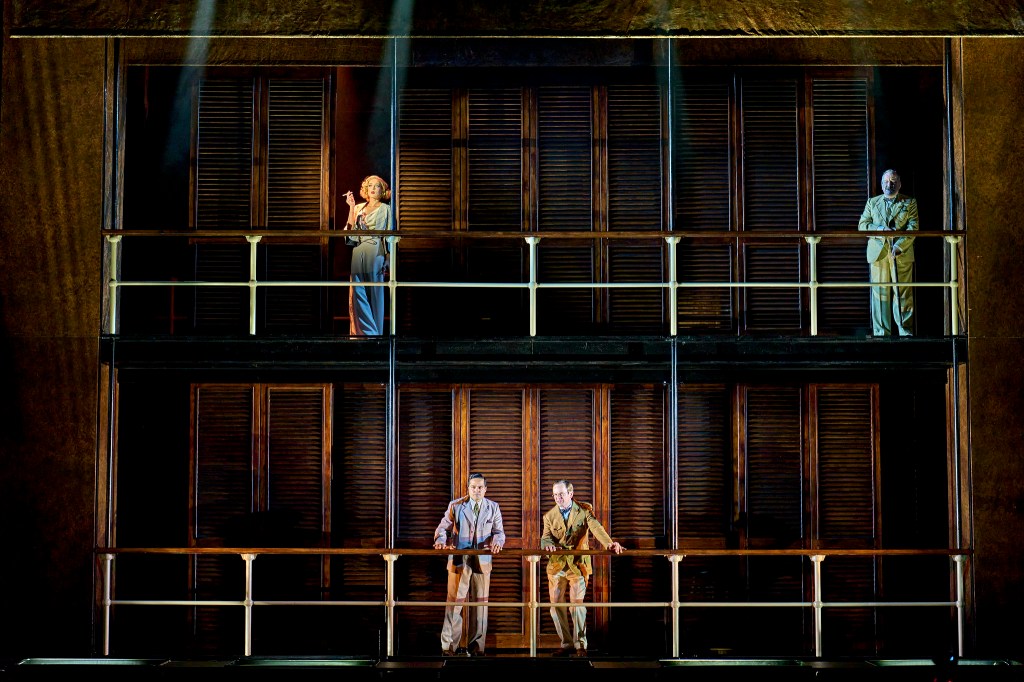
My initial reservations about the boat setting were dispersed by Mike Britton’s surprisingly flexible set, transforming before the audience’s eyes as decks and rails were lowered, the initially narrow stage slit becoming a two-decked cruise liner. Shutter doors were laid as the saloon and cabin backdrops, expanding and contracting to hide and reveal the golden sarcophagus.
Oliver Fenwick’s haunting lighting behind these shutters in the murder scene were truly spine-chilling, shrouding Linnet’s nightmarish visions of vengeful passengers behind the shutter doors before echoing gun-shots startlingly signalled the interval. Focused lighting also allowed small areas of the set to be illuminated, drawing our attention to a cabin or saloon while shrouding the surrounding set in darkness. It’s less intricate and interlocking than Murder on the Orient Express’ movable train carriages but neatly expands across the whole stage creating a realistic nautical illusion (minus the water of course).
Mic Pool’s sound design draws the rest of the picture, capturing the essence of the Nile soundscape with the splashing tides and a light cacophony of distant animal calls. Other times, eerie backing tracks build a steady sense of tension.
Poirot mysteries are always a delectable mixture of comedy and thriller, teeming with tension but enlivened by the oddities of the old detective. The character is stuffed with so many little eccentricities, Belgian expressions, and playful dialogue, and Hadfield’s depiction is no different. Hadfield brings Poirot to life with such gentility, being an approachable friendly face and a confident, almost omniscient detective as he retorts the facts alongside the ensemble reenactments. His parallel opening and closing monologues are particularly eloquent. Additionally, Hadfield’s cuttingly witty repartees, excitable demeanour and wall-breaking winks to Christie’s tropes make for entertaining and meta sequences (albeit a tad pretentious), but he particularly shines in his chemistry with the equally jovial Barrett in their crime scene investigation.
However, I found Death On The Nile’s tone to be a strange dichotomy, utilising the same mixture of humour and fascinating murder mystery tropes as its predecessors, yet lacking in emotional momentum. Murder on The Orient Express left Poirot with a moral dilemma, torn apart by his ideals of justice and moral obligations. Death On The Nile feels far more chipper, showing a bubbly Poirot, often over-excited by the investigation but lacking the solemnity from his previous investigations as he insincerely jests over the victim’s corpse. Its slapstick fights, hilariously dead-pan deliveries, and an array of well-crafted comedic interactions are extremely amusing, but the emotional weight of the show needs a little more punch.
For once, I was also astonished to have guessed the killer during the interval! Christie is renowned for her genre-defying twists, and her pieces have always kept me guessing. She loved toying with audience expectations to keep people guessing and subverting expectations, but sometimes a clue sticks out amongst the others, and everything adds up… or maybe I’ve seen too many murder mysteries!
Despite this, there was immense catharsis in seeing Poirot methodically combing through the evidence, each clue a jigsaw piece snapping into place in a perfectly ordered puzzle. Perhaps that’s the best metaphor for the show; perfectly precise and well-structured fun but ultimately a few pieces short of perfection.
Agatha Christie’s Death on the Nile runs at Lowry (Lyric Theatre) until October 4 2024 and tours the UK until May 23 2026.
Photo: Manuel Harlan
 JADAR
JADAR 