★★★★☆
Directed by David Esbjornson, The Shawshank Redemption is on tour across the UK. Adapted from Stephen King’s short novella, Owen O’Neill and Dave Johns breathe new life into the story on stage.
The Shawshank Redemption is a long revered piece of fiction drawing inspiration from the corruption of the American prison system with heavy undertones of religious and class separation.
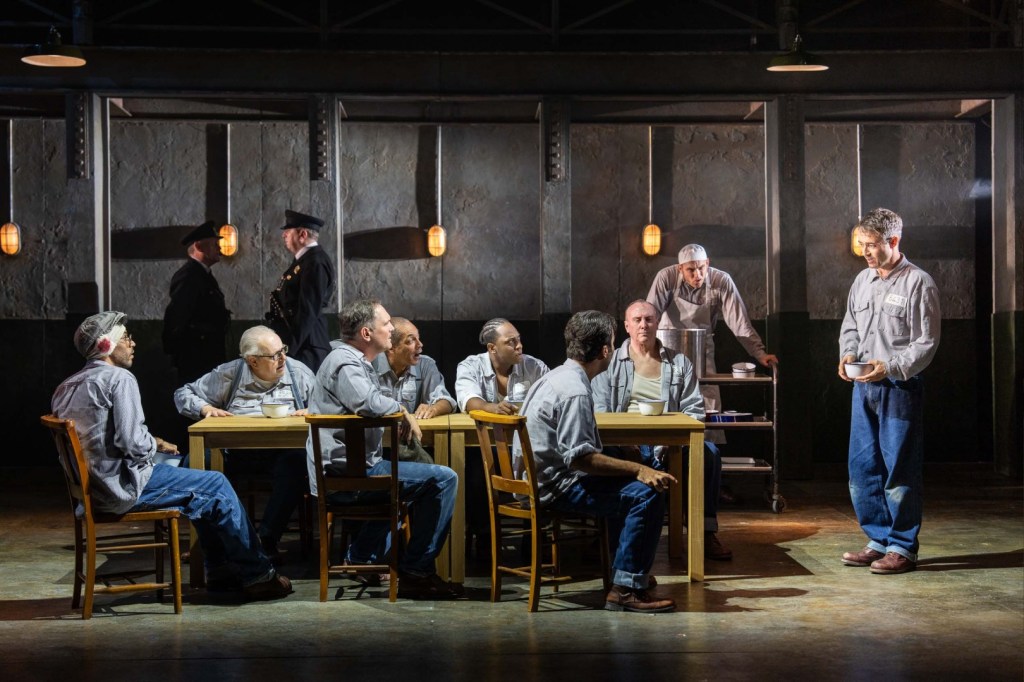
I thought the design of the piece was excellent, nailing the aesthetic of the film and vintage American prison systems. This was highlighted both visually in costume and set design as well as soundscapes. Gary McCann, the set and costume designer, and Andy Graham encapsulated the world of sound and visuals expertly. Chris Davey did a breathtaking job on the lighting design. One of my favorite noticings was his dedication to ensuring that the faces of each person who wore a hat were continuously well lit via side stage lights. This production was largely hyper-realistic, showcasing a genuine interpretation of the corporeal punishment system, however, there were bold moments that broke the illusion of realism.
Across the first act, I was gearing up for a heavy connection to panopticism and voyeurism, how we view punishment, how we view crime, where (and who) we get our information from in a world that lives inside the corrupt power. Interestingly, there has been a recent cultural shift in western fascination with death/violence portrayed in media following the 20th century. One of the groundbreaking films that showcased true brutality was The Shawshank Redemption (1994). I felt the play structure and dedicated acting performances across the first act geared up spectators for a similar core theme. The American accents were (for the most part) superb, the transitions between scenes had remarkable technical proficiency, and there was a deep love poured into the show, very articulate in how they grab our attention.
Unfortunately, there is a recent trend in shows I have seen across the last several years where the on-stage violence falls flat when it is necessary to the production. The moments of intensity, that were shown, lost effect because of the stage combat. I was more fascinated in how they used lighting and sound to mask the effect, as to watching the knaps of stage-punches and seeing half-energized kicks across the stage.
Leaving the first act, I was more than thrilled to see how they would tie together the loose ends of violence, how they would pull off the vicious and brutal actions throughout the rest of the story and cover the great escape of Andy Dufresne. However, what began as a hyper-realistic piece slowly broke away from its intensity as they included visual and metaphorical representations of the events across the second act. Andy’s great prison break included a hand-drawn butterfly and a glowing mechanical monarch floating across the stage. This seemed to be a marvel to some in the audience. I felt this disconnected audiences from the raw emotional intensity that this piece is known for and did not fit into the artistry of the piece thus far. The moments of hymn-singing and physical theatre would have worked well if they were cohesive across the first act. However, if you were looking for representations of Andy as Jesus Christ, I do think this symbolism nailed this interpretation.
As mentioned prior, the first act did an excellent job gripping our focus on voyeurism, panopticism and what we view as audiences. However, they lost their grip on the visceral awareness that made the story so loveable in the first place. I was left confused on their main focuses. One recurring issue they surpassingly focused on was queer violence within prisons and increasingly flamboyant characters. I felt the script did not warrant a full dissection of ‘The Sisters’, who were known for their violent gang-rapes across the prison. In my interpretation, this then shifted the focus of the piece to showcase queerness as opposed to the issues with rehabilitation that lead men to commit violent crime. They did not have a proper evaluation of this theme, and it felt like it fell flat from its exposition. The writing did not have enough exploration to heavily accentuate these themes.
In addition to that, the ending of the piece felt rushed from the moment Andy escaped prison. The show seemed nervous to add silence throughout the piece which took away from the ending. I wanted to see them stand in the silence, almost feeling freedom on their fingertips before being harshly called back into reality. Additionally, I wanted to see Red’s monologue as the climax of the piece but felt they rushed this ending.
In terms of the design of the stage, they missed two major moments across the second act. One being the library. The importance of this cultural hub and the difference that Andy made was not shown physically, and the decision to utilise miming in the second act did not fit stylistically with the reality established in the theatre already. The turning point in this story is the furthering of education, which was not shown.
Second, I was upset at their decision to move the set after Red’s closing monologue, him discussing his freedom while still sat inside the prison walls did not work for me. It felt like a lack of design forethought as opposed to an intentional choice.
The cast was made of all-stars. It was obvious each performer was sufficiently trained and prepared for this production. I was beyond impressed by the overall level in which the actors held their intensity. There were times it felt exaggerated but I was able to lean into the dramatics easily. Some of the most notable performances were Joe McFadden as Andy Dufrense, giving us a more sensitive portrayal of the character and Ben Onwukwe as Ellis ‘Red’ Redding, putting up a performance that did meet par with the film. I was also impressed by Bill Ward as the sinister and pretentiously ‘caring’ Warden, Ashley D Gayle who played the various levels of ‘Rooster’ excellently, Fernando Mariano as Rico, and Kenneth Jay as Brooksie.
Overall, the production was held to an incredibly high standard and was truly impressive. There were moments that broke trust with the audience, but for the most part, the acting performances were a true joy to watch. I felt a reworking of the script would aid the ending of the show; a lot of the themes they wanted to explore could be done with one strong and cohesive metaphor throughout. I wanted to see a deeper critique on the voyeurism of prison systems and punishment audiences partake in. I loved their representations of neurodiversity and queerness but felt the script did not fully allow for these to be fully fleshed out. I did enjoy the design and was pleasantly surprised how well this script adapted to be on the stage. I would recommend this piece to long time fans of the movie and novella as well as any new theatre fans who want to see how much can be done in a one place set with phenomenal performances.
The Shawshank Redemption runs at HOME (Theatre 1) until October 11 2025 and tours the UK until June 6 2026, with further tour dates to be announced.
Photo: Jack Merriman
 JADAR
JADAR 