★★★★☆
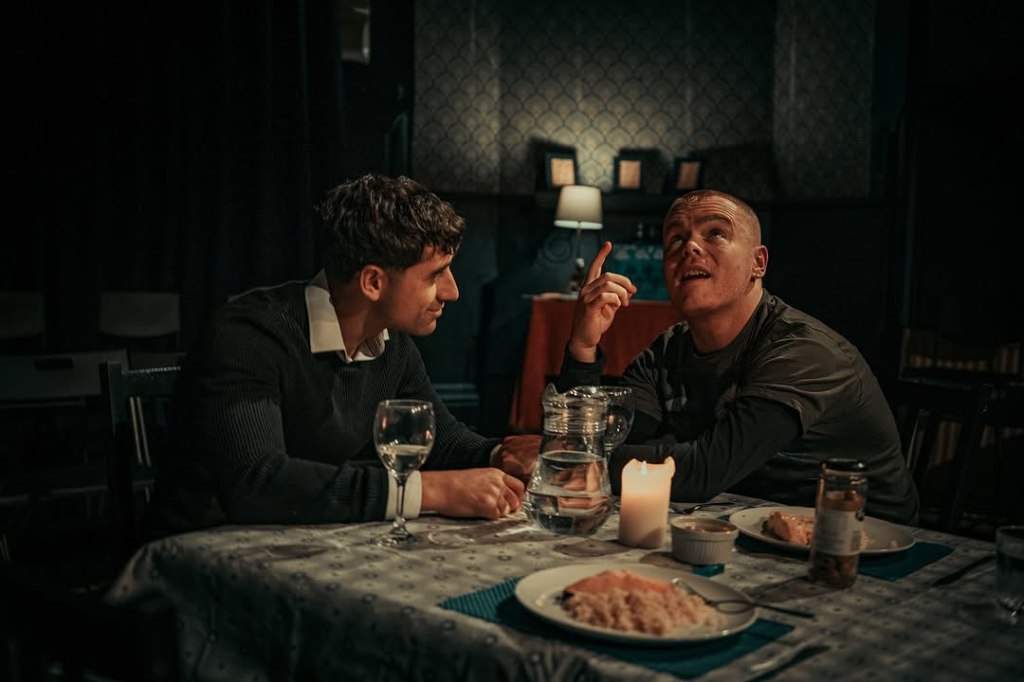
Directed by Oliver Hurst, Dennis Kelly’s Orphans has made its Manchester premiere at the Kings Arms Salford.
Orphans is an intense, unsettling and dark story. Audiences catch Helen (Hollie-Jay Bowes) and Danny (Ryan Clayton) having a quiet night in when they are interrupted by Helen’s brother, Liam (Ryan O’Neill). Liam is a violent and restless character who comes to their aid after committing a violent crime against another man – slowly revealing what actually happened and who the man was.
The entire play is intense, leading us through a maze of misdirected intentions and outrageous declarations made by Liam, Helen and Danny. The play questions how far we go for family, what we are willing to ignore and how far can our morals bend. The play analyzed race, class and violence while discussing abortion, assault and family.
The show brought up several ethical questions: What do we truly owe to our loved ones? What do we owe to others? I appreciated the intensity but felt the origins of the question were misdirected. There was an additional element of racism, abortion, and emotional abuse that felt unexplored, and due to the external factors surrounding the production, partially confusing in their intent. There were moments of comedy and moments of great tragedy that the audience seemed to adore.
Immediately, it is important to mention that the description of this show and the content shown were strikingly different. The website and production materials made little mention of the graphic intensity of the show. It is an intentionally difficult watch. It is meant to be jarring, shocking and intense for viewers.
However, there seemed to be a bit of a disconnect in the intention behind this. I felt one of the major elements they did not have the means to discuss is the racially motivated torture descriptions. It felt oddly voyeuristic to be sat in a mainly White audience (Jay might have been the one person of colour), with a white cast (though Ryan is part Iraqi and Hollie-jay is part Irish) and white creative team telling an intensely graphic story about racism. Though the original script might have called for this classification of characters, the distinct lack of resources for people of color given by the production company is something to note. If you are going far enough to post a sign outside the theatre addressing the triggers, then citing resources and evidence of the racism present in England and across the United Kingdom is the bare minimum; without this, it felt unexplored and lacking empathy.
The first five minutes of a show are incredibly important in every production you will watch. This is your one chance to captivate your audiences, and if you are unsuccessful, it will drastically change your production. I felt they had a largely successful beginning with O’Neill stepping into the space covered in blood, shaking as he enters the contemporary and quiet apartment audiences found themselves in. It was remarkably gripping from the moment O’Neill stepped onstage.
I love the immersive aspect that Hurst leans towards. I found the staging to be enjoyable and thought-through. I loved seeing the Kings Arms be transformed into the round, a distinct trademark of Hurst. I think his ability to direct intensely emotional pieces in a small space, let alone in the round, is remarkable. The movement of the performance felt authentic, and it never felt forced. His visible capacity is brilliant.
However, there were times, I felt, the action slipped away and hinted an a knowing unseen to the audience. When Liam entered the room originally, there was an expectancy in the room that weight heavily on me throughout. Their lack of surprise at the start, to me, felt due to over-rehearsal.
In terms of other design aspects, I found them to not add much to the story but they did not take away from it either. The design was straightforward and cozy. I found the lighting (George Miller), set and costumes to be simple and minimal. There were hints of sound design that bookended scenes with a loud gradual siren accompanied by dark red lights. These transitions were short, imitating a movie-esque moment associate with panic attacks or tunnel vision. Originally, I found the transitions to be out of place to the scene and expected with the production. I thought the effect it had took audiences out of the illusion established prior. There is little to remark about the design which really allowed for the acting performances to shine.
The acting performances were incredible, mimicking a naturalistic realism that complimented the story well. I found that I believed their characters and reactions for a large majority of the story. The benefit of smaller theatre spaces is an ability to see smaller reactions, and performers are able to avoid over-acting.
I truly did feel like I was watching a conversation unfold in front of my eyes but did find certain story elements predictable. I would have liked to see a deeper analysis of emotions from the production, but only a few times felt like the emotional range was stunted. I wanted to see a wider variety of the several tactics of emotional and mental abuse one might see in real relationships. The couple was dysfunctional and displayed several layers. I wanted to watch how one might try to convince their partner without yelling, without resorting to separation. I would have loved to see more physical storytelling from the performers and understand what was going unsaid in their conversations. I think this addition would truly add that extra element to the show. When anger fails, how else can we release frustration? Where is our breaking point when the frustration cannot be explained, sympathized with or desired by our family
The shining jewel of this piece was the actors’ reflection of their characters. O’Neill, Bowes and Clayton were truly spectacular. It felt very special to see a show with three actors portraying such distinct styles and emotional rawness.
The characterization felt beyond fringe level and pleasantly shocking. I did not find this show, ‘intensely human,’ as it was described to be: I found it raw, intense and vicious with three characters I ended up hating.
A majority of my issues had to do with the actual playwright and its escalation of drama. One question I repeatedly asked myself was ‘Why?’ Why this story and why now? As a fan of contemporary British playwriting, I was intrigued why this piece was selected. The play originally premiered at the Edinburgh Fringe and has received acclaim on both ends of the spectrum. I was excited to see this production but felt the writing did not adequately explore Helen’s character, her complexity and her angers. Her responses felt masculine in nature, frustrated and void of empathy. What changes her mind about having an abortion? What went unsaid that could have aided her development?
I thought the exploration of racism also became nonexistent throughout the show. It is important to question why this playwright chose not to explore this defining element. It felt ignored, perhaps allowing the audience to bridge the gap of critique. I also felt the emotional journey that the audience was taken on was largely the same: there was not a distinct moment that it transitioned from fear to frustration to pure terror. It felt like the core emotion of each character was anger and their jerk gut response was to yell. I was truly blown away by O’Neill’s ability to act so soft, loving and caring throughout the piece before become a sadistic and abusive individual, his range was remarkable. I felt truly scared of him in moments.
This production is a true marvel at what can be done in an intimate space, with a small and outrageously talented cast. This show is a must-see for all fans of intense psychological horror during the autumnal season.
I air on the side of caution for potential triggers and feel it is important to mention what did go unsaid in this production. Right now, the global majority is being targeted in the United Kingdom by White supremacists. Hate crimes have increased drastically in the last few years. There is an increase in racial and religious motivated offenses. Religious hate crimes against Muslims have risen by 19%.
This is the context missing from Orphans making this a distinctly different viewing experience for audience members. I felt the core of this show reflected dramatic intensity when the core should have reflected the issue within modern Britain. There is no way to address class issues without addressing the unjust treatment of people of color and the religious diversity present across our country. I believe it is the responsibility of the entertainment provider to address the core themes they discuss and analyze them alongside the audience. For me, I do not think it was fully analyzed.
It raises the question, who can be directing, writing and producing pieces of theatre that they might not necessarily relate to? Is it better to tell the story without representation or avoid the story altogether? In my opinion, it is time to get marginalized voices inside the room, making the choices and broadening the UK theatre world while telling stories of pain, of love, and of family.
That being said, I do not know what research went into the production, who was in the room and how they chose to talk about the issues behind the scenes. However, I felt a gap in the writing and a gap in the execution digitally.
The acting was sharp, sickly comedic, emotional and gripping from all three performers who truly gave us an excellent performance. I felt let down by the writing and its lack of variety in reactions available to sample from. I wish to see more public displays of statistics on crime, education of audience members and resources given on potentially triggering topics.
Orphans runs at Kings Arms Salford until October 17.
Photo: Kelsea Knox
 JADAR
JADAR 