★★★☆☆
After composing two of his most intense works (Peter Grimes and The Rape of Lucretia), Benjamin Britten turned his attention to comedy. The result was Albert Herring (1947), a bright, small-scale opera that replaces tragedy with gentle satire.
Set in Loxford, a prim English village, it follows Albert, a greengrocer’s timid son who becomes the unlikely May King after every “respectable” girl in town is deemed too wayward for the crown. What begins as a quaint civic ritual unfolds into a story of quiet rebellion, as Albert’s drink is spiked at the May Day celebration and he sets out on a brief, liberating escapade. Beneath the humour lies Britten’s sharp observation of social hypocrisy and the British obsession with moral decency.
Part of what makes Albert Herring feel so light is its scale and cultural intimacy. Compared to the heavy-weight dramas of Puccini or Verdi (let alone Wagner’s mythological epics), Britten’s opera is modest, digestible, and rooted in everyday experience. There are no kings, gods, or tragic deaths here; instead, we get shopkeepers, vicars, and overbearing matrons in a setting recognisable to its mid-century English audience. Put another way, it is no epic saga but a novella: concise, humane, and distinctly local in both language and spirit. It is an opera of teacups rather than swords, wryly holding a mirror to a nation’s social manners, much like a sitcom.
This new semi-staged production from English National Opera (ENO) carries symbolic weight. It’s the first time in the company’s history that Albert Herring has been staged, and it also marks ENO’s first shared production between London and Manchester. The performances at Lowry in Salford Quays follow the Arts Council England directive that the company move out of London (or forfeit its £12 million annual funding) as part of a drive to “level up” cultural investment. The Salford performances, then, are more than a touring stop: they are the beginning of ENO’s gradual shift northward.
Musically, the evening fares well. Conductor Daniel Cohen draws bright detail and nimble pacing from the 13-piece ENO orchestra, allowing Britten’s wit and transparency to shine. Caspar Singh, in his ENO debut, is a winning Albert: vocally assured, dramatically sympathetic, and convincingly transformed from bashful shopkeeper to self-possessed young man. Emma Bell, meanwhile, dominates as Lady Billows: a glorious caricature of moral authority (think of Miss Trunchbull both in looks and mannerism). Her clipped delivery and rigid posture create a delicious portrait of small-town tyranny. Carolyn Dobbin gives a well-judged performance as the long-suffering Florence Pike, and Anna Elizabeth Cooper and Dan D’Souza bring charm and warmth as the spirited lovers Nancy and Sid. The trio of children (Abigail Sinclair, Natasha Oldbury, and Henry Karp) deliver their scenes with admirable confidence and natural comic timing.
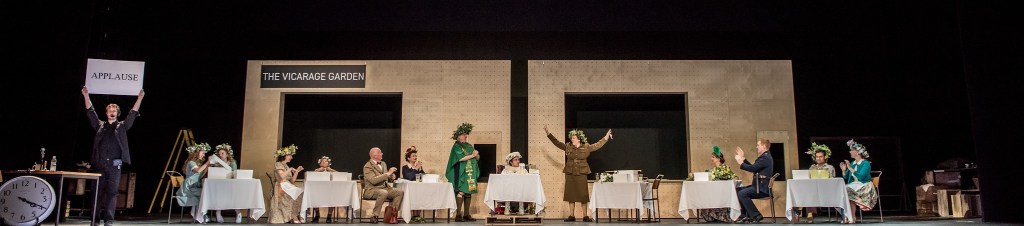
The production’s problems, however, are visual and conceptual. It appears intentionally minimal, but that seems more an accident of economy than of design. The stage is reduced to a few corkboard walls, labelled signs, and basic props; at times, it feels less stripped-back than simply under-imagined. For a work as modest in scope as Albert Herring, where the orchestra is small and the cast limited, the visual storytelling becomes even more important to balance it out. Minimalism can be effective if it feels deliberate (i.e., if it invites the audience to focus on nuance or subtext) but here, the concept seems undecided. It isn’t boldly sparse, nor is it rich enough to fully engage the eye. The result is something that just about works, but never fully convinces or surprises.
McDonald introduces various metatheatrical devices, such as a stage manager who flashes “applause” signs to cue the audience after Lady Billows’s speech, and moments when singers perform from within the auditorium rather than on stage. These choices are meant to blur the boundary between performance and spectatorship, but they add little insight. They feel more like playful interruptions inserted to keep things lively, rather than extensions of a coherent vision. The fourth wall is broken repeatedly, though not purposefully enough to justify the intrusion. The pacing also suffers: what should feel brisk and sparkling sometimes sags under the weight of its own cleverness. There are moments of charm and spontaneity, but they struggle against the production’s uneven rhythm and patchy tone.
If there’s a broader issue, it’s that McDonald’s Albert Herring never fully decides whether it is meant to be an affectionate farce or a biting social critique. It hovers uncertainly between the two, as if testing different interpretations without committing to one. Still, the musical performances redeem much of what the visuals lack. Cohen’s ensemble is crisp and responsive, the cast cohesive and characterful. And despite the conceptual clutter, Britten’s wit and affection for ordinary imperfection still come through. ENO’s Salford debut may not redefine its new era with a grand statement, but it demonstrates the company’s resilience and artistry under pressure. This Albert Herring doesn’t quite bloom, but it’s alive, spirited, and at times, quietly touching.
Albert Herring runs at Lowry until October 22.
Photo: © Genevieve Girling

 JADAR
JADAR 