★★★★★
Joined with Hamilton as the musical with the most Olivier Award nominations, it is no surprise that Regent’s Park Open Air Theatre’s 2024 revival of Fiddler on the Roof has quickly embarked on a UK tour. With its arrival in Manchester following a tragic attack on the city’s Jewish community (amidst reports that religious hate crimes are the highest that they have ever been), this musical is sadly more relevant than ever.
Based on the Tevye the Dairyman short stories (c. 1894) by Shalom Alecheim, Fiddler on the Roof premiered in 1964, less than two decades after the end of the Holocaust.
The story centers on Tevye, a milkman in the village of Anatevka, who attempts to maintain his Jewish traditions as outside influences encroach upon his family’s lives. He must cope with the strong-willed actions of his three older daughters who wish to marry for love; their choices of husbands are successively less palatable for Tevye. An edict of the tsar eventually evicts the Jews from their village.
The themes have remained relevant since the first story in 1894 and are especially pertinent today. There is dramatic irony, in that the characters, though aware of the rise in antisemitism (which lead to them fleeing), are ignorant of just how bad things are going to get, much like in Cabaret, which is set during the early days of Nazi Germany. It is especially tragic knowing that some of the characters plan to seek refuge in Poland; we know that if these characters live to see the 1940s, they are unlikely to see the next decade.
Aleicham, himself, was unaware of these horrors; he died decades before the Holocaust. But the musical premiered just two decades after it, and writer Joseph Stein did not have to make these parallels clear; the audience knows. The book, and this production, refrain from obvious, on-the-nose, preachy, patronising references, like the cringe-worthy line “Make Germany Great Again” in The Book Thief. This production thinks more highly of its audience and respects its intelligence.
Regent’s Park Open Air Theatre commissioned this production prior to the October 7th massacre and the ongoing genocide in Gaza (director Jordan Fein seems to be a supporter of Jewish Voice for Peace). Racial, ethnic and religious hate crimes, including antisemitism, have risen drastically in recent years. A few weeks ago, there was an attack on the Jewish community right here in Manchester. Since then, mosques and Muslims have been attacked. Last summer, racist riots swept the country, with the primary targets being people of colour and Muslims. This Autumn, we had the nationwide Raise the Flag campaign and a nationalist demonstration in London. Fiddler is about a specific community in a specific period yet it speaks to various communities in various places at various times, including right now – and in a future that looks pretty bleak for minorities.
The character Yente, the Matchmaker, reveals that she plans to seek refuge in Jerusalem in the Holy Land. This exchange was quite troubling because we know what happened after European Jews mass migrated to Palestine, with Palestinians facing (and continuing to face) similar brutality to what European Jews faced in the 20th century.
As for the production itself: it’s a little slow at first but the speed picks up from the dream scene, which finally had me transfixed.
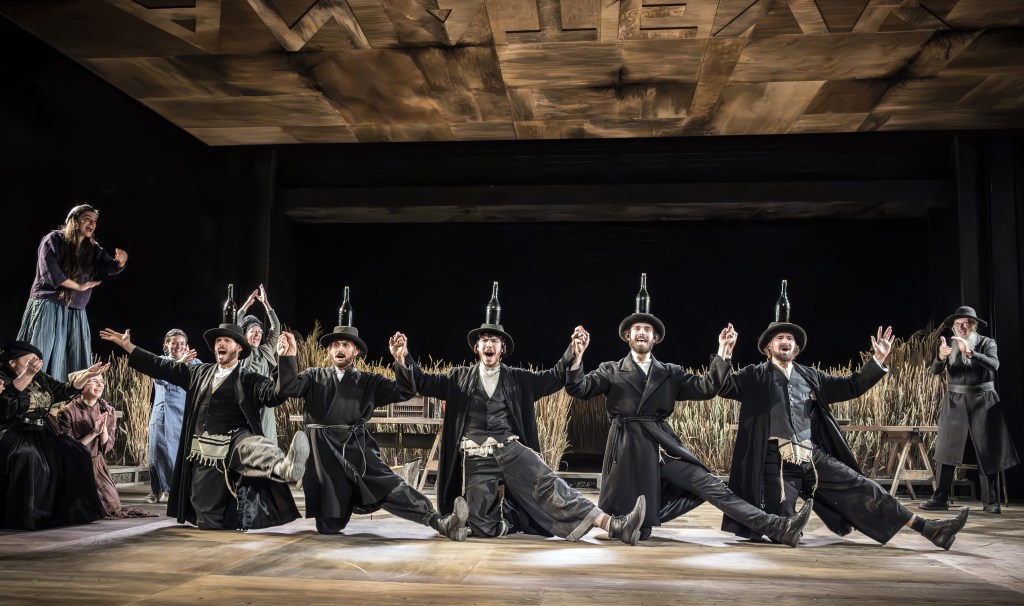
The production is beautifully designed by Tom Scutt. The set is mostly made up of wheat, including a wheat-filled roof, from which the titular Fiddler (who represents the precariousness of tradition, faith, and Jewish identity in the face of hardship and change) often plays. The roof repeatedly raises and lowers, depending on the atmosphere. At its lowest, it heightens the tension, creating a feeling of claustrophobia and suffocation, like their is no escape.
This production surely worked better at the open air theatre, what with its lack of an actual roof creating a feeling of exposure, with the Russian pogrom descending from the woods. The indoor production, instead, cloaks the set in black, establishing something of an abyss. This is a closed-off community that chooses to segregate itself not only to preserve its traditions but also for its safety. Unfortunately, there is nowhere to hide.
At first, other characters sit around the stage, watching the main characters, and some of them continue to linger, which references the nosey, voyeuristic tendencies of small communities, where keeping up appearances is everything.
The costumes are mostly period appropriate, and whilst they are dark and dull, as these characters are Orthodox Jews, there are some lovely shades. The intimate lighting (Aideen Malone), too, brings some vivid variety to the monotonously coloured set (brown surrounded by black). It also creates a feeling of comfort and community, which is soon shattered.
Jerry Bock and Sheldon Harnick forefront their best songs, with the three best songs (‘Tradition’, “Matchmaker, Matchmaker’ and ‘If I Were a Rich Man’) performed one after another at the beginning. It feels a bit bait and switch: it’s a solid score, and there are a few more memorable numbers, but nothing quite compares to the first few songs.
That said, further songs are brought to life with excellent singing, design and choreography (Julia Cheng). The iconic ‘The Bottle Dance’ is stunningly recreated. But ‘Tevye’s Dream’ is the showstopper of this production. Two tables are aligned to make a massive bed, with Golde at one end and the ghost of her grandmother at the other, and the rest of the cast lining the bed. It becomes more and more dramatic – and simultaneously scary and funny.
The cast is led by the charismatic Matthew Woodyatt at Tevye (he played Mordcha / Inkeeper / alternate Tevye at the Barbican this summer) and Jodie Jacobs as his wife, Golde. Their dynamic is interesting: they first met on their wedding night but they quickly grew to love each other. Whilst Golde appears to be more traditional, with Tevye thinking of ways to convince him to allow their daughters to marry for love, she is ultimately more forgiving, with Tevye being the one to disown a daughter for marrying a gentile.
The hilarious Beverley Klein returns to her Olivier Award-nominated role of Yente, a matchmaker (and town gossip). The feisty daughters are played by the vivacious Natasha Jules Bernard (Tzeitel – she played Mirila at RPOAT), Georgia Bruce (Hodel), Hannah Bristow (Chava), Ashleigh Schuman (Shprintze), and Georgia Dixon (Bielke). Raphael Papo returns to his Olivier Award-nominated role of the Fiddler but he is sharing the role with Roman Lytwyniw (Alternate Fiddler), with each doing different cities, and Manchester had the latter. The Fiddler never speaks but he is striking every time he is onstage, both visually and aurally.
We often think of Orthodox Jews as living suppressed lives, devoid of colour and joy. Fiddler on the Roof does not shy away from the suffocating expectations, conventions and traditions of Orthodox Judaism, but it also presents its characters as loveable, multifaceted individuals, who are not monolithic. It successfully explores generational differences and culture clashes, which many people from ethnic and religious families, even today, can relate to.
Fiddler remains painfully relevant but director Jordan Fein has brought joy to the forefront in a musical that could very easily slip into woeful torture porn. His characters are not merely victims, and not even just survivors, but full-fleged people who want to live and love and laugh and lie down after a hard day’s work. Whilst he breathes new life into the classic musical, it’s not the radical reimagining one might have expected from the man behind “Sexy Oklahoma“; it’s fresh, fierce and funny but still bound by tradition.
Fiddler on the Roof runs at Palace Theatre Manchester until November 1 2025 and tours the UK until January 3 2026.
Photo: Marc Brenner
 JADAR
JADAR 