★★★★★
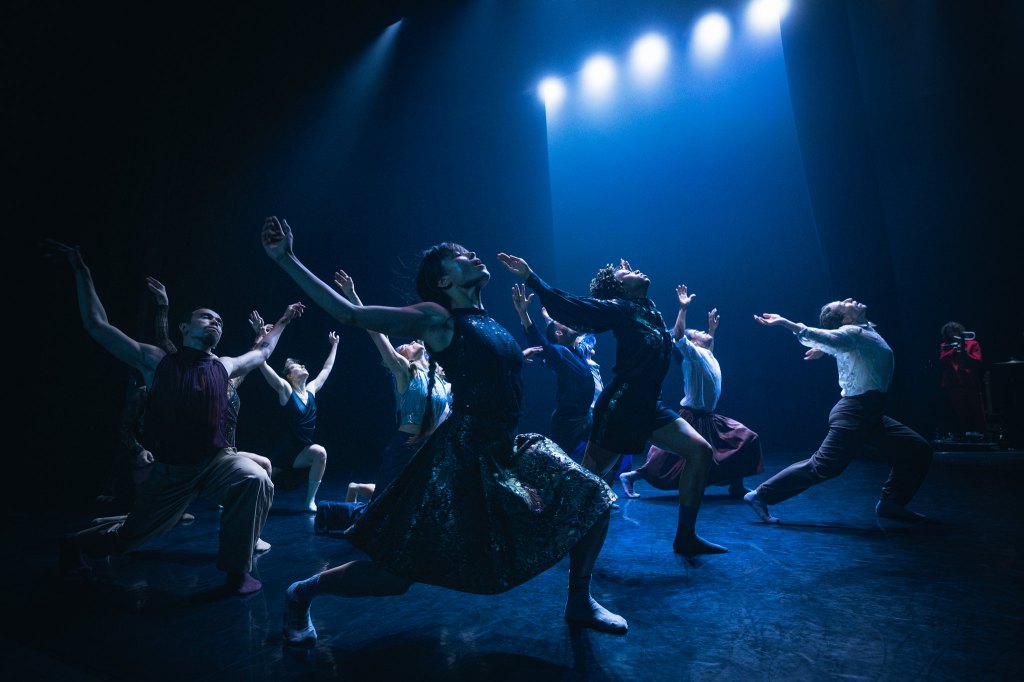
This Autumn, Lowry is hosting two of the hottest choreographers in the country: Matthew Bourne and Hofesh Shechter – who just so happen to be my two favourites, even though their styles could not be more different: where Bourne is elegant and glamorous, Shechter is eery and grotesque. Bourne challenged traditional ballet with his modern movements and gender reversals, whilst Shechter has challenged dance all together, shunning (traditional) beauty, or rather, redefining it. His latest work, Theatre of Dreams, seamlessly oscillates between dream and nightmare, drawing the audience into a visceral world where rhythm becomes emotion and chaos becomes art.
Theatre of Dreams is not narrative-driven; it’s an immersive, sensory experience that prioritises atmosphere over storyline. Rather than following a linear plot, it unfolds through shifting moods, abstract imagery, and powerful ensemble work. The choreography evokes emotion through repetition, rhythm, and tension, allowing the audience to interpret meaning for themselves. It’s less about telling a story and more about creating a world – one that feels both hauntingly familiar and disturbingly surreal (much like a dream). The piece pulses with raw energy, driven by Shechter’s signature use of pounding percussion and primal movement.
It begins with a single performer rising from the stalls. Immediately, the fourth wall is broken, and the audience is sucked into the show, which is a clever narrative device. Is this our collective dream?
The show has no set save for several curtains, which swiftly glide on and off stage, repeatedly revealing different dancers. There are lots of black outs, and each time, the dancers manage to get in the right position, not a foot out of step, in complete darkness. I think I briefly saw a dancer at the side of one curtain, which is not a big deal, but it felt a little disappointing because, until then, everything had been seamless.
The choreography ranges from solemn to lively and fun to aggressive. Dancers run on the spot, or across the stage, from something invisible – or just life. There is something zombie-like about Shechter’s choreography (especially in Clowns). The dancers often move as if caught between life and death, their bodies heavy, twitching, and driven by an unseen force. This physicality creates an unsettling sense of dehumanisation, as though they are part of a collective consciousness rather than individuals. The repetitive, trance-like movements and low, grounded posture give his work a primal, ritualistic quality, blurring the line between the living and the mechanical. It’s this tension — between vitality and decay, control and chaos — that makes Shechter’s style so hypnotic, unsettling and distinctive.
At one point, I started silently singing Michael Jackson’s ‘Thriller’. If anybody ever makes a musical about a zombie apocalypse, or a musical adaptation of a zombie movie, they better hire Shechter to choreograph!
On a few occasions, a band, dressed in bright red, appear, bringing vibrancy to the dark, disturbing piece. They play to the backdrop of Shechter’s trademark cinematic sound-score. On one occasion, they broke the fourth wall, forcing the audience to their feet, with dancers swarming the aisles to force the more timid people up. I knew that I would get picked on – I often do – and, indeed, a performer came right for me and dragged me into the aisles (I dragged my friend, Preyashi, with me too). It was not long until everyone was on their feet – not just clapping but dancing. I have never seen a show so successfully manage to get everybody moving and grooving. The energy was absolutely infectious, and everybody was bouncing off each other. This is how you do immersive theatre.
It then all came crashing down, with the band telling us to go back to our seats, and the show becoming even more dark than before. The immersive, joyful dance was such a surprise in such a dark, intense show, and whilst it felt jarring, it was a brilliant metaphor for the unpredictability and theatricality of life.
Unlike other choreographers, Shechter does not using preexisting music (like Bourne), nor does he hire musicians to compose a score. He composes his own soundtracks. This deeply enhances the cohesion of his work. The sound and movement feel inseparable — the pounding drums, distorted strings, and pulsing basslines seem to emerge from the dancers’ bodies themselves. Because the choreography and score are conceived together, there’s a perfect synchronicity between rhythm and motion, emotion and sound. This unity heightens the immersive quality of his performances, pulling the audience into a world where music doesn’t just accompany the dance – it drives it, possessing both the dancers and the space they inhabit.
Tom Viser’s lighting design is some of the best I have ever seen in a piece of dance theatre. He carves blocks of light that frame the action. His colour palette brilliantly reflects, and enhances, the action unfolding onstage. Osnar Kelner’s costumes are slick and sexy, with the disco-inspired outfits dazzling the eyes, especially when Visser’s bright lights hit the sequins.
Theatre of Dreams evolves over the course of 90 minutes; even if you are unfamiliar with Shechter, you quickly learn to expect the unexpected. At one point, there is a topless woman, shortly followed by a fully nude man, with another naked man appearing towards the end of the show. Aside from the unserious girls behind us, nobody laughed at the nudity; it was awkward, sure, but we were all so absorbed in the action.
Theatre of Dreams is a hauntingly beautiful, visceral experience, where music and movement collide to create a world that’s as hypnotic as it is unsettling.
One might not expect somebody’s favourite choreographers to be Bourne and Shechter. In contrast to Bourne’s polished storytelling and theatrical flair, Shechter’s choreography feels instinctive and almost anarchic, as if each dancer is fighting to break free from invisible constraints. But together, they represent two poles of contemporary dance: Bourne, with his reimagined narratives and cinematic precision, and Shechter, with his uncompromising exploration of human intensity and collective unrest.
Theatre of Dreams tours the world until December 18.
Photo: Todd MacDonald

 JADAR
JADAR 