★★★★★
Marie Antoinette is best-remembered for an arrogant or ignorant phrase she never actually uttered: “Let them eat cake.” While she certainly warrants scrutiny, it’s striking that she attracted – and continues to attract – more criticism than her husband, the Monarch. Like many women in history, she was subjected to misogyny not only in life but also in death. Marie Antoinette Style at the V&A is less a defence of the ill-fated Queen than a thoughtful exploration that seeks not to reduce her to her clothing but to examine the politics of her wardrobe, its cultural resonance, and its enduring influence. In a bitter irony, the Queen’s opulence both sealed her fate and secured her immortality.
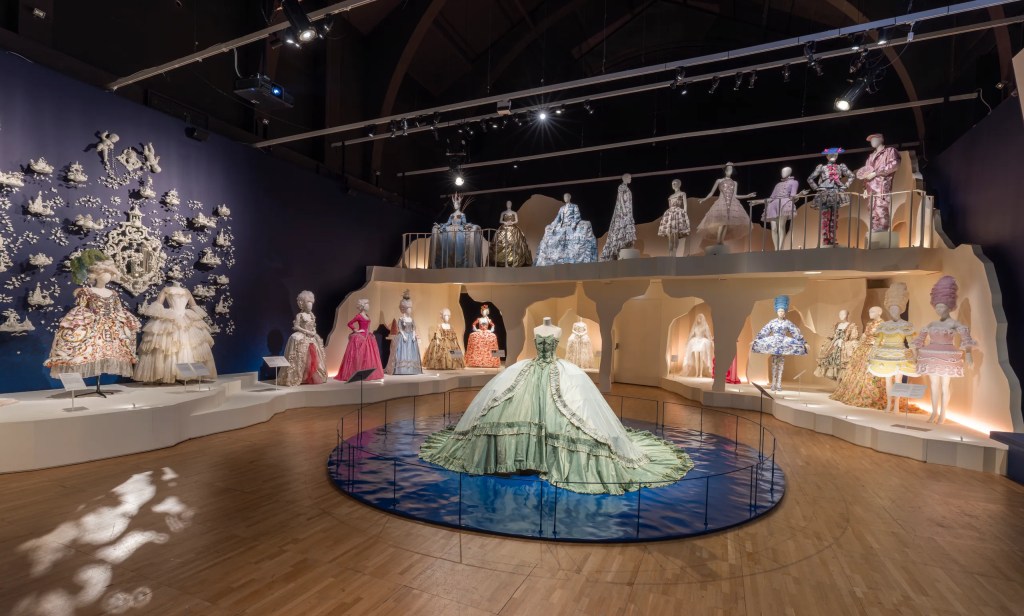
The exhibition, which is made up of over 250 items, feels like a dreamscape, with floating chandeliers and infinite ribbons. We are transported into the fantastical world of Marie Antoinette, an arrogant, deluded woman. It is unclear, however, if her style was a distraction or a form of power. Perhaps it was both frivolous and political.
The exhibition is mostly a sympathetic portrayal of the controversial Queen, painting her as a revolutionary for fashion and a victim of misogyny. It is easy to understand how somebody marrying into Royalty aged just 14 could get caught up in all the glamour – but this exhibition strips back the artifice to reveal the woman underneath. This is difficult, however, because everything Antoinette did was carefully constructed.
The piano soundtrack is unsatisfactory for such a grand exhibition. Perhaps they should have used music from the period for the first few sections and modern songs inspired by, or associated with, Marie Antoinette (e.g. Madonna’s ‘Vogue’ and Marina and the Diamonds’ ‘Primadonna Girl’) for the contemporary collection.
The exhibition begins with items belonging to Marie Antoinette and her contemporaries. We are shown not only clothes but also objects, such as chairs and cabinets, for style goes beyond clothes. Most of the items are remarkably well-preserved.
Fashion changes dramatically over the years, as suggested by the contemporary phrase, “So last year.” Just a few years ago, skin-tight jeans were sexy, but now they’re considered unattractive; the looser, the better. Marie Antoinette Style shows us that this is not a modern phenomenon: the style of Marie Antoinette, the epitome of fashion, changed noticeably over the years, right down (or up) to her shrinking hairstyles in the late 1700s.
As the title suggests, this is an exhibition about the style of Marie Antoinette, not the woman herself. There could be more of an historical outline for people unfamiliar with the history (or the Sofia Coppola film) to place the pieces. However, the exhibition makes references to Antoinette’s background and scandals, and how they interacted with her fashion. It also gets into the politics of style. In the 18th century, it was stylish for upper-class women to breastfeed their own children, rather than employ a wetnurse. The exhibition features Antoinette’s “breast cup”, which is rumoured to have been personally modelled by her. Revolutionaries, of course, dismissed this as unnatural and consumerist, but if you were rich, would you not also make the most of such comforts?
We also see how the revolution shaped and changed fashion, such as bringing an end to fripperies. Antoinette’s style shifted from opulent and extravagant court fashion to simpler, more modest attire as a way to adapt to her changing circumstances. She began to wear less restrictive styles and simpler fabrics, like cotton and linen, which mirrored the revolutionary ideals of simplicity and a break from the monarchy’s perceived decadence. Her changing style reflects how fashion was used as a political statement during the French Revolution. The extravagant styles Antoinette once championed became a symbol of the old regime’s excess, and her simpler dresses became a sign of her downfall rather than her adaptation – which was not enough to save her from the guillotine.
The next section is about the afterlife of Antoinette, when her cult was revived by the Empress Eugénie, who was a great admirer of the late Queen, who died 33 years before her birth. Eugénie collected Antoinette’s belongings, restored her former residences, like the Petit Trianon, and even dressed up as her for historical portraits and events. By inhabiting Antoinette’s former homes and collecting her belongings, Eugénie not only created a legendary image of the former queen but also sought to connect with her personally. Both were foreign-born women who became queens of France and faced criticism from the French people. Eugénie was blamed for the fiasco of the French intervention in Mexico and the eventual death of Emperor Maximilian I of Mexico. The exhibition could have paralleled the Queens better, but it chose rather to focus on the older Queen.
The exhibition ends by exploring the third life of Marie Antoinette through modern interpretations of her style, with a dazzling collection of contemporary costumes, some more recognisable than others. Some are recreations of her signature style, others are more subtle in their references, and there are even cake dresses! It could have benefitted from a few more Drag Race looks – and more commentary on her contemporary relationship with the Queer community: there are rumours that Antoinette was, herself, Queer (though these were arguably just salacious rumours), and her story has been used to explore themes of female power, excess, and rebellion against rigid social structures.
Before the contemporary section on Antoinette’s afterlife, visitors are abruptly taken to her death. A dark room houses items such as the last note she wrote before she died; a locket containing hair belonging to her and her younger son; the chemise (shift) she wore in prison; and, allegedly, the guillotine blade that beheaded her. There are also photographs of her death mask.
It’s a stark contrast to the celebratory, glamorous rooms surrounding it. It feels jarring, and deliberately disjointed, in that it reminds us that she was more than just a fashion icon, but a real person, and a mother, who was murdered. Whilst she has been vilified for centuries, this section humanises her, especially as a mother.
There is, perhaps, a bit of a failure to properly contextualise why the starving peasants of France despised her, and whilst one could defend that by stating that this is an exhibition about her as a style icon, not necessarily her as an historical figure, fashion is undeniably political – and fashion is partially responsible for costing Antoinette her head.
Today, Marie Antoinette feels more relevant than ever. The rich grow ever richer while the poor struggle to afford even basic groceries. In the United States, a reverse Robin Hood bill has redirected wealth from ordinary citizens to billionaires through massive tax cuts. Not long after millions joined the “No Kings” protest, Donald Trump began construction on a lavish ballroom, paid for by billionaires; was gifted a gleaming gold crown by South Korea; and hosted a Great Gatsby-themed Halloween ball, the irony entirely lost on his glittering, self-satisfied guests.
Marie Antoinette may never have uttered the words “Let them eat cake,” yet history has ensured she embodies the phrase in all its irony. She reminds us that you cannot have your cake and eat it – particularly when your confection is built on a crumbling empire.
Marie Antoinette Style runs at V&A South Kensington until March 22.
Photo: Peter Kelleher
 JADAR
JADAR 