★★★★★
Opera North’s new season at the Lowry opened with a La bohème that feels both lovingly familiar and delightfully alive. As someone who has seen the opera many times (this was my fifth), I wasn’t expecting to be surprised. But this performance had a spark: a combination of musical finesse, charismatic acting, and visual imagination that lifted the familiar into the unforgettable.
A small historical gem puts the evening into charming context. Though one might assume that La bohème reached Britain through London, its UK premiere actually happened right here in Manchester in 1897. Accordingly, there was something fitting, even poetic, about watching Puccini’s young lovers return to the city that first embraced them.
Although the story originates in Belle Époque Paris, Phyllida Lloyd’s long-loved production relocates it to the late 1950s: a world of smoky cafés, post-war artistic hunger, and the stylish grit of Left Bank bohemia. This shift frames the characters not as distant romantic archetypes but as recognisably modern creatives trying to live on passion, talent, and fumes. Their stories would later inspire everything from the Broadway musical Rent (1994) to the explosive emotional palette of Moulin Rouge! (2001).
Musically, Puccini’s gift for melody remains astonishing. He shapes emotions with an immediacy that feels almost conversational, while the score glows with delicate instrumental colours. His long collaboration with the librettists distilled Henry Murger’s episodic bohemian tales into a sequence of vivid human snapshots. The result is one of opera’s most direct emotional experiences: intimate, youthful, and heartfelt.
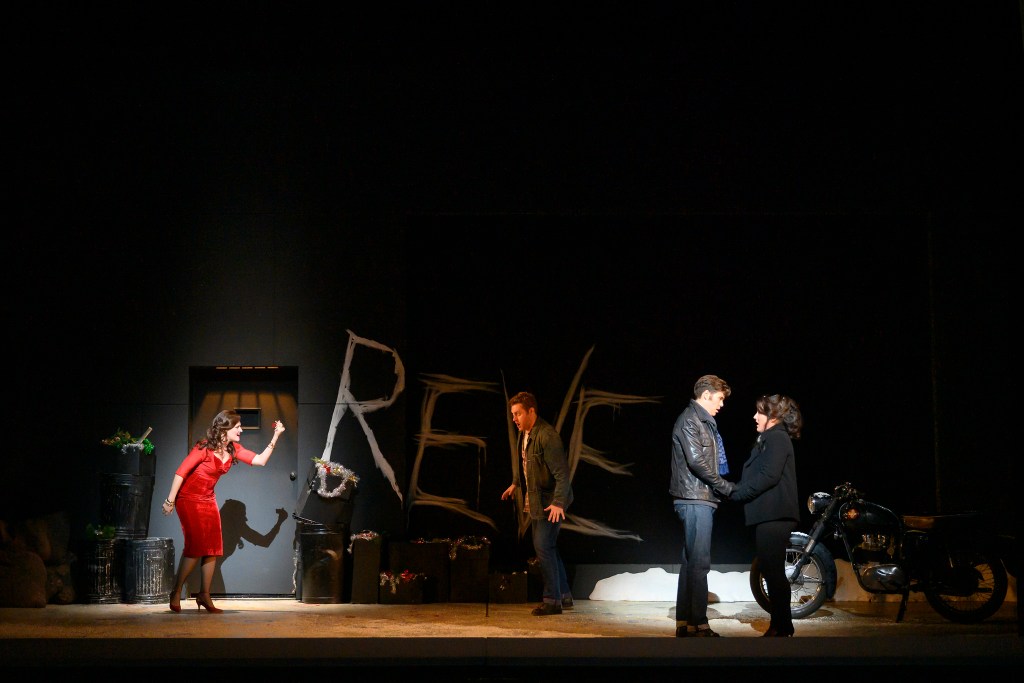
The production’s visual world is anchored by one striking device: certain scenes unfold within enormous white frames, as if moments from the bohemians’ lives were being captured like instant photographs. Not every act uses this device, and its selective appearance prevents it from becoming a gimmick; instead, it sharpens specific memories into pictorial clarity. The garret itself is a glorious riot—splashed with colour, clutter, canvases, and objects that look borrowed, scavenged, or created on a whim. Bold reds punctuate the palette, signalling the heat of love, frustration, and artistic temperament.
One of the most brilliant touches came in the club scene: the doorway to the venue is a deep, black frame illuminated from above with a dark orange glow. The light spreads outward in such a way that the whole threshold resembles a coffin lying upright. It’s a striking piece of silent foreshadowing: ominous, subtle, and truly a touch of genius.
But there were smaller moments of wonder, too. For instance, in the café/club scene, the black wall that occasionally opened up fully while other times revealing only slivers of the bustling interior; in the bohemians’ home, the unexpected and, frankly, hilarious Warhol-style portraits of Musetta; in another act, a gigantic wall painting dominating the background with unapologetic grandeur. Even the stove radiates warm orange light, casting huge, expressive shadows on the wall and serving as proof that no corner of the set is without intention.
And then, that duet: as Mimi and Rodolfo confess their feelings, the entire backdrop dissolves into darkness and an enormous moon rises behind them. The simplicity of the image—as well as its sheer scale—makes the moment feel suspended in time, like a single frame of pure romance.
Costumes flourish in late-1950s character, creating a world that feels effortlessly bohemian. Mimi’s look nods to the iconic Vali Myers, while Musetta bursts into the café scene in a spectacular leopard-print coat that announces her long before she opens her mouth. Leather jackets, lumberjack shirts, berets, and even a touch of Marilyn Monroe-style drag complete the picture: a truly bohemian, eclectic mix that captures the production’s artistic vision.
The performances were remarkable across the board, each singer bringing a different shade of truth to Puccini’s score. Anthony Ciaramitaro’s Rodolfo sang with youthful ardour, his upper register bright but never forced, while Olivia Boen’s Mimi was the emotional linchpin of the night. Her portrayal—both vocally luminous and acted with delicate vulnerability—brought tears to my eyes more than once. Yuriy Yurchuk offered a wonderfully grounded Marcello: warm, witty, and vocally assured. Seán Boylan’s Schaunard added a spark of mischief, and Kamil Bien brought delightful colour as Parpignol. Jeremy Peaker, meanwhile, made an unexpectedly memorable impression as Benoît, the landlord, with his comic timing.
But Katie Bird’s Musetta deserves a paragraph of her own. She swept onto the stage in full diva mode, a whirlwind of comic bravado, irresistible charm, and fearless theatricality (making everyone laugh). Her voice gleamed, her gestures were joyously overstated, and her presence electrified every ensemble she touched. She was, quite simply, magnetic.
All of this unfolded under the assured musical direction of Garry Walker, whose pacing felt natural and breathing, never rushing the opera’s tenderness nor losing momentum in its more chaotic moments.
The Opera North Chorus, prepared with precision and vitality by Anthony Kraus, sang with exceptional clarity and energy, especially in the bustling Act II.
This Bohème reaches younger audiences not by simplifying the opera, but by presenting it with confidence, style, and emotional clarity. It respects the opera’s heart while reframing it in a way that feels resonant, modern, and genuinely exciting. If this is the energy Opera North is bringing into the next seasons, then Mozart’s The Marriage of Figaro in spring 2026 cannot come soon enough!
P.S.: Opera North’s physical programme deserves mention for its exceptional clarity and quality. It contextualises the production with intelligence and flair, even including a delightful exploration of how Paris became synonymous with romance through opera and other art forms.
Opera North’s La bohème runs at Lowry (Lyric Theatre) until November 14 and tours the UK until November 22.
Photo: Richard H Smith
 JADAR
JADAR 