★★★☆☆
Despite the treacherous weather from Storm Claudia and horrific stand-still traffic, Lowry was packed to the nines once again, this time uniting its audience for Handel’s classical oratorio, reimagined by Opera North. The biblical tale of ‘Susanna and The Elders’ originates from the Old Testament’s Book of Daniel, inspiring numerous paintings, poems, and compositions, from Gentileschi and Rembrandt to Picasso and Floyd (the latter creating a 20th century operatic retelling in 1955).
First performed in 1749, Handel’s three-act oratorio is Opera North’s latest revival, reimagining the harrowing tale of Susanna with a rather bold and artistic twist. In their fourth collaboration with Phoenix Dance Theatre, this performance offers a promising premise, blending an antiquated score and tale with lively contemporary dance, captioning, and sign language elements.
The plot follows Susanna (Anna Dennis), whose recent marriage to Joacim (James Hall) is sullied by two lustful village elders (Colin Judson and Karl Huml). When Joacim travels on a business trip, the men rape Susanna before accusing her of adultery, putting her on trial to face their false allegations. Will Joacim return on time to save his wife? Will the stranger Daniel (Claire Lees) be able to prove her innocence? Will Susanna be spared from injustice?
Being an older Biblical story, Susanna grounds itself in a world of misogynistic world views and sometimes preachy storytelling. Susanna is a powerless woman, whose value is solely pinned to her husband and her chastity; her agency and voice are constantly undercut by the men around her, and when she is freed, it’s her purity we celebrate rather than justice. Susanna does get a moment of catharsis where she toys with her tormenters, but there’s little thought given to the lasting trauma her character has been through.
Additionally, the story is fairly simplistic, meandering in repeated poetic verses and flourishes. While occasional repetition would have been enchanting (especially with the singers’ mesmerisingly sustained trembling notes), they often needlessly stalled the action. For instance, the show’s first half is a whole hour and a half, culminating in a wedding and a symbolic allusion to Susanna’s rape.
Of course, these issues stem from the source material, and aren’t a surprise in older operas, providing an interesting peak into an older society, their worldviews, and their musical stylings. However, I was left wishing for a bolder adaptation, punchier and more concise, perhaps delving further into Susanna’s turmoil, the insidiousness of corruption (an apt topic today), or even a reclamation of agency in what is otherwise a fairly modern adaptation with sleek business suits, baths (instead of a brook), and contemporary dance. Indeed, Susanna feels a little at odds with itself, focusing on past and present but never truly choosing one for a concrete creative vision.
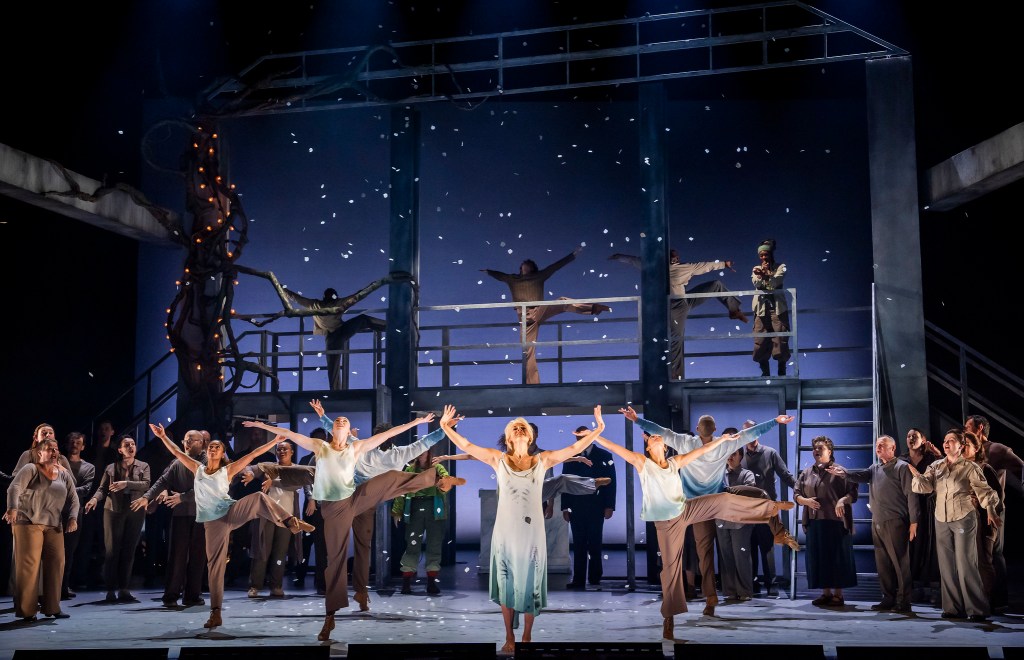
Despite these ambiguities and pacing problems, Susanna boasts many strong creative elements. Zahra Mansouri’s set design is interesting, bringing in a metallic platform, combined with snaking tree branches in another combination; old and new, nature and man. While the main set is static, an array of translucent sheets are constantly repositioned around the set, as physical barriers preventing escape, and metaphorical veils between dancer and singer, gorgeously evocative and artistic.
Equally, there’s memorable symbolism in Susanna’s luxurious white bath-suds and draping robes, later besmirched by dark petals and grubby hand-prints.
Choreographer Marcus Jarrell Willis and the ensemble from Phoenix Dance Theatre create a visual spectacle, enrapturing audiences with expressive interpretive dances that capture every emotion and flittering note as they parallel the singers. They enrich each scene with supple movements, while the singers perform with equally astounding vocal agility.
Anna Dennis (Susanna) particularly shines in the piece, showcasing her angelic voice and decorating each number with stunning versatility. Her performance effortlessly echoes the highs of love and the desperation of injustice. Additionally, the ensemble numbers were awe-inspiring with exquisite harmonies and intricate interweaving melodies.
The show also integrated BSL, with Tianah Hodding acting as an observer to the conspiracies against Susanna, trying to prove her innocence but constantly ignored by the villagers. It’s one of the most creative uses of sign language I’ve seen to date, with Hodding’s character effectively mirroring Susanna, with both figures being ignored and silenced by authority. My only wish is that these moments were spotlighted better in the busier scenes and perhaps a little more frequent.
Opera North’s Susanna is simply brimming with potential. Their collaborations showcase the art of storytelling and movement, simultaneously interweaving them with incredible operatic performers. Its creative approach makes it one of the most unique and inclusive operas I’ve seen to date, and I only hope this trend of innovation continues in Opera North’s future. With a slightly shortened score and an edited story, Susanna could be an impactful trailblazer. As it is, Susanna is ambitious but just can’t seem to strike the right balance between its creative endeavours and older source material.
Opera North’s Susanna plays at Theatre Royal Nottingham on November 21 – the last stop of its UK tour.
Photo: ©Tristram Kenton
 JADAR
JADAR 