★★★★☆
The Sleeping Beauty remains one of pop culture’s most famous fairytales, adapted numerous times with multiple movies, retellings, pantos and plays drawn from the over 700-year-old tale. Its ballet adaptation is equally rich in history, first premiering in 1890 with music produced by the legendary Pyotr Ilyich Tchaikovsky in collaboration with choreographer Marius Petipa.
Fans of the Disney film will have a few things to unlearn for the ballet with the evil Maleficent adjacent villain instead being Carabosse, and the trio of good fairies being embodied by the Lilac fairy.
Regardless, the ballet’s story is fairly similar to the beloved modern classic. After celebrating the birth of their beloved daughter, the King (Fabian Reimair) and Queen (Laura Hussey) are left distraught when the cruel Carabosse (James Streeter) curses the babe. Empathising with the child, the Lilac Fairy (Anri Sugiura) introduces a clause… true love’s kiss will save Aurora (Emma Hawes) from her eternal slumber.
With a short scene change, 16 years have passed, and Aurora’s fate is drawing near, instigating the crowns’ search for potential suitors, dramatically foiled by Carabosse’s trickery as she falls into a deep slumber. Seeing this, the Lilac Fairy puts the rest of the kingdom to sleep, awaiting the salvation of their princess. Will Prince Désiré (Aitor Arrieta) be the one to break the curse?
The Sleeping Beauty by English National Ballet is truly a visual feast, every routine, costume or set piece meticulously crafted and perfectly blending into one cohesive creative extravaganza.
Kenneth MacMillan’s choreography draws heavy inspiration from the original production, re-instituted known routines and creating new pieces to bridge the gaps. His choreography is exquisite with flittering footwork, poised pounces, graceful gestures, jaw-dropping jetés, and astoundingly-held arabesques.
The ensemble’s fluidity is a sight to behold, oscillating between impactful adagios and fast-paced acrobatics and creating bold, flowing arm lines and body shapes.
My favourite number was the high-octane ‘vision’ sequence, performing enormous, fast-paced group numbers, sometimes gently encircling Aurora, others spilling in separated lines to fill every cranny of the stage. It was a faultless routine!
The garland waltz was another engaging number, with bobbing floral arches intricately combined to create new patterns and unique shapes as the dancers intermingled.
Emma Hawes in particular performs some incredibly sophisticated routines as Aurora, first filled with liveliness and excitability, before becoming more mature, moving into ethereality and undercut by a stern yearning passion in the ‘vision’ dance. Hawes emotional depth, effortless serenity, and flexible physique were top-class, especially when paired with Arrieta’s tenderness and impressively regal-looking acrobatic displays.
Sugiura’s Lilac Fairy was another stand-out, emitting effortless elegance in her routines and gentle miming while neatly contrasting the heavy-handed and darkly dressed Carabosse.
Like Birmingham Royal Ballet’s The Sleeping Beauty, the choreography feels perfectly in-tune with the stirring and iconic Tchaikovsky score and its fascinating motifs. Performed by a giant orchestra, each song is filled with unique personality from soft chimes and enchanting harps to menacing strings and percussive blasts.
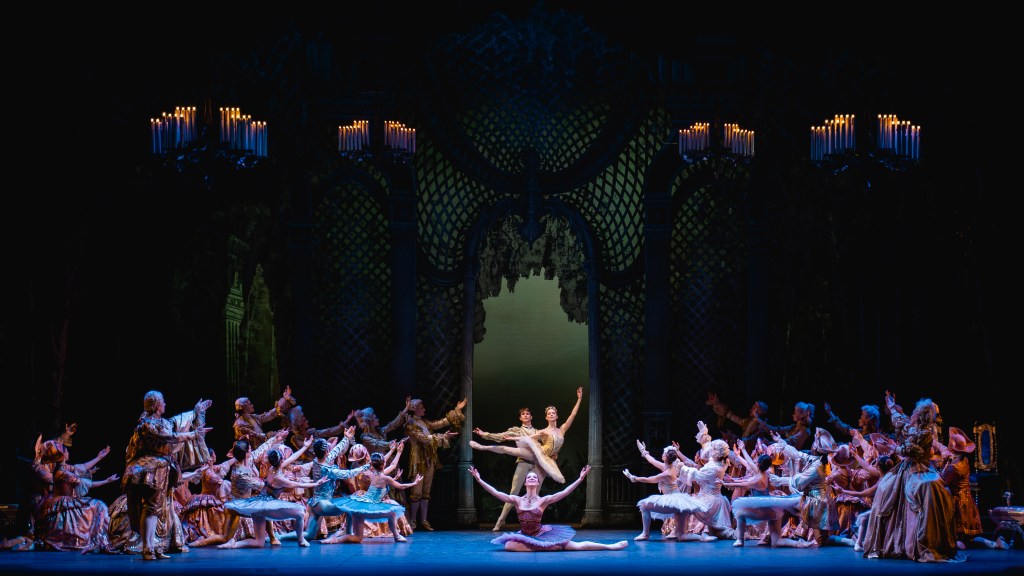
Peter Farmer’s set designs are expansive, moody masterpieces, first opening on an elaborate trellised garden arch with foliage shrouds, candelabras, and a floral centrepiece in the castle grounds. The next change transports us to the village with rustic watercoloured yellow hues, shadowy branching greenery before the dense forest set arrives, thin tree adorned curtains and a lagoon of fog engulfing the prince before a magically executed sparkly boat ride.
Last but not least, the palace is set with its gorgeous dome interior, raggedy wind-blown curtains and a golden beam of light. Each set feels straight from a storybook with its aged watercolours and sprawling environments.
Nicholas Georgladis’ costume designs are equally breathtaking, fuelled by sumptuous historical designs. In the first celebration, fairy attendants are decorated in warm pastel tutus (very Barbie-esque!), complimenting to royal family adorned in their decadent golden fabrics, ornately patterned layers, sprawling sleeves, frilled collars, and flamboyant hats. Aurora first appears in a perky pink tutu, accented with gold her costume bursting with the same innocent excitement. After the curse her dresses lean into mature tones with pure whites and regal golds, each dress as lavish as the last and finalised with large dazzling jewellery statement pieces.
By Act Two, the court’s fashion has changed with stupendous white wigs, feathered tricorn hats and humongous court gowns. Aurora’s lengthy slumber is craftily reflected by this textile transformation, the renaissance-inspired regalia transforming into the Georgian era visually transporting audiences between the 17th and 18th centuries. Carabosse remains unaffected by these norms, heavily inspired by Queen Elizabeth I with an enormous, ruffed collar, her signature red hair, high hairline, and a ghoulishly pale face.
In a unique departure, this Carabosse feels more whimsical than terrifying, creating an almost parodic feeling to the character as she cackles hysterically, hissing menacingly and bouncing to-and-fro with her monstrous henchmen- an intense performance by Streeter. While some political parodies feel a little clunky or tongue in cheek, this one is rather amusing, albeit a little misogynistic in its demonisation of powerful historical women.
Unfortunately, The Sleeping Beauty’s main drawback is always its length. In my review of BRB’s production, I noted how monotonous and repetitive the wedding sequence can feel, and history has repeated itself again. While long routines like these are a staple in traditional ballet, I feel that these need to be toned down a little to fully engage with modern audiences. Each sequence is admittedly gorgeous, but really drags the action to a halt, instigating a few tired murmurs and sighs from nearby audience members.
Despite this, both English National and Birmingham Royal consistently prove why they are top of their field, their inventive and contrasting creative visions proving the flexibility of tradition ballet.
ENB’s The Sleeping Beauty is an unbeatable night of ballet entertainment, a timeless tale of love and evil brought to life by a striking score, an array of visionary creatives, and an ensemble of first-rate performers. It’s completely accessible for newcomers, while maintaining the sophistication and timelessness of classical ballet. You could say it was toe-tally tutu-riffic!
Sir Kenneth MacMillan’s The Sleeping Beauty runs at Palace Theatre Manchester until November until November 22 before transferring to Mayflower Theatre, Southampton from November 26 to 29 2025 – the last stop of its 2025 UK tour. It then plays at Royal Albert Hall, London from June 25 to 28 2026.
Photo: Emily Nuttall
 JADAR
JADAR 