
★★★★☆
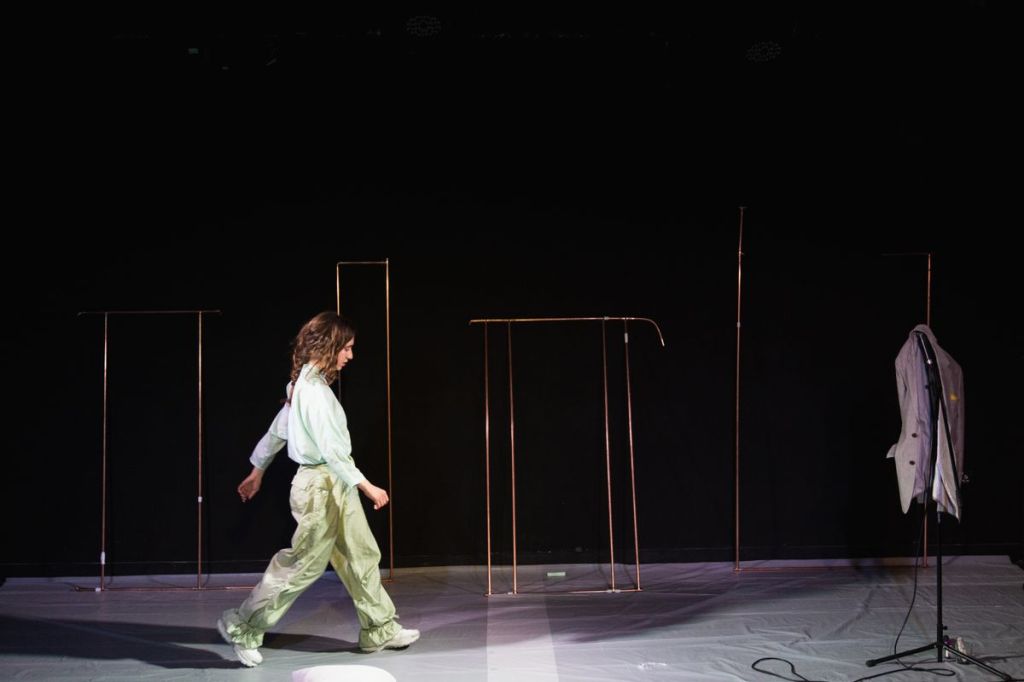
In this intimate four-actor production of a play written by Manchester-based Italian writer Giulia Fincato and staged at The King’s Arms, The Thing with Feathers opens with a question that lingers over every scene: what remains after everything ends? At first, the answer seems to be “hope” – the thing that is left “after the last cloud, the last bird.” But as the story deepens, it becomes clear that hope is only the first layer. What truly survives is love.
The plot follows two long-time partners, Sue (Michaela Short) and Emily (Fiona Scott), living out the final stretch of their lives in a house that has become their nest. Time slips past almost unnoticed; only in sincere, intimate conversations do they acknowledge that everything beyond their walls — the tree outside, the people in the village, their careers — is quietly falling apart and converging toward an end.
The story unfolds across two perspectives: the present state of the world, and memories of the past, when they were young, ambitious, frightened, yet eager to reshape their lives. We see young Susie (Tsen Day-Beaver) and Em (Neve Kelman) buying the house, creating their nest, and supporting one another’s decisions and bold plans.
As the play moves forward and their world drifts toward ruin, Sue and Emily are left with a suspended, unanswered question: what happens to us now?
What makes this portrayal especially striking is that the story is carried entirely by women. This choice subtly reshapes the emotional texture: it softens the edges, shifts the perspective, and infuses the final moments with a gentler, more resonant weight. The intimacy of the small theatre amplifies all of this. With the performers only steps away, the audience doesn’t merely watch — they absorb the piece. You feel the energy moving across the room; you see the tremor in a hand when anger rises, the slight shake of excitement, the breath caught before a difficult truth. This proximity transforms the story into something lived rather than observed, making their fragile world unfold almost within arm’s reach.
The title inevitably calls to mind Emily Dickinson’s poem ‘Hope’ is the thing with feathers, where hope is imagined as a bird that endures every storm without complaint. The play begins in that spirit, echoing the poem’s promise of endurance. Yet as it progresses, it quietly revises this idea. When the tempest has passed and little remains, it isn’t hope that continues to sing — it is love. The play honours the poem’s imagery but ultimately shifts its conclusion: after everything collapses, what binds the characters and still matters most is the love and care they carry for one another.
In the end, the world of the play may fall apart — “pretty much completely” — but Sue’s happiness comes from knowing they are together. And that simple truth clarifies everything the story has been moving toward.
Photo: Tilly Wigley

 JADAR
JADAR 