★★★★☆
Whether it be the original C.S. Lewis novel (1950), the 10-part series (1967), the BBC show (1988), one of many theatrical productions, or the beloved movie (2005), generations of adults and children alike have experienced the magic of Narnia. Celebrating the 75th anniversary of the novel, The Lion, The Witch and The Wardrobe has finally reached the Lowry in the last leg of its second UK tour, after playing pandemic-disrupted performances there during Christmas 2021.
This production, created by Sally Cookson and written by Adam Peck, was first performed at Leeds Playhouse in 2017, later touring in 2021, battling numerous problems and ploughing through understudies in a rough season during the pandemic, including festive season in 2012. Now it’s back and bigger than ever, ready to captivate audiences with its wonderous whimsical wintery world.
The story follows siblings Lucy (Kudzai Mangombe), Susan (Joanna Adaran), Edmund (Bunmi Osadolor) and Peter (Jesse Dunbar) evacuating to Scotland to escape the atrocities of World War 2. After discovering a magical world inside a wardrobe and meeting the peculiar faun Mr. Tumnus (Alfie Richards), they are soon thrust into the centre of another war spearheaded by Narnia’s tyrannical White Witch (Katy Stephens) and her eternal winter. Aided by the bubbly Mr. and Mrs. Beaver (Ed Thorpe & Anya De Villiers) they are led to legendary Aslan (Stanton Wright), who aids their quest to restore balance in Narnia.
Alike Leeds Playhouse’s A Christmas Carol, LWW sits in the realm between musical and play, composers Barnaby Race and Benji Bower introducing an array of folksy orchestration played by the talented cast of multi-rolling actor-musicians. Each song, whether melancholic or upbeat, is marked by a sense of hope as characters dream of peace and freedom. It’s a stirring score through and through, particularly excelling in its sumptuous full-ensemble harmonies such as its heart-warming rendition of Vera Lynn’s ‘We’ll Meet Again’ and in a multitude of seamless scene-transitions, suitcase-holding silhouettes darting through time displacements, wardrobe doors hurtling through space, and musicians whirring about the stage.
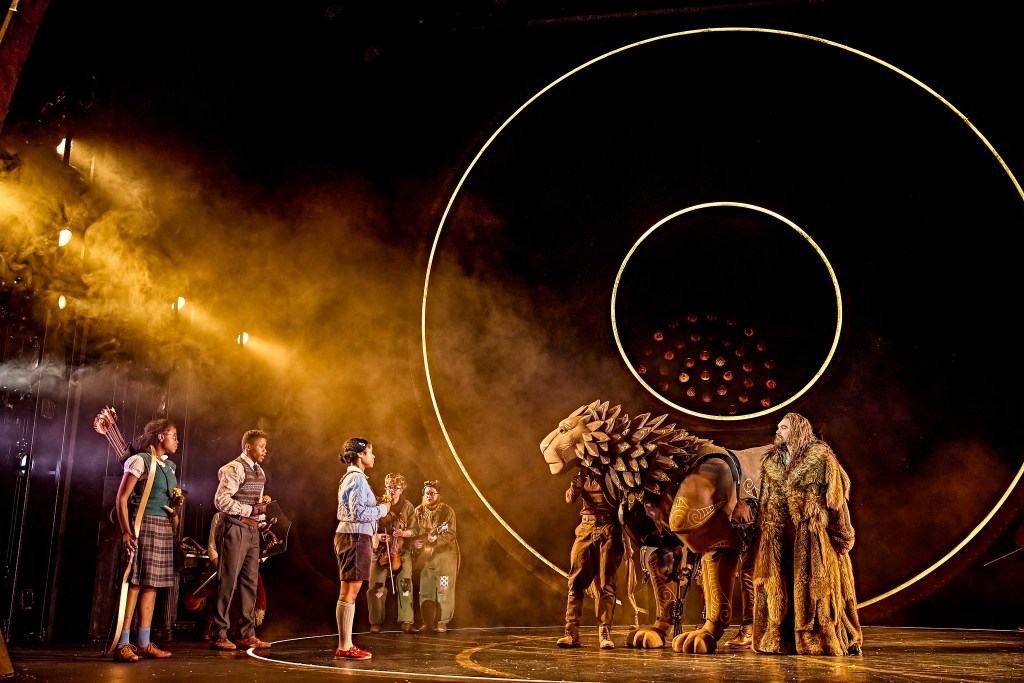
Tom Paris’ sets are thoughtful and detailed with a clock overlay that vanishes as the children enter Narnia, revealing three light-up circle platforms within the stage’s main circular frame. Captivating train puppetry transports us to Scotland with the gentle professor and his scraggly cat Schrödinger (puppeteer Andrew Davison). Decorating the mansion are piles of books, “ugly” ancient busts, a sprawling dining room table, and the titular Narnian wardrobe. Inside, Lucy is greeted by gentle snowfall, rising lampposts, and various figures dressed in white with parasols and glowing orbs.
Paris’ stylised costume designs are equally enchanting, interweaving war-time fashion, soldier uniforms, old brick-a-brack, and retro patterns with the eccentric furry features of Narnia’s creatures. Racket tails, crutches, pilot goggles, tin helmets, khaki hues, horn-adorned caps and bunny-eared berets all assemble to create a mishmash of quirky critters uniquely grounded in the reality of the parallel world’s ongoing war.
In contrast, the White Witch is seen in extravagant fur-coat and elongated icicle crown, both of which degrade, her crown melting and her costume tarnishing in her descent. Accompanied by a biker-helmeted dog pack and hoisted by a wheelable crane, she towers menacingly above her subjects, performing various magical tricks and illusions directed by Chris Fisher (of Cursed Child fame). Stephens’ pretentious warmth is foiled by evil glares, creepy grimaces and startlingly brutal moments of cruelty – a ravishing depiction of the bewitching snow queen. After Edmund’s own ‘Pink Elephants on Parade’ vision with the giant Turkish delight man, and an appearance from the menacing deep-voiced Maugrim (Shane Antony-Whiteley), Stephens’ reaches her crowning glory in a spine-tingling summoning song. Rising in the air, her glamorous fur-coat train replaced with throngs of fabric envelops the stage, shrouding the entering beasts and entrapping Edmund in a spooky pre-interval extravaganza.
The attention to detail is especially noticeable in the White Witch’s costume, with her ice crown, which starts off outlandishly oversized, melting as the show goes on, ending as a few little spikes.
This first act’s engrossing ingenuity is followed up by the incredible ‘The Lion Walks’ number as the Christ-like Aslan makes his big entrance. A phoenix flies overhead as the creatures gather in awe, spectating the dazzlingly lit Aslan; Max Humphries’ three-person operated puppet joined by a human representation. Stanton Wright’s deep majestic voice, flowing locks, dense fur-coat, and fierce stride are striking when paired alongside the immense wooden puppet counterpart. The puppetry particularly shines in the resurrection scene where Lucy and Susan soar above the galloping Aslan, moving with stunning fluidity. The show’s creatures and puppets never fully embrace animal physicalities like their feline competitors The Lion King, but LWW makes up for this with fun costuming and heaps of personality.
The first act is a taste of pure magic, carefully crafting each fibre of Narnia with steady action and hearty emotional beats. However, act two unfortunately suffers from a multitude of pacing issues, racing through the plot with clunky fights and rushed interactions that particularly undermining the gravitas of deaths and victories. Aslan’s death is a little too fleeting, as is the underwhelming defeat of the Witch, merely disappearing as the puppet pounces after a brief battle with the children. The villain’s looming presence snuffed out in an instant.
Regardless, the show is a mystical marvel with elaborate costuming, stunning sets, thrilling score and illusion work sure to leave the little ones in awe. At its core is a prevailing message of hope, community and love that couldn’t be more fitting for the Christmas season (that and Santa’s appearance with his dancing reindeer).
The Lion, The Witch and The Wardrobe runs at Lowry (Lyric Theatre) until January 11.
Photo: Brinkhoff-Moegenburg
 JADAR
JADAR 