★★★☆☆
Robin Hood, presented by Crossroads Pantomimes and directed by Jonathan Kiley, embraces playful, chaotic energy, with Jason Manford and Ben Nickless at the heart of the production. While the show leans heavily on their double act rather than a traditional pantomime structure, their chemistry is utterly delightful and makes for a thoroughly entertaining evening.
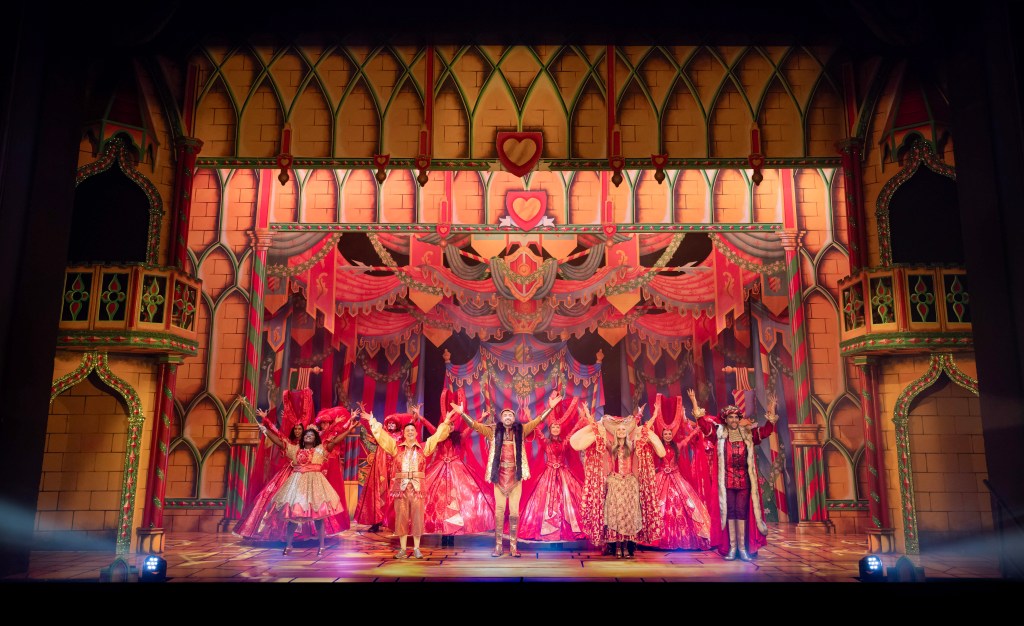
The Opera House stage is lined with hand-painted sets, with “Robin Hood” written in the stars (lights programmed by Philip Burke), transporting us right into the Sherwood Forest. This nod to traditional pantomime feels particularly charming in an age of projection-heavy design, especially in large-scale commercial shows such as this one.
Jason Manford’s Robin Hood is charismatic with pipes to boast, sneaking in cheeky jokes wherever he can between his good-guy heroics. He also finds time to plug his upcoming Sky film early on – a slightly clichéd move that pulls focus.
Ben Nickless, as Willy, delivers pun after pun with absolute precision. He relishes the classic one-liners and reliably secures the biggest laughs of the night. As the central comic relief, much of the humour rests on his shoulders – and he carries it comfortably.
Robin Hood’s supporting characters – Maid Marion (Sarah Vaughan, who played Cinderella in last year’s Manchester panto), the Spirit of Sherwood (Landi Oshinowo), and the Sheriff of Nottingham (Adam Strong) – are largely upstaged by Hood and Willy. With limited material to work with, they feel confined within the pared-back pantomime world of this stripped-back Robin Hood. It was disappointing that the two female characters weren’t given many jokes to play with, although the Spirit of Sherwood does get her moment during the ’12 Days of Christmas’ song, when her wig falls off and the stage itself collapses behind her – a chaotic yet hilarious disaster. Oshinowo is genuinely funny in that scene, and it would have been great to see her given more opportunities to shine throughout the show.
Manford makes a memorable exit at the end of Act One, appearing on a levitating fire engine that nearly sails into the audience. Suspended mid-air in a burst of unexpected production value, it closes the first half on a genuine wow moment. It’s bold, surprising, and arguably the wildest moment of the evening.
The chemistry between Manford and Nickless remains the production’s saving grace. Their best moments come when they bounce off one another so naturally that it’s genuinely unclear whether something has gone wrong or whether it’s part of the act. Jammed doors, fluffed lines, and disappearing props only add to the chaos, giving the sense that the pair are having so much fun the show occasionally derails itself.
That joy is infectious. It’s clear that Manford and Nickless adore working together, and their genuine enjoyment keeps the audience on side even when the story isn’t very interesting.
If the production was always going to lean so heavily on Manford and Nickless, it raises the question of why the Robin Hood story wasn’t reimagined more boldly – or replaced altogether – rather than quietly stripped back.
Where the production falters most noticeably is in its storytelling. Despite being Robin Hood, we never actually meet the Merry Men, Little John, or Friar Tuck, instead hearing them repeatedly referenced as the ‘Merry Thems’. This choice feels odd for a children’s show and reads less as inclusive humour and more as punching down at LGBT+ people. In a largely nuclear family audience, the joke landed awkwardly and often fell flat.
The absence of these key characters is a major oversight, leaving the narrative feeling thin and undercooked. At times, it’s unclear whether Robin Hood was the right story at all – the show often feels closer to The Jason Manford Show, with the classic tale acting as little more than a loose framework.
Pantomimes are made for children, but a little more narrative care could have offered adults something to engage with, while giving younger audiences more substance. It’s understandable that productions want to relate to young audiences, but bringing ChatGPT and 67 references into the theatre quickly feels tiring. The lack of focus makes the show feel repetitive, and a stronger commitment to the Robin Hood story could have elevated the production, making the Robin Hood elements more engaging.
Some creative choices are more troubling. Several dance numbers see the female ensemble appear in bra tops and revealing costumes. Surrounded by children in the audience, it’s difficult not to question why this choice was made – and for whom. It felt demeaning to the performers and particularly strange when their male counterparts remain fully clothed in comparatively neutral costumes.
Another glaring omission is the complete absence of a pantomime dame. Traditionally the heart of any pantomime, the dame often delivers the biggest laughs and the greatest sense of mischief. Skipping this role entirely leaves the show feeling flatter and strangely cautious. In a city like Manchester, this could have been a triumphant drag moment; instead, it feels like a missed opportunity. Nickless partially fills the gap (a nod to the many “gap” jokes throughout the show) but doesn’t quite capture the sparkle of a well-executed panto dame. It’s questionable whether this choice is reminiscent of wider cultural anxieties surrounding drag and children’s entertainment. Either way, it feels like a step backwards for a form known for its boldness, camp, and subversive joy.
Overall, Robin Hood does succeed in delivering an entertaining evening, largely thanks to the undeniable chemistry and charisma of its two leads Jason Manford and Ben Nickless. However, questionable jokes and costumes, a lack of narrative depth, and the absence of core pantomime elements leave you wondering who some of these choices were made for – and whether the production could have offered far more by fully committing to the story it set out to tell.
Robin Hood runs at Opera House Manchester until January 4.
 JADAR
JADAR 