★★★★★
In the UK, many people’s familiarity with To Kill a Mockingbird stems from their GCSEs. My school, however, opted for Of Mice and Men. Both novels were sadly removed from the British curriculum in 2014 to focus on works by British authors (it seems Michael Gove did not realise that “English Literature” refers to the language, not the nationality). There have also understandably been concerns about the books’ use of the N-word and the harm this might have on Black kids. Mockingbird, though praised for its prescient exploration of how White women weaponise their symbolic woundability against Black men, has received criticism for its White saviour narrative. Aaron Sorkin had the difficult job of bringing a book written in the 1960s and set in the 1930s into the 2020s – and he does a great job, insofar as the text will allow.
Mockingbird is about childhood innocence confronting racial injustice and prejudice in the Depression-era American South, told through the eyes of young Scout Finch as her lawyer father, Atticus, defends a Black man, Tom Robinson, falsely accused of raping a White woman, Mayella Ewell. It explores themes of courage, empathy, and the coexistence of good and evil in a deeply divided community.
In this adaptation, Scout (Anna Munden), her brother, Jem (Gabriel Scott), and their friend, Dill Harris (Dylan Malyn), narrate the story, with the narrative coming to life around them, like a play within a play. The production goes back-and-forth between the two narratives. When the past is shown, the young trio mostly play their past selves, but sometimes their present versions insert themselves into the story, reliving their history (and trauma). We are reminded that what we are seeing has already happened – as we are told early on, the characters’ fates are sealed – and the characters are telling us this story having reflected on what happened.
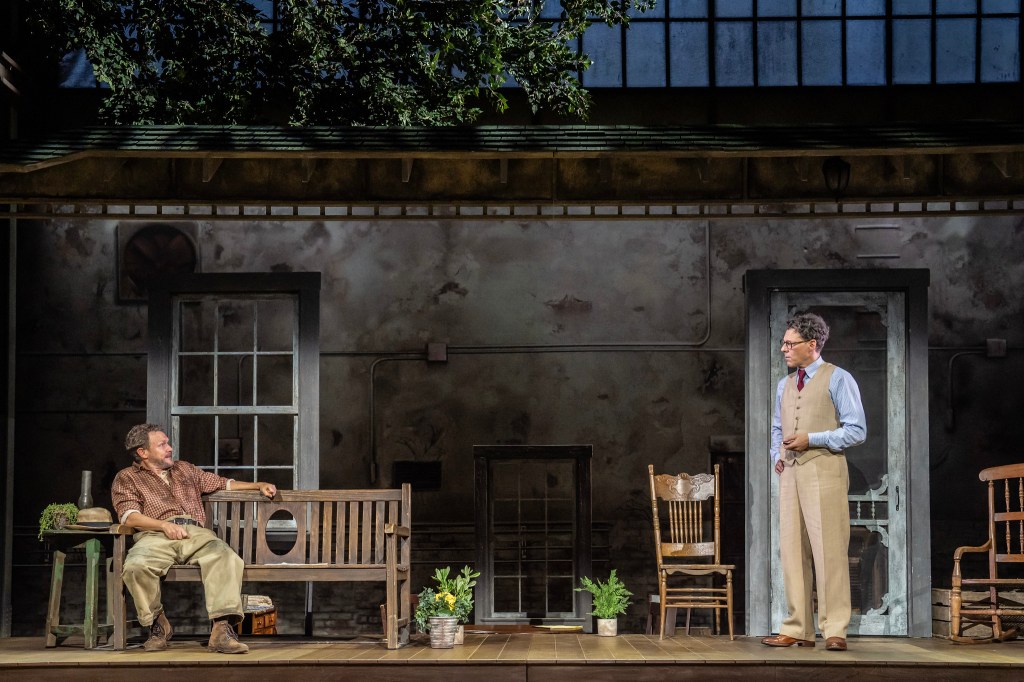
Bertlett Scher’s direction is slick and seamless. Miriam Buether’s elaborate set smoothly transforms before our eyes, with large set pieces descending from above and the actors themselves wheeling on set from the wings, which works well because it feels very much like a story coming to life.
The most interesting design decision has to be the empty jury box. Whilst this is ostensibly because they did not have enough performers, it also has a dramatic effect, turning the audience into the jury, forcing us to reflect on our own ignorances and prejudices, and reminding us that it was ordinary people that condemned Tom Robinson to his death. Whilst the most intense racism comes from poor White folk, the story also explores classism and elitism; Sorkin and Scher do not let their liberal, educated, middle-class, White audience evade responsibility.
Ann Roth’s costumes are historically accurate. Whilst most of the characters are poor, many of the costumes are stunning. Jennifer Tipton’s lighting helps transport the audience from scene to scene, day to night, etc. but also enhances the atmosphere, from intimacy to intensity. There is something cinematic about Adam Guettel’s original compositions, which could be straight out of a Sorkin movie.
The cast, too, is incredible. Richard Coyle was sadly off but Off-Stage Understudy John J. O’Hagan was excellent as the much-loved Atticus. Munden, Scott and Malyn (in his professional stage debut) are perfectly cast as the three youngsters, even though they are adults; they make for very convincing children who are mature and wise beyond their years (their undeniable adulthood speaks to this). Lee’s novel explores generational differences, with young people generally being more liberal and open.
The primary antagonist, Bob Ewell, is played by Oscar Pearce, with Richard Dempsey playing Mayella’s lawyer, Horace Gilmer. I despised them – so you know they did well! Evie Hargreaves brings raw humanity to Mayella, who oscillates between victim and villain. She oozes pain and desperation. The Ewells are pathetic, and you cannot help but feel sorry for them – even though Tom’s admission that he felt sorry for Mayella (a White woman and thus his racial superior) led to his death.
Aaron Shosanya is calm and collected as Tom, motivated to stay alive not only to prove his innocence but also to be there for his wife and three children – yet he is still characterised as an angry Black man by the White folk. Andrea Davy is very loveable as Calpurnia, with all her wit and charm.
The incredible cast also includes Harry Attwell as Mr. Cunningham / Boo Radley, Stephen Boxer as Judge Taylor, Colin R Campbell as Sheriff Heck Tate, and Sarah Finigan as Mrs Dubose, Phillipa Flynn as Miss Stephanie / Dill’s Mother, with James Mitchell covering Link Deas (usually Simon Hepworth) and thus Tom Brace-Jenkins (usually ensemble) covering Mitchell’s usual role of Dr Reynolds / Dr Roscoe.
Lee’s novel offers much to consider and think critically about. I love a morally dubious protagonist, such as Hector in The History Boys, who is, frankly, a paedophile. Sorkin, whilst portraying Atticus as a good, decent person, does not shy away from his moral inconsistencies. Atticus’ motivation for helping Tom is explicitly his commitment to justice rather than racial equality. Whilst he does not appear to be a racist, he does not directly answer Jem when asked what side of the Civil War he would have fought on. Atticus explains that the intense hatred that men like Bob have for Black people partially stems from the South’s humiliation over being defeated decades ago but even this is not so much an indictment of slavery, secession and treason; it’s more just Atticus’ desire to constantly see the best in everybody and possibly a justification of racism.
55 years after the publication of Mockingbird, Lee released her only other novel, Go Set a Watchman, which was falsely billed as a sequel but was, in actuality, a much earlier draft. This Atticus has significant moral and personal differences: it is revealed that he is a member of a group dedicated to maintaining segregation, and he expresses opposition to the NAACP. Sorkin seems to bring a little of Watchman into this adaptation: this Atticus does not appear to be a segregationist but he is not redeemed as a champion of racial equality either. He enjoys a sibling-like relationship with his maid, Calpurnia, but there were plenty of racist White folk who got on with their second-class Black help (and there are still racist White people today with Black friends – and they often make sure we know that they have Black friends).
Lee’s book is criticised for its lack of engagement with its Black characters, including the man whose trial is at the centre of the narrative. Sorkin, instead, gives Tom and Calpurnia more attention but also more agency, with Calpurnia standing up to Atticus. A late scene allows her to expose Atticus as a morally inconsistent hypocrite. Sorkin adds layers to an already nuanced text so it speaks more strongly to today, whilst remaining historically accurate. I do wonder, however, why more Black creatives were not brought onboard; it’s ironic to criticise the novel for side-lining its Black characters whilst side-lining Black creatives. There is a discussion to be had about the push for Black talent onstage but not offstage.
Mockingbird, and especially this adaptation, reminds me a little of the controversial song ‘The Night They Drove Old Dixie Down’, a first-person narrative relating the economic and social distress experienced by the protagonist, a poor White Southerner, during the last year of the American Civil War. It’s one of the most human accounts of history that I have ever heard, even if its subject matter is taboo.
Indeed, Sorkin is careful not to condemn most of the characters but rather he explores how and why they are the way that they are. Atticus refers to Mayella as a victim of ignorance, poverty, and her father – the man who actually physically (and possibly sexually) assaulted her. She’s a raging racist, sure, but this is learned behaviour – and also a defence against the (true) accusation that she is being forced to lie to (a) defend her father and (b) satisfy her racist father’s insatiable thirst for the blood of a Black man.
Mockingbird is semi-autobiographical; it is partially inspired by a case Lee’s father took but also similar cases of Black men and boys being falsely accused by White women, resulting in their deaths. Whilst physical racism usually comes from men, White women, who are capable of just as much hatred, have long weaponised their symbolic woundability against Black men. Mayella, however, is not motivated by hatred, which arguably allows White women to be let off the hook; all of the truly hateful characters are male. But the story goes beyond just anti-Black racism; it also explores misogyny, classism, elitism, and antisemitism, with Bob presuming that Atticus has some Jewish heritage.
Mockingbird could not feel more relevant, especially in the US right now, with Trump’s tyranny and the current protests against ICE – but also here in the UK, what with the rise of Reform and the recent racist riots.
President Lyndon B. Johnson famously said, “If you can convince the lowest White man he’s better than the best colored man, he won’t notice you’re picking his pocket. Hell, give him somebody to look down on, and he’ll empty his pockets for you.” The poor White folk in Mockingbird are not too different from the poor White Yanks who propelled Trump to power, or the poor White Brits who think that the rich racists in Reform care about them.
These people are themselves victims of capitalism, neoliberalism and greed – and right-wing propaganda, which their lack of a formal education makes them more susceptible to, as well as the human propensity to blame external factors for one’s own problems instead of taking responsibility for yourself. Mockingbird addresses a hierarchy that puts Black people at the bottom and then divides White people along socioeconomic lines. It encourages sympathy, empathy, compassion and understanding – before finally acknowledging that a small minority of people are beyond saving and are thus better off dead.
Harper Lee’s To Kill a Mockingbird runs at Lowry (Lyric Theatre) until January 24 and tours the UK until May 23. Richard Coyle plays Atticus Finch until March 7.
Photo: Johan Persson
 JADAR
JADAR 