★★☆☆☆
After the success of Murder in the Dark, Torben Betts was asked to write another play in a “Murder” series. Whilst Murder in the Dark is a mystery thriller and ghost story, Murder at Midnight is a comedy thriller and murder mystery. I welcomed this shift in genres because I felt that the former took itself too seriously and descended into accidental self-parody; the latter, however, is inconsistently serious and unserious, by virtue of attempting to blend thriller and farce.
Murder at Midnight is about a gangster’s New Year’s Eve gathering, full of mistaken identities, dark humour, and a mystery surrounding a previous murder.
The play opens with two police officers (Bella Farr and Andy Mcleod) inspecting a crime scene, with blood splattered on a white curtain. We do not know who has been killed but the coppers reveal that it is suspected that the man who owns the house murdered his wife, who went missing awhile back.
The man is question is Johnny The Cyclops, whose name refers to his eye patch. It is not revealed why he wears an eye patch – presumably because he is missing an eye, but it is not revealed how he lost his eye – and I’m not sure that the creatives know why, for Jason Durr is not wearing an eye patch in any of the promotional photos. Johnny is straight out of EastEnders, and Jason Durr chews up the scenery.
His loopy mother, Shirley, is played by Susie Blake, who was the best thing about Murder in the Dark. Susie revealed that she is foremost a theatre actress, and that is not surprising; her craft is incredible. She’s an absolute joy to watch onstage, even if you aren’t particularly enjoying the play that she is in.
Max Bowden, best-known for being the most recent in a long line of actors to play Ben Mitchell in the aforementioned EastEnders, is the most likeable character. He plays Paul, an undercover policeman who has caught feelings for Johnny’s second wife (and his missing first wife’s best friend), Lisa – even though he is himself married.
Lisa is played by Katie McGlynn, who is a great comic actress but her cockney (Aussie?) accent makes Dick Van Dyke’s sound authentic; they should have just let her speak with her native, nasally Manc accent – it would have been perfect for the character. But I appreciate that the show is very East End of London.
Iryna Poplavska, the Ukrainian Ugly Betty, plays Cristina, Shirley’s Romanian nurse. Poplavska has the audience rooting for her safety, though she occasionally descends into overacting, which is perhaps how she has been directed. The constant racing around the house, and then outside, and all the screaming (“Meester Feesh!”) is grating and exhausting. Cristina accidentally gets involved in the criminal underworld but this is not explored much; it’s more just a way for the play to introduce Mister Fish, which feels sloppy.
Mister Fish, aka Paul, a desperate man trying to steal from Johnny, is played by Callum Balmforth, who successfully showcases the character’s moral ambiguity; he has the clearest motivations.
The cast is rounded off with the hilarious Peter Moreton as Johnny’s mentally unstable right-hand man, the aptly named Trainwreck.
The performances are generally strong but sometimes you can see the performers acting. That is to say, the acting does not always feel natural and organic.
It’s a cast of colourful characters, who are deliberately written as archetypes and caricatures, but Betts occasionally strips away their facades to reveal insecurities; we see how their clocks tick. I would have preferred more of this, because some of the characters feel underwritten, underdeveloped and one-dimensional. Every character has a tragic backstory but these are addressed once or twice and then never spoken about again; they don’t really seem to impact the plot but rather they are used to give explanations and motivations for bad behaviour.
Several characters give monologues to an invisible bedroom in the mirror but characters also reveal their inner-most thoughts when everyone is around them. There are twists and turns but they never feel shocking because characters just blurt things out (including what really happened to Johnny’s first wife, Rachel) instead of having it pried out of them, as in most murder mysteries. In fact, the “murder mystery” description feels misleading because the only mystery is what happened to Rachel and who is going to die, as opposed to someone dying and then others trying to work out who killed them and why.
The play includes sexism and xenophobia but it never really does much with this, thus leaving the bigotry in place, except for a passionate/preachy speech by Cristina, towards the end of the play, which feels incredibly out of place. A woman in front of me looked at her friend and gestured for Cristina to get on with it.
It feels like the play does not know what it wants to be, by virtue of trying to do too much. It’s a murder mystery, a gangster thriller, a revenge drama, a comedy, and a farce. Whilst multiple genres can be blended nicely, here they feel like they are competing, resulting in a play that is tonally uneven. One moment the play takes itself seriously and then the next it does not take itself seriously at all; it becomes difficult to invest in a story, and its characters, when we are not sure how we are supposed to feel about anything.
As with many farces, the second act is when it goes full farce, but it’s a jarring shift from the slower first act; it takes too long to become farcical. The farce is funny but not laugh-out-loud funny like famous farces, such as The Importance of Being Earnest, Noises Off, Private Lives, and the works of Mischief. It is perhaps held back by the more serious elements; it should have just gone barking mad, throwing out everything but the kitchen sink (perhaps that too).
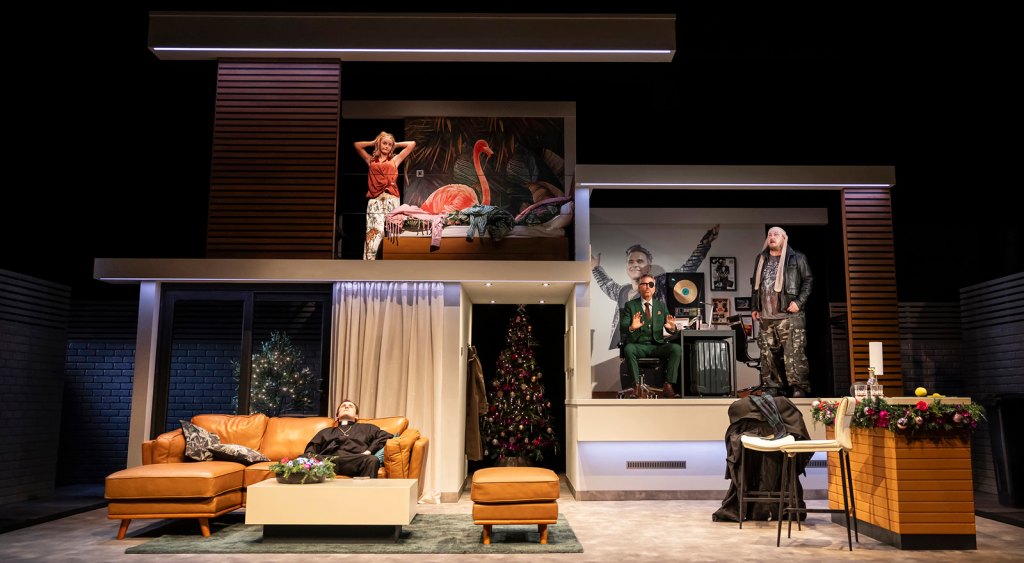
Directing a farce is not easy because characters are always coming and going (and in this play, dying), and the set is often an elaborate home, but Philip Franks rose to the occasion, making excellent use of the space. The Quays Theatre’s stage is pretty small but it only feels overcrowded when Franks wants it to.
The production is expertly designed by Colin Falconer. The house sits on three levels, though they are not placed directly on top of each other. This references edgy, modern architecture but perhaps it is also to suggest that these rooms do not actually sit like this but rather they are just three separate rooms in a massive house that have been shoved together for the purpose of the play. Indeed, if the three rooms are actually that close in proximity, the characters would hear each other with all the shouting, but they do not, which suggests that they do not actually sit like this – and this is successfully captured through the design.
The costumes are all appropriate to the characters that wear them, and some of them are rather stunning. Jason Taylor’s lighting design is warm, homely and intimate, with a slight intensity at times, capturing the problems brewing beneath the surface, popping up one after another.
With Murder at Midnight, Torben Betts had the opportunity to fix the flaws seen in Murder in the Dark, but he instead creates additional problems. The play has potential, and with a significant rewrite, it could become a consistent, coherent, comedic crime thriller. Hopefully it will be third time lucky with the next “Murder” play. Murder on the Dancefloor, perhaps?
Murder at Midnight runs at Lowry (Quays Theatre) until January 24 and tours the UK until April 4.

 JADAR
JADAR 