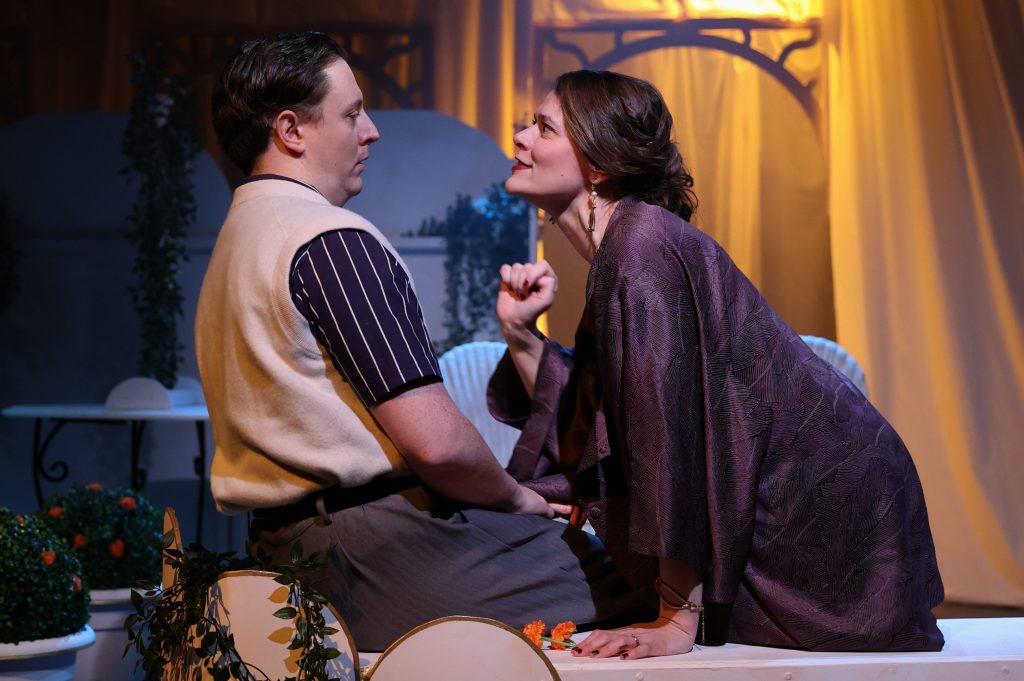
The long anticipated wait for HER Productions’ spin on Private Lives has arrived at Hope Mill Theatre this January. This traditional comedy of manners was written by Noël Coward and is set against a 1930s South of France backdrop. The production follows two newlywed couples meeting by pure coincidence while on the first night of their honeymoons. The themes of the show follows acute domestic violence present in the leading relationships with delicate portrayals of the intimacy that can accompany it.
The play follows Amanda and Elyot five years after their divorce where they meet again on their respective honeymoons. The show highlights their circling relationship through its spirals. Victor and Sybil are the current spouses who follow them across France in an attempt to rectify their pride. The play itself is outdated, and I was excited to see how this feminist production company tackled the themes of sexism and violence appropriately.
I want to applaud the design team on this production; the costumes were breathtaking, and the colors very clearly complimented the performers and their characters, even reflecting their connection to other cast members. There was a clear vision, and it aided the time period and clear direction.
Additionally, the intimacy coordinator, Heather Carroll, and movement director, Chris Brown, did an excellent job. I was blown away by the physical command the actors had in their characters. I must also give major kudos to the fight director, Adam Cryne, who made the hits, shoves, and slaps exceptionally powerful. I have not seen such a high quality fight on stage in a long time and could tell how much work had been placed into these moments. The fighting and intensity that came together in the intimacy, movement and physical combat really made this show stand out.
The acting performances of Hannah Ellis Ryan (Amanda), Charlie Nobel (Elyot), Jack Elliot (Victor) and Hope Yolanda (Sybil) were all precise and intense. I thought each performer did an excellent job, rising to the occasion and playing to the direction given as overtly emotional and playing to the comedy. I thought they did an excellent job balancing the 1930s comedy of the piece and the intense anger needed.
Unfortunately, I needed further analysis to enjoy this piece. Some themes were unexplored and did not breach the topic how I would have liked to see. This could be entirely up to preference in the theatre I create and challenge. As a theatremaker, I believe it is my duty to take responsibility for the narrative I am telling. This production did not add additional societal critiques or reflect the themes of sexism in a combative way. This is largely to do with the demands of the script as opposed to this production and team. I understand the challenges of working with an outdated script and flipping the narrative to reflect modern day. However, I felt that this particular production was unable to do so.
A large majority of the audience enjoyed the show and were laughing throughout. I believe my disconnect was with the script and the manner in which it asks to be performed. I think my lack of connection to the humor style could have been a generational difference, as I was on the younger side of viewers. I felt the repetitively sexist jokes, like a woman snoring loudly for slapstick comedy, did not strike me as particularly funny. It felt outdated and aided the sexism found in the script.
The choices made by the director, Amy Gavin, were reminiscent of a 1930s comedy and took several elements from the film and time period. There were moments that felt silent movie-esque, showcasing reflections of traditional slapstick, pantomime and physical comedy. These moments particularly shone through across the movement sequences, developed by Chris Brown (movement director). There were several moments that reflected the silent comedy era including scene transitions, brief moments of movement interjection and even projected scene sequences. I wanted to see this develop to a point of almost insanity but the comedy continued in the same cadence, making it almost a play-by-play of a 1930s comedy as opposed to a critique on it.
This particular rendition of Private Lives did not allow for a wide variety or reflection of emotion like one might expect. The emotional journey taken by the audience was morose, showcasing largely only frustration to anger without any gaps to fill between these emotions. It was exhausting as an audience member, as the moments between anger were so overly sweet; there was no real belief throughout the production. This lack of humanity in the characters made the show a difficult watch, as they were playing a heightened stereotype as opposed to a real human. Though I understood the intention behind this, it completely took me out of the story. I felt there was little arc in their emotional journeys and left feeling let down by the ending.
Amy Gavin added a unique video element that was displayed on the background of the set via projector. The intention was to show the hidden moments that presented themselves in the writing. The videos displayed were videos from the couples on their wedding days, and more striking, the cruel physical violence following. This technique drew away from the analysis of the script and words being said. The intimacy being projected filled the gap of intimacy and did not allow for the actors to perform this intimacy for the audience, and I felt a disconnect between the videos and the performers. This particularly rang true when Amanda smiled and laughed, acting blasé about the abuse she suffered on stage while the video projection showed horrifying bruises and depictions of it. The emotional weight of the moment was not shown, and the projection acted more as a wedge between character and emotion than as an addition to both.
Additionally, in a show largely about domestic violence and what is shown and hidden in our personal lives, I did not feel there was a genuine grasp on the weight of the actions being displayed. This production could take a very nauseating approach to telling a story of such an intense nature, making this show a horror, however, it felt like every hit, slap, or smack made the audience roar with laughter. For me, I felt that these actions should warrant a grotesque reaction. This could have been largely orchestrated by the audience at my particular show.
The script itself is sexist and outdated. I was curious to see how this could be countered or pushed back against. Keeping the sexist nature of the script is unnecessary. It undermines the intention to show abusers of two genders and instead implies a heavy distrust in the female experience. Amanda, behaving as an abuser, then laughing at Sybil and calling her a “bitch” continued to perpetrate the same sexist structure present in the modern day without making any solid or noticeable critique. Understanding women can be both victims and perpetrators of violence and abuse is necessary but the script does not allow for this as it continually made reference to Sybil’s kindness, making her weak or emotional.
The constant high energy provided by the cast was not split up; it did not fall in the second act, which made it feel like a heightened and untrustworthy story in general. Instead of critiquing the script and the violent nature of the individuals, it allows it to take place. It is a script that openly showcases domestic violence, and it does not stray away from the impact. The script itself compares the cyclical nature of abuse to the rigid comedy structure still present in media today, almost comparing comedy and abuse together. This is a brilliant comparison to be made but the outcome can lean either in support or in critique. It had a negative impact in the discussion. Though I do not believe this to be the intention of the show, this particular script and rendition do encourage the sexist nature of the script without a major critique in the way they present the story and without a noticeable character realization. The cycle of abuse continues in the stories we tell.
I love the production company and team behind this show. HER Productions have made major strides for theatre in the North and have normally only received my praise. This production did not hit the right notes for me, and I felt disappointed in the broach of the subject matter. This production did not succeed in their recreation and retelling of this story. That being said, it has allowed me to critique how I look at representations of abuse and the place women have in stories, which could have been the intention.
I would recommend people to form their own opinions on the production and this retelling as mine is largely based on the script and the outdated nature of the story being told. I am curious to see how the Royal Exchange will counter these traditional and outdated viewpoints with their production taking place later this year.
Noël Coward’s Private Lives runs at Hope Mill Theatre until February 8.
You can reach the national domestic abuse hotline on 0808 2000 247
Photo: Shay Rowan photography
 JADAR
JADAR 