★★★★☆
Over the last few years, Lowry have showcased their dedication to artistry, highlighting a diverse range of multidisciplinary artists from near and wide within their expansive Andew Law Galleries. Previously, I attended the Local, National and International and Quentin Blake and I exhibitions in this space, and I’m astounded yet again by how adaptable the space is with the right creative visionaries at the helm.
Their newest exhibit was commissioned through their artist development programme, Developed With, an 18-month project inspiring Northern artists to create ambitious pieces across the winding gallery.
In The Guardians of Living Matter, John Paul Brown and Sophy King meticulously craft an intriguing multi-sensory exhibition, inviting viewers to step into a speculative futuristic post-climate crisis world where nature and technology are entangled into every fibre of the planet. Set in 2076, the space is transformed into the headquarters of the titular ‘Guardians’ after the unforeseen collaboration between low-carbon AI and underground networks of mycelium fungus sparked hope for humanity. Their interactions are researched and monitored by humans at the HQ.
Commendably, Brown and King ensure that the environment is considered in every aspect of their exhibit, practising low-carbon art-making by using offline AI datasets and saved or reclaimed materials, even considering how materials are redistributed post-exhibition. Branches were saved from felled trees near their studios, previous artworks were repurposed, and cladding was reused from the Royal Exchange’s dance floor… it’s admirable attention to detail.
Stepping into this immersive sci-fi world, guests are encouraged to sign-in and pick up their visitor day pass in the reception area, a set complete with dynamic logos, HQ blueprints, and informative fact-files to set the tone.
The next room’s centre-piece is ‘The Tapestry of Future-Past’, created from plastic-coated paper with vivid chalk drawings wrapping around the room to create an all-encompassing Fibonacci spiral. Each section of the tapestry demonstrates the discoveries, protests and research between 2026 and 2076, binary code melting into the columns and melding with black fungal strands while humans, cats and pigs interact with each landscape.
Emerging from these interactions, the ‘Oracle’ takes shape; the ultimate visualisation of both inhuman forces combined into one immense aerial display. The Oracle is a living sculpture made from mycelium coated hemp rope with residual fruiting mushrooms and white sinews. A closed AI system then controls the lights, interacting with the fungus by changing the colour and placement of the lighting and casting striking branched shadows across the walls. A motion-triggered light sweeps across the room when visitors enter, while a gentle mixture natural and techy soundscapes echo through the room.
‘The Laboratory of Affirmations’ acts as the scientist’s research room, numerous crumpled journals, annotated calendars, colourful post-its, sketched designs, photos, coffee mugs specimen vials, awards, and molecular models scattered across the workspace adding a sense of authenticity. A computer panel holding a sample of mycelium generates phrases from 50 words based on the signals sent by mycelium, while a touch library provides a tactile way to interact with some the strange textures on display.
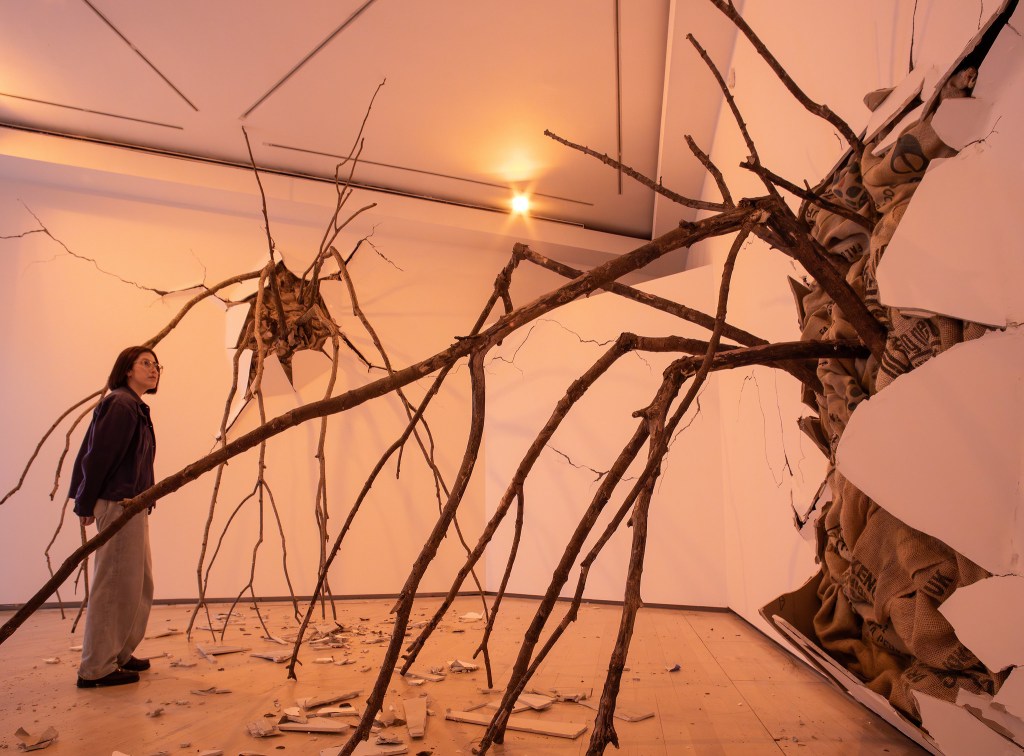
A window into the ‘Museum of Artefacts’ gives visitors a peak into the varieties of mushroom specimens, stretching branches, and protective lab-coats. Inside, coffee sacks and broken plasterboard hint at what’s creeping from neighbouring ‘Bureau of Entanglement’, amusing warning signs and taped lines hinting at interdimensional danger. Ominous red lights set the room aglow while skeletal willow branches poke from cracks in the walls and a mix of welding mechanical whirrs and chirping birdsong fill the air. Nature crawled through the cracks of reality, plaster barely clinging to the walls in a Stranger Things reminiscent rift.
The exhibition is rather enthralling with fascinating imagery and amusingly immersive set pieces, ultimately creating a unique sci-fi nature experience with an apt eco-friendly approach. I really enjoyed the tour, especially with the artists providing background information about their materials or in-depth analysis of their pieces, how they were crafted, and what they represented. However, without these insights I am left wondering how well audiences will understand the premise of some of these pieces. True, there’s plenty of information dotted around but you can’t beat a guided informative tour when it comes to crafting immersive world-building displays.
The Guardians of Living Matter runs at Lowry (Andrew Law Galleries) until March 29.
Photo: Michael Pollard

 JADAR
JADAR 