★★★★☆
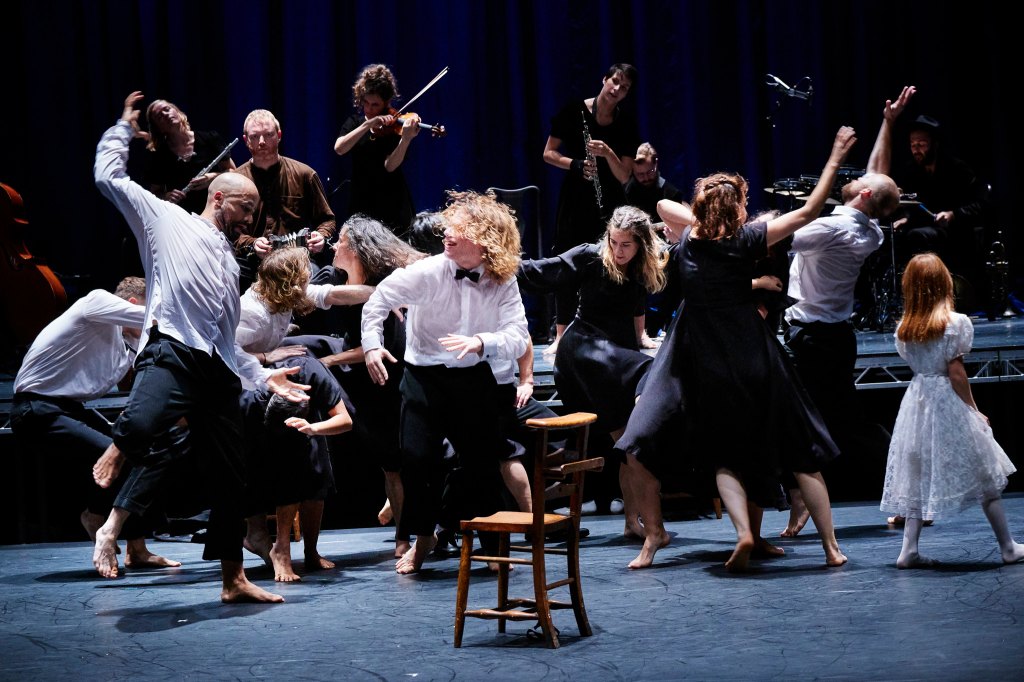
There is a particular kind of madness that unfolds on stage in MÁM: not chaos for its own sake, but a carefully cultivated delirium. Michael Keegan-Dolan’s Olivier-nominated work arrives already haloed by critical acclaim, and it earns that reputation through choreography that is as physically ferocious as it is theatrically alive. These are not just dancers: they scream, leer, collapse, seduce, and howl. They perform as bodies pushed to the brink, and then past it.
The opening images are stark, almost aggressively so. Everything is monochrome: black suits, black dresses, white skin, white light. The stage feels stripped to the bone,
ritualistic and severe. A child in white stands apart, visually echoing Alice in Wonderland,
caught between innocence and initiation. For much of the evening, she watches, still and observant, while the adults unravel around her. When she finally dances alone, briefly but decisively, it becomes my personal highlight of the night: a moment of clarity amid excess, fragile and quietly commanding.
That said, the Black Philip-esque figure who
removes his mask to play Irish folk and sea songs on the concertina remained stubbornly opaque to me, an image rich in atmosphere but resistant to meaning.
Keegan-Dolan’s choreography is astonishing in its range. It slides from tightly coiled
unison into drunken lurches, from communal stamping into moments of unsettling
intimacy. One performer, in a gesture that is by turns comic, unnerving, and strangely
moving, quite literally kisses every single person on stage: an impressive logistical feat, and a lot of kissing. It tips into something tastefully erotic without ever becoming gratuitous, unlocking a flood of emotions that oscillate between tenderness,
desperation, and grotesque humour.
Throughout, the dancers shed layers of decorum as blazers come off and ties loosen, revealing how quickly “civilised” humanity dissolves into something messier, needier, more animal.
Visually, the set is minimal, but cleverly so. Rather than adding clutter, it peels away. First, a hidden layer reveals the musicians; later, another rupture exposes yet more of the machinery behind the performance. In the final minutes, this stripping-back culminates in a gesture that breaks the fourth wall entirely, not as a gimmick, but as a conceptual full stop that reframes what we have been watching.
Musically, MÁM is delightfully plural. Irish folk and sea songs sit alongside baroque-
inflected violin lines and full-blooded jazz, delivered by the contemporary ensemble
Stargaze, whose presence shifts the atmosphere dramatically once revealed. The jazz band is particularly striking, with the oboist leaving a lasting impression. At times, this richness feels intoxicating, while at others, slightly overwhelming. The work is
segmented, deliberately so, but I occasionally longed for a stronger connective tissue: something elusive, a je ne sais quoi: a tie, a frame, a glue to bind its many ecstatic fragments together.
Interpretation is left wide open. To me, MÁM felt like a meditation on adulthood: the loss of structure, the seduction of excess, the frightening freedom of choice. My partner, watching beside me, was convinced it was a descent into hell itself. Both readings feel valid. The Irish Times famously called it “90 minutes of ritualised ecstasy,” and that description lands with force: this is a kind of modern Rite of Spring for a contemporary, unmoored world. MÁM is avant-garde, emotionally charged, occasionally opaque, and undeniably powerful. With the production currently touring the UK, this is a rare chance to experience a work that embraces excess, confusion, and contradiction. Madness, here, is not a flaw… it is the point.
MÁM runs at Lowry (Lyric Theatre) until February 4 and tours the UK until March 4.
Photo: Ros Kavanagh
 JADAR
JADAR 