★★★☆☆
There was hype. Real hype. Massive queues snaked outside the Manchester Opera House, and inside, a full house buzzed with expectation. A brand-new stage adaptation of Single White Female (touring the UK and based on the 1992 psychological thriller film, itself adapted from SWF Seeks Same by John Lutz) promised a contemporary reimagining for 2026. And in many ways, it delivered.
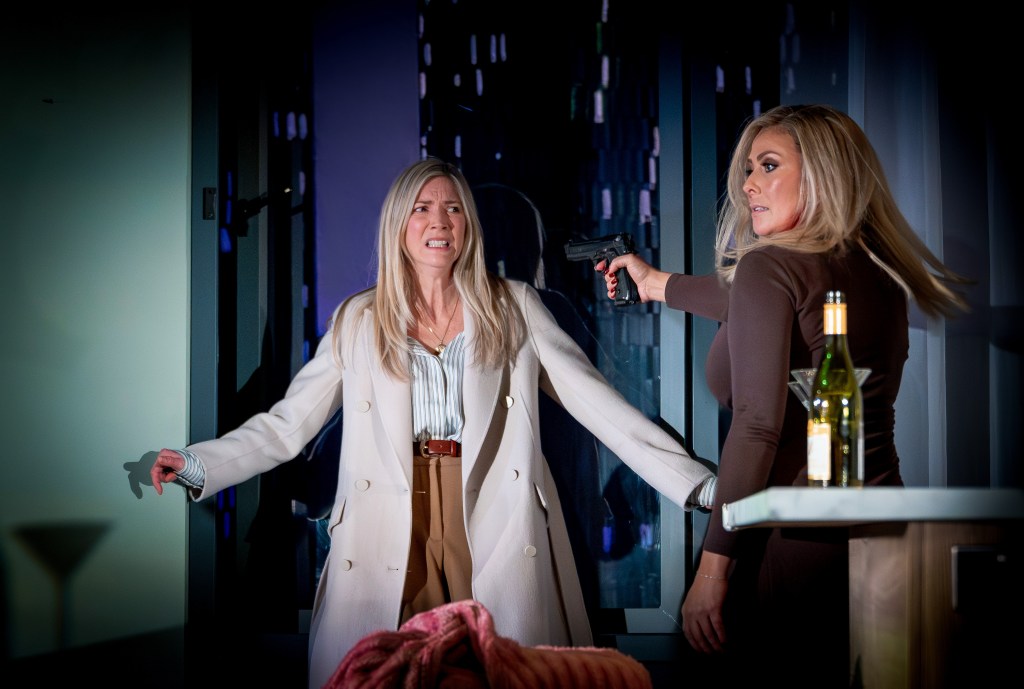
Adapted for the stage by Rebecca Reid and directed by Gordon Greenberg, this version wisely keeps much of the action in the apartment. The stage never changes. It doesn’t need to: after all, most of the film is also set in the apartment. What we get is a single, open-plan living room that feels astonishingly real. Designed by Morgan Large, the set is deceptively simple: an entry door, two sliding doors leading to bedrooms, a kitchen area, and a hallway suggesting the rest of the flat. A three-bedroom new-build. But the detail is extraordinary. Running water in the kitchen. Cabinets stacked with plates and glasses. A space that genuinely feels lived in. It captures that peculiarly British 2020s reality: functional, modern, slightly impersonal, and, as Reid has noted, reflective of the “shoddily built apartments that people all over the UK are struggling to contend with.” This is a marked departure from the film’s opulent neo-Gothic Manhattan apartment.
Here, the vulnerability of the characters is embedded in the architecture itself, and it works. The writing mirrors the set design, too: dense with detail, full of Chekhov’s guns placed carefully in the opening moments. Nothing appears accidental. Props, lines, visual motifs: everything is there by design. The baby stroller suspended above the stage (initially puzzling, later chilling) becomes part of the slow-burn architecture of suspense. Through the living room window, a looming skyscraper adds another layer of realism, particularly for a Manchester audience, for whom it could be any of the city’s ever-rising high-rises.
Lighting by Jason Taylor and sound and composition by Max Pappenheim elevate the experience further. Massive LED light frames encase the stage, pulsing and sharpening the psychological tension. Is it occasionally effect-hunting? Perhaps. But does it work? Absolutely. The technical design adds a sleek, modern thriller aesthetic that compensates for the static set.
The most significant adaptation choice, however, is in the writing, namely the replacement of the dog from the original story with a teenage daughter, Bella. This transforms the narrative entirely. Suddenly the story isn’t just about adult obsession, but about parenting, teenage vulnerability, bullying, social media, and the dangers of online life: a timely layer in an era when several countries are debating or implementing social media bans for under-16s.
The psychological stakes deepen; the thriller gains a contemporary moral anxiety. Hedy, the new flatmate, is played by Kym Marsh. Her performance builds steadily. While initially restrained, she grows into the role and is genuinely compelling by the final act, helped by writing that gives her space to unravel and shine.
On the other hand, Allie, played by Lisa Faulkner, is less convincing. The chemistry often feels off, and her delivery never quite sheds a sense of performance. Too often, one sees the actress rather than the character. The dialogue exchanges sometimes fall into an old-school theatrical rhythm (i.e., waiting for monologues to finish before responding) rather than feeling like lived, overlapping conversation. Frankly, in 2026, that heightened, declamatory style feels dated.
The supporting performances are mixed. Amy Snudden as Bella is a revelation. She outshines the rest of the cast, carrying emotional authenticity throughout and suggesting a very bright future ahead. The male roles—including Graham and the gay best friend (whose best line, after a disastrous Grindr date, is that he is “no longer a vegan”)—add comic beats… but not always intentionally.
And that is where the production falters. Despite being billed as a thriller, many of the most shocking moments were met with laughter, even pantomime-style shouting from the audience. While some comic relief is clearly intentional, some laughter feels misplaced, symptomatic of tonal inconsistency. At times, it slips from psychological thriller into something closer to camp, and much of that comes down to the performances. And one doubts that was the aim. For all the hype and expectation, it ultimately fell flat. We were never quite taken to the edge of our seats. There was no sustained sense of fear, no breath-catching moments of dread, as a thriller ought to provide. Instead, shocks were met with laughter. The storyline is undeniably compelling, but for a thriller to be truly thrilling, the lines must land with precision. When they don’t, tension dissolves, and what remains is simply drama with a dark plot.
Still, there is much to admire. The conceptual shift to a contemporary UK setting is fitting. The set is meticulously crafted. The design team creates atmosphere of genuine sophistication. The adaptation introduces new thematic urgency through Bella’s storyline. Not flawless. Not fully cohesive in tone. Occasionally trapped in theatrical habits that feel out of step with its modern setting. But undeniably ambitious and often gripping.
With a packed auditorium and a UK tour underway, Single White Female proves there is still appetite for psychological drama, especially when it dares to reinvent itself.
Single White Female runs at Opera House Manchester until February 14 and tours the UK until Festival Theatre, Malvern until June 13.
Photo: Chris Bishop

 JADAR
JADAR 