★★★★☆
For her first production as Artistic Director and Co-CEO of the Royal Exchange Theatre, Selina Carrtmell has chosen to revive Jim Cartwright’s first play, Road, which had its Manchester premiere at the RX in 1995. Cartmell is simultaneously celebrating the play’s 40th anniversary and the theatre’s 50th, affectionally billed “A Homecoming” – complete with a video appearance from Sir Tom Courtenay, who starred in the theatre’s first production, The Rivals, the namesake of the theatre’s bar, which hosts the interval show of this immersive production. With tickets selling out before performances even began, expectations were high – fortunately, Cartmell reached for the stars with this ambitious production, ensembling a cast of stars and even suspending one of them mid-air.
Road explores the lives of the people in a deprived, working-class area of Lancashire during the government of Margaret Thatcher, a time of high unemployment in the north of England. Set on a road on a busy night, the audience delve into the houses on the street and the characters’ lives. It is, essentially, made up of a series of vignettes, with a few characters recurring, and a narrator, Scullery, who guides the audience along the road.
The play is often performed on a promenade, visually representing the titular road, allowing the audience to follow Scullery along the road and visit different sets and the different homes of the characters. At the Royal Exchange, however, the show is, of course, performed in-the-round, which creates a feeling of voyeurism, confronting the mostly middle-class audience with the difficulties of working- and underclass life.
The voyeurism is deliberately dented, however, by making the production immersive, thrusting the audience into the action. Cartmell effectively utilises all three levels of the auditorium, as well as the entire venue, with actors performing sketches of working-class life. The actors do the same thing over and over again, representing the monotony of this lifestyle, where opportunities are slim. It felt more like a Factory International production; the ambition and artistry signify a new era for the RX, one where tradition and convention are both honoured and challenged. It’s a bold opening statement from the new boss, signifying a shift in style as the theatre celebrates half a century of existence and excellence.
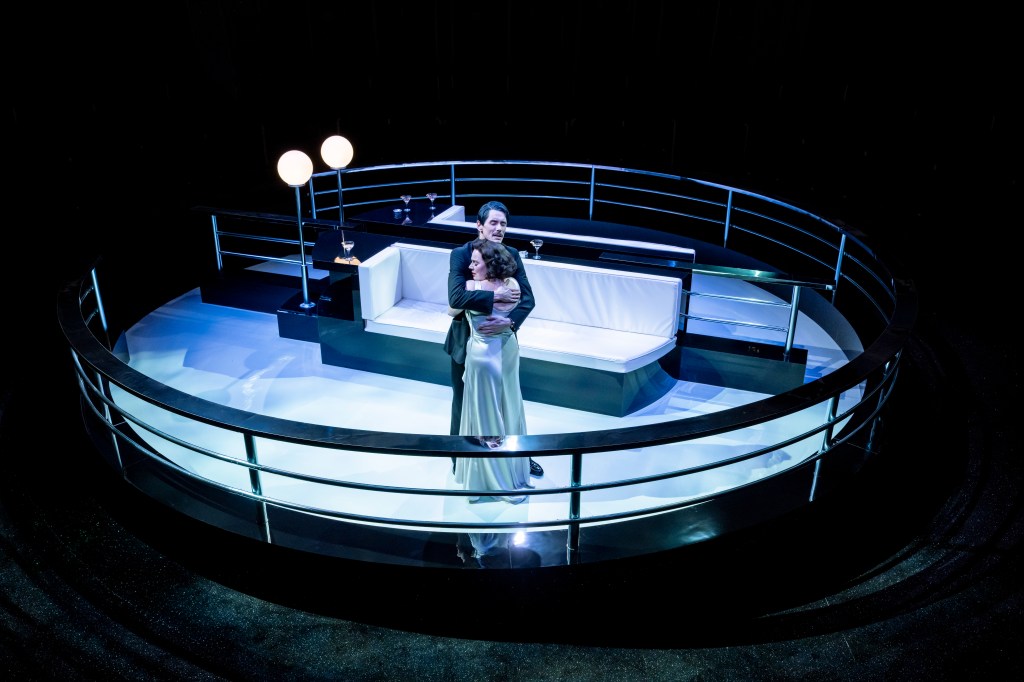
Leslie Travers’ stage design is absolutely stunning, with metal bars surrounding the circular set, evoking industrialism (or, rather, faltering industrialism, thrusting people into unemployment and poverty), and TV screens dangling from above. The air is heavy with the stench and smoke of cigarettes. All of this heightens the claustrophobia, trapping the audience in the action.
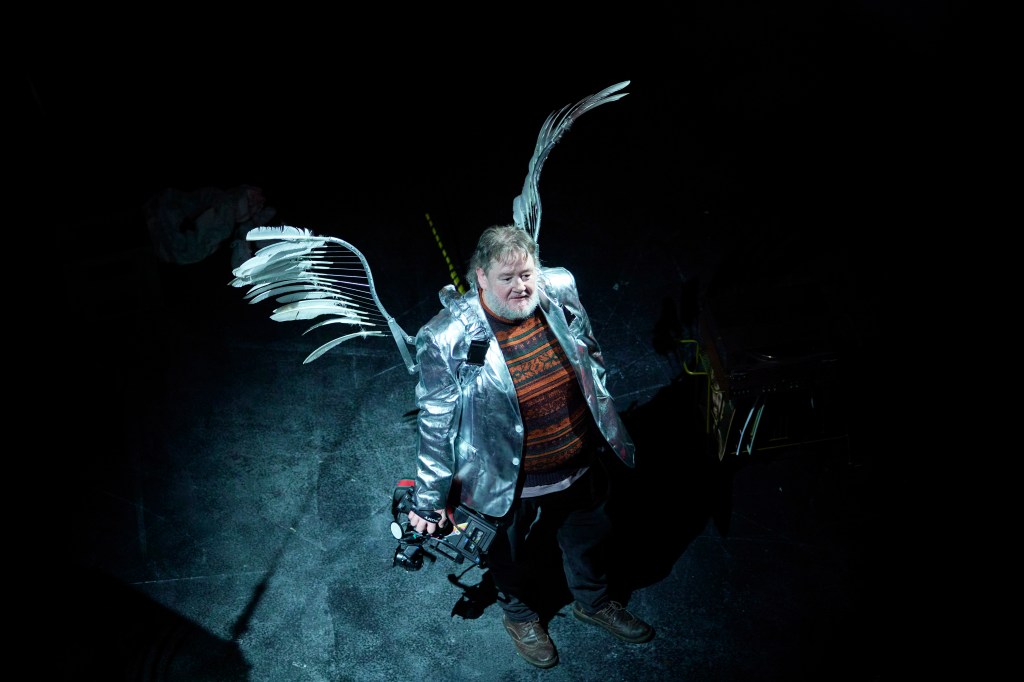
There’s something whimsical about the production. Audiences walk into the auditorium to see Shobna Gulati, sat on a chair, suspended mid-air. Towards the end of act one, Johnny Vegas wears angel wings. The whimsy could represent anything from drug-fuelled hallucinations to a desperate desire for change.
The music production (with sound design by Tingying Dong) is sublime, with songs such as Judy Garland’s ‘Over the Rainbow’ from The Wizard of Oz and Cliff Edwards’ ‘When You Wish Upon a Star’ from Pinocchio also representing some of the residents’ desire to escape their situation.
Aideen Malone’s lighting design switches between realism and whimsy, reminding us that whilst these stories are inspired by reality, this is ultimately fiction and something to learn from. Travers’ costumes, too, whilst historically accurate, are vibrant and funky, which encapsulates this dualism.
The Royal Exchange always attracts a strong cast but Olivia Barr’s casting direction for this production is absolutely incredible. With the exception of Johnny Vegas (Scullery), each actor plays at least two characters, each super distinct, so you are always aware that they are playing new people. Whilst Golati, Vegas, Lucy Beaumont, and a completely unrecognisable Leslie Josephs, who has been turned into Catherine Tate’s Nan, get top billing, the cast also includes Jake Dunn, Laura Elsworthy, Liam Garrigan, Dean Michael Gregory, Dana Haqjoo, Rachel Marwood, Kyle Rowe, Lucie Shorthouse, and Laura Woodward. Not a weak link in site but Gulati and Josephs often steal the show by chewing up the scenery, and Dunn is absolutely one to watch, and not just because he’s rather easy on the eyes.
Where this sublime production falters a little is both in its source material and its handling of said source material.
The play is made up of unrelated monologues and scenes. Most characters do not appear again so there is little to no character development. It is difficult to emotionally invest into something so fragmented, and whilst I was often shocked, I struggled to care and feel.
Furthermore, as somebody from a Lancastrian town, I wondered how realistic the play’s portrayal of a Lancastrian town was, even back in the 1980s, and if some of the characters verged on caricature. But I’ve been told that it was, and remains, very accurate for lots of working- and underclass northern towns. I appreciate that I’m from a middle-class neighbourhood, and whilst my parents, the children of working-class immigrants, have raised me and my brothers to stay true to our roots, that is, ultimately, not our reality – so I am grateful to learn more about other people’s experiences.
However, this specific production seems to prioritise comedy over tragedy. The play is, essentially, a tragicomedy, with comedy used to balance the tragedy; it’s a very heavy play so the comedy arguably helps strengthen the messages. This production could have gone further beneath the surface to help the audience better understand these people’s circumstances, especially when the RX has a very middle-class audience. The characters are undeniably very funny but, as a small-town Lancastrian, there is something a little uncomfortable about a middle-class audience laughing, perhaps even gawking, at the behaviour of troubled working- and underclass people. Whilst the characters all feel very raw and human, some of them are perhaps written a bit too archetypically, and others verge on caricature, denying them a multifaceted portrayal.
It is that which, in my opinion, prevents this otherwise incredible production – which is simultaneously bold, brutal and beautiful – from getting a full five stars. But this roaring revival of Road is, undeniably, a strong start to the new season and a brilliant bounce-back after a mixed programme post-pandemic. If this production is anything to go by, Selina Cartmell is just what the Royal Exchange needed.
Road runs at Royal Exchange Theatre until March 14.
Photo: Ros Kavanagh
 JADAR
JADAR 