★★★★★
Operation Mincemeat is currently having its regional premiere, as part of a world tour, at Lowry, the venue where it began as a scratch performance as part of the inaugural REWRITES programme. It feels a bit reductive reviewing the best-reviewed show in West End history. It has already amassed 88 five-star reviews. This makes it 89. What could I possibly add?!
Operation Mincemeat is a musical comedy based on the WWII British deception operation of the same name to disguise the 1943 Allied invasion of Sicily. Two members of British intelligence obtained the body of Glyndwr Michael, a tramp who died from eating rat poison, dressed him as an officer of the Royal Marines and placed personal items on him identifying him as the fictitious Captain (Acting Major) William Martin. Correspondence between two British generals that suggested that the Allies planned to invade Greece and Sardinia, with Sicily as merely the target of a feint, was also placed on the body.
It’s a wild story, which I knew the basics of, but the show reveals that it was even wilder than I knew, with constant twists and turns. “You literally couldn’t write it,” says a character, revealing that a silly, slapstick, satirical musical was the best medium for such an outrageous piece of history.
A meta-musical, it blends British satire, farce and musical theatre parody, with its comedy comparable to Monty Python, The Goon Show, and The Play That Goes Wrong. As a musical, it’s like Mel Brooks has created a (Young) Frankenstein out of Hamilton and Six, in the style of John Cleese. It’s certainly something of a pastiche, incorporating diverse styles, with its closing number, ‘A Glitzy Finale’, going full musical theatre. “Let’s blow the budget,” jokes a character. It feels like a completely different show, as done as the Act 2 opener, ‘Das Übermensch’, which feels very much like fellow German dance number ‘House of Holbein’ in fellow British historical musical Six.
Operation Mincemeat throws everything but the kitchen sink but it throws it exceptionally well. It’s incredibly self-aware but also has moments of tenderness and a lot of heart. Its politics are clear but they never feel patronising or preachy, especially when the entire show is already unashamedly on-the-nose.
The songs are equally as witty and worthy of the book. Both the book and the songs (music and lyrics) were written by the same people (David Cumming, Felix Hagan, Natasha Hodgson, Zoë Roberts – all but Hagan starred in the original production), allowing the transition between speech and songs to feel incredibly slick, smooth and cohesive. There’s a nice mix of music styles and even some emotional ballads, which slow the action down and force the audience to recognise the human aspect of this shocking story and silly show.
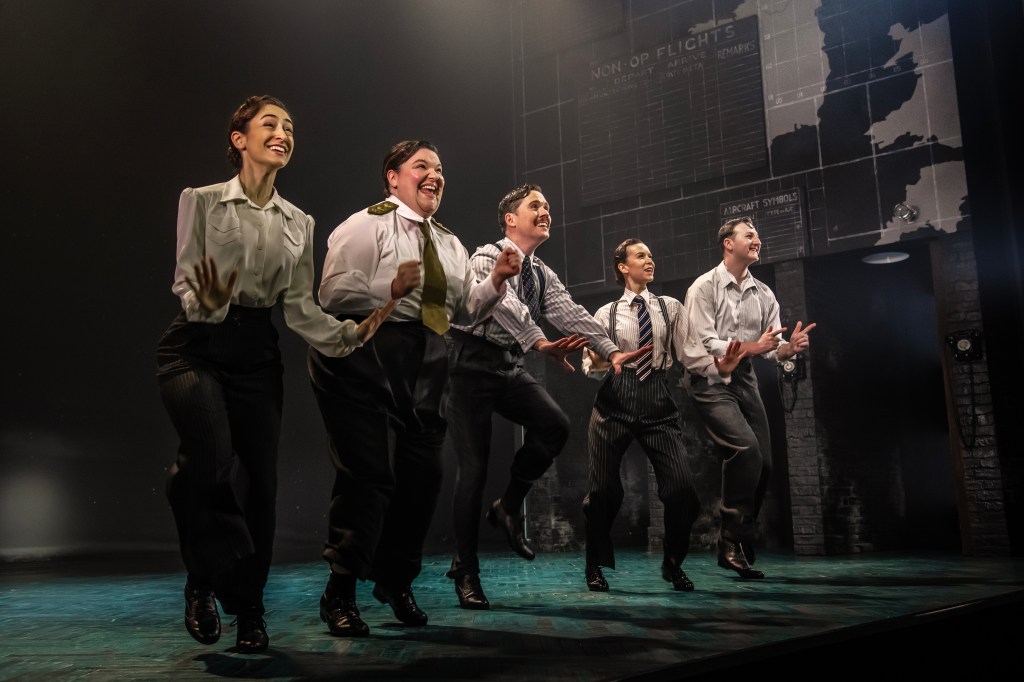
Whilst it began as a fringe show, with several off West End runs, it is now, to my surprise, a pretty elaborate production. Ben Stones’ set is static but beautifully designed, and there are countless set pieces that come on and off. The aforementioned closing number is an absolute extravaganza. Stones’ costumes operate in a liminal space between authentic and outlandish, which fits the tone of this unserious show about very serious real events. Mark Henderson’s lighting includes beams around the stage; it creates a lot of atmosphere and tension. The aforementioned Nazi number sees him turn the stage into a ferocious rave at a Berlin nightclub, parodying the fascists of both then and now. There’s even a “Make America Great Again” reference, which would feel too forced in a more serious show (I criticised the line “Make Germany great again” in The Book Thief) but is a whole lot of fun in a show like this, which makes a point out of stating the obvious.
It’s only a cast of five but the show feels bigger than it is because of the production (the set is what you’d expect for a show with a big ensemble) and the performers (whilst there are only five performers, they all play multiple characters, all of them larger-than-life characters that take up a lot of room – and impressive choreography, by Jenny Arnold, which fills the stage).
There was a lot riding on this cast. Firstly, it’s a complex production: each actor plays multiple characters, sometimes switching in the same scene, and there are so many scene-changes; the writers and director Robert Hastie have not made things easy for their cast. Timing needs to be absolutely perfect. Further, the original cast (which included three of the four writers) are so beloved. Fortunately, this cast (Christian Andrews, Seán Carey, Charlotte Hanna-Williams, Jamie-Rose Monk and Holly Sumpton) make the parts their own, and you quickly forget anyone else ever played them. Andrews stole the show, with the audience cheering every other actor equally but going wild for him.
With the West End production playing at the very intimate Fortune Theatre, a lot of people worried that playing larger venues, like Lowry’s Lyric Theatre (as opposed to the Quays) might drown the performers out, but the creative team and cast have cleverly adapted the show for a larger stage. Though, admittedly, the show does not use the entirety of Lowry’s stage, which is significantly larger than the stages in some of the other venues that the show is playing.
Whilst the show is undeniably very funny, it’s a very particular type of comedy. It’s not really my style – too British, perhaps – and I did not leave with my face aching from laughing, in the way that I did after other musicals, such as Unfortunate. But the comedy appeals to most people, many of whom find themselves laughing out loud throughout. The fact that the musical has become a roaring success on Broadway, despite being so quintessentially British, is a testament to how well written, well performed and, well, funny, it is! It certainly has more universal appeal than Oh, Mary!, which has divided British audiences, with some finding its comedy to be alienatingly American. I imagine, however, that both shows have a lot of fans in common, with their absurd, farcical comedy (and yellow branding), though the latter is so vulgar and outrageous that it makes Mincemeat look tame!
Whilst Operation Mincemeat may not always be my cup of tea, it’s undeniably an Übermensch show, and I don’t have any actual criticism. There is a lot of hype around this musical, and it more than meats expectations. It’s exceptionally well-done; it’s just that I, personally, prefer my meat rare (if this was a review of Oh, Mary!, I’d have said “raw”). If you love history, comedy and musical theatre, you must see Operation Mincemeat at least once.
Operation Mincemeat runs at Lowry (Lyric Theatre) until February 28 and tours the UK until November 28.
 JADAR
JADAR 