★★★★☆
As one of the founding fathers of the sci-fi genre, it’s no surprise that H.G. Wells’ works continue to inspire new adaptations to this day. War of the Worlds is perhaps his most prolific work, published in 1898, introducing readers to a cold post-industrial Victorian society unravelling under the threat of mechanical Martian invaders. His novel was concerned with the cruelty of colonial invasion, the flaws of imperialist values, and the continual development of new war technology.
Since then, numerous creatives have taken the reigns, with eight films, Orson Welles’ infamous radio show, Jeff Wayne’s 1978 musical, and multiple games and theatrical productions, each reframing dystopian narrative within contemporary concerns.
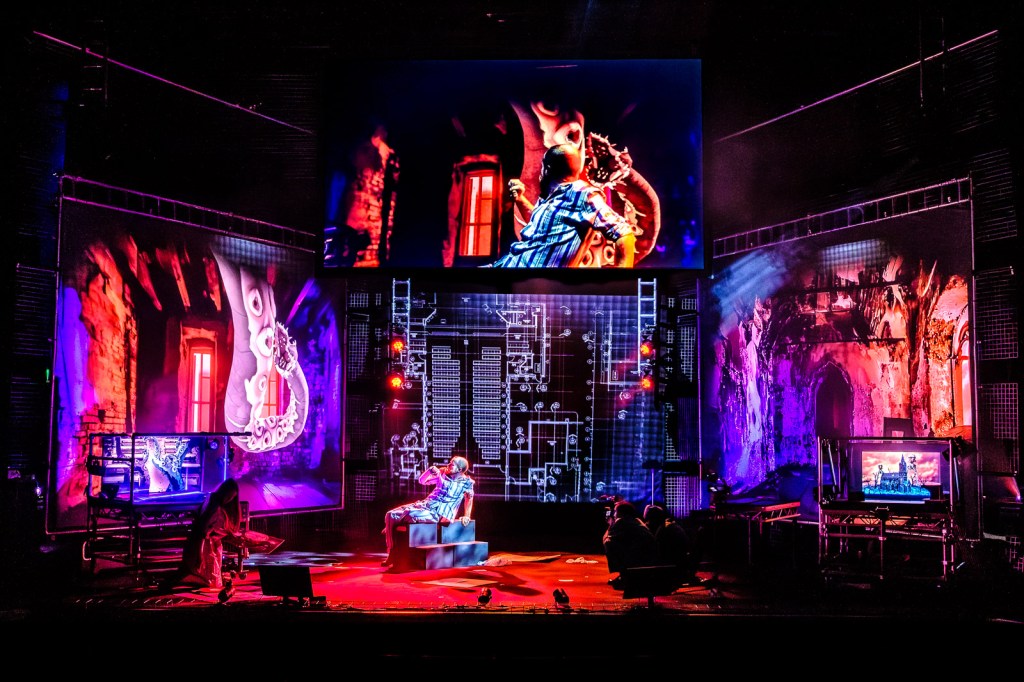
Imitating The Dog’s adaptation is situated in 1960s London, red apocalyptic skies and burning British landmarks reflecting the corruption of society as hateful anti-immigration discourse slowly isolates and destroys humanity – a theme just as prevalent today.
We follow Will Travers (Gareth Cassidy), who wakes up in an abandoned hospital with little memory of how he got there or what is happening outside. Extraterrestrials roam the streets, destroying any signs of life while a slew of madcap survivors skulk around every corner. Rumours of a safe passage across the channel spark hope but can he find his wife (Amy Dunn) before it’s too late? And is there any safety on this road trip from hell?
A four-strong cast bring the story to life with incredible attention to detail and meticulous direction culminating in a theatrical rendition of a one-take movie production.
Amy Dunn, Bonnie Baddoo and Morgan Bailey alternate between playing survivors, filming complex angles, setting up props, and changing the on-stage two miniature dioramas while Cassidy acts through the show’s entirety.
Composer James Hamilton’s score is chilling and tense, some moments leaning into eerie celestial choirs, others were stirring staccato stringed nightmares.
Abby Clarke’s set consists of two large screen environmental backdrops with a huge projection screen centre stage showcasing the “film’s” final product, as the cast put the shots together in increasingly creative and fairly amusing ways underneath.
To maintain the illusions, they used various camera tricks, projections, 2D props (and exaggerated sound effects), zoom-ins, miniature models, video elements, clever camera angles, pepper’s ghost effects, some double exposure, and several distortion filters. All of these effects seen on the screen are observable in what feels like a behind-the-scenes tour on the main stage, captured by Steve Jackson’s video system design. Andrew Crofts’ lighting is just as captivating with bright strobing red and white lights captivating the ominousness of the apocalyptic London streets.
The result is a jaw-dropping spectacle that works shockingly well as both a movie and a theatrical production. Yet it’s not without flaws: there’s an admittedly negligible delay between the audio/action and the screens, the pepper’s ghost effect is heavily distorted, resulting in elongated foreheads, and the on-the-spot walking moments use scenery reminiscent of clunky YouTube parodies with awkwardly scaled environments and the farcically slow walking cycles. Initially, it was also a little overwhelming to take in all the details, with the backdrops, miniatures, performers, and the main screen all competing for attention, however, after a while it becomes a lot easier to settle into the action and enjoy the technical wizardry.
I often critique productions for their overreliance on screens for visual storytelling but this production made me eat my words! It’s the first time I’ve seen screens used so seamlessly and with such ingenuity.
It’s difficult to highlight the poignancy of War of the Worlds without referencing the show’s final twisted moments. The intense stares, twisted grins, hysterical laughs, and menacing camera angles used to create some of the creepy survivor characters at first seems like a stylistic choice, oddball characters reflecting the trauma of the world around them. After the twist, they can be read as something else… the result of paranoid delusions and a mind consumed with hatred in its own Milton-inspired hellscape. The flickers of rowdy crowds, the residue of charred ashy corpses, and the bobbing dinghy boats – war-charged images confronting the protagonist with his own prejudices and spite.
It’s a refreshing twist on a beloved sci-fi classic with a poignant message, stellar acting, breathtaking effects, and an incredibly ambitious creative direction. The scrupulously crafted theatre-film concept is both amusing and strangely gripping. As we move into a world that leans ever-further into technology, I hope more shows experiment with the boundaries of expressive theatre-making.
Imitating the Dog: War of the Worlds runs at Lowry (Quays Theatre) until February 28 and tours the UK until May 2.
Photo: Ed Waring

 JADAR
JADAR 