★★★★☆
When the same cast unveiled Phelim McDermott’s riotously theatrical, circus-inflected staging of Così fan tutte at the London Coliseum earlier this month, audiences were treated to a visual feast of acrobatics, carousel imagery, a sword swallower, and dazzling colour. It was maximalist, exuberant, and unapologetically showy: a production that embraced spectacle as wholeheartedly as Mozart embraces melody.
Manchester told a different story.
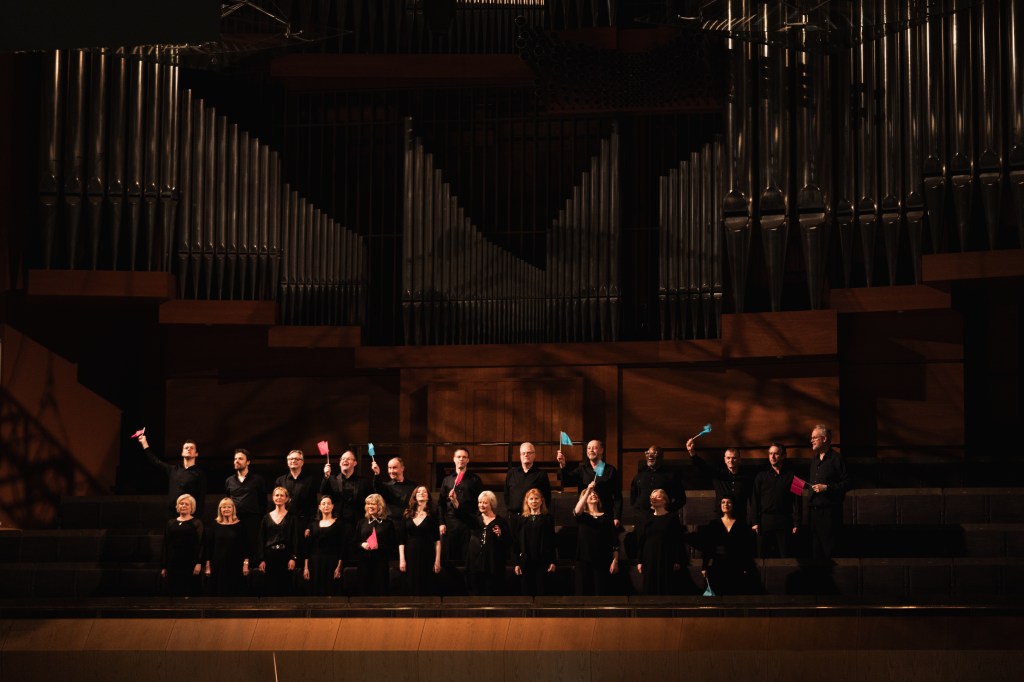
At the Bridgewater Hall, this performance of Così fan tutte arrived in semi-staged form: costumes, a few suggestive props, and some carefully placed movement before the orchestra. No Ferris wheels. No carnival mechanics. No neon boardwalk bursting into life. And yet, stripped of its visual flamboyance, the piece gained something else: concertation. The music sat firmly at the centre, unencumbered, allowed to articulate its ironies and its tenderness with clarity.
The original production (first seen in 2014) relocates the opera to 1950s Coney Island: all fairground brashness, motel signage, and seaside Americana. Under Ruth Knight’s concert-style direction in Manchester, those environments had to be imagined rather than seen. The libretto still references “the island”, tosses in mentions of “50 bucks”, and the supposedly departing soldiers salute in unmistakably American fashion. The setting, therefore, remained conceptually intact, even if visually absent. We supplied the boardwalk ourselves. Semi-staged opera is not immersive in the cinematic sense. The chorus swept on waving flags, generated a surge of energy, then receded again. There were no elaborate transitions, no scenic illusions to ease us between locations.
But what this format sacrifices in spectacle, it frequently regains in musical transparency. Mozart’s orchestration felt lighter, more finely etched. Ensembles, especially the great finales, unfolded with heightened precision, the emotional crosscurrents easier to follow without theatrical distraction.
Così fan tutte translates roughly as “Thus do they all”, often interpreted more pointedly as “Women are like that”. It is an opera buffa rather than a Singspiel: no spoken dialogue, only recitative and aria seamlessly interwoven. The musical continuity sustains the emotional ambiguity. Performed here in English, the text landed cleanly and sharply, sharpening the comedy. Mozart, ever a pragmatist of the theatre and keen that his works communicate directly with audiences, would likely have appreciated the immediacy.
The plot is simple on paper and far more unsettling in practice. Two young officers, Ferrando and Guglielmo, are persuaded by the worldly-wise Don Alfonso to test their fiancées’ fidelity. They pretend to leave for war and return in disguise, each attempting to seduce the other’s beloved. Despina, the maid, becomes a willing accomplice (persuaded by the promise of a small share of Don Alfonso’s winnings) and adopts (hilarious) disguises of her own to help advance the deception.
What begins as a philosophical wager curdles into emotional destabilisation. Attraction shifts. Certainty falters. The comedy hovers perilously close to cruelty, and, by the end, the opera refuses to offer easy moral reassurance.
Vocally, the evening was richly rewarding. Lucy Crowe’s Fiordiligi was outstanding, her soprano gleaming in the vertiginous leaps of “Come scoglio” and melting into vulnerability in “Per pietà”. Taylor Raven’s Dorabella offered warmth and suppleness, her mezzo-soprano earthy and impulsive by contrast. Joshua Blue shaped Ferrando’s lyrical writing with elegant phrasing and sweetness of tone, while Darwin Prakash’s Guglielmo brought a burnished baritone and charismatic ease. Andrew Foster-Williams avoided caricature as Don Alfonso, presenting him less as a villain than as a detached manipulator.
And then Despina took over. Irish soprano Ailish Tynan’s comic timing was razor-sharp. Every gesture felt considered, every vocal inflection purposeful. She drew genuine cackles from the audience: not polite operatic chuckles, but full-bodied laughter. In a semi-staged context, where personality must do the work scenery cannot, that level of character detail is invaluable.
Under Alexander Joel’s direction, the orchestra maintained buoyancy and stylistic finesse throughout. Tempi were alert without feeling hurried. The ensemble writing (those miraculous Mozartian layers of simultaneous emotional contradiction) breathed and
sparkled. The balance between pit and platform was carefully judged, ensuring the drama retained momentum even without scenic propulsion.
With the English National Opera set to establish a Manchester base in 2029, performances like this feel quietly significant. This was not the full Coney Island spectacle. But its musical integrity, its vocal excellence, and its trust in Mozart’s architecture made a persuasive argument of their own. A pared-back Così, certainly. But proof, if any were needed, that Mozart requires very little adornment to captivate.
Anyone aged under 21 can claim free tickets to all English National Opera performances at the London Coliseum, as well as at selected partner venues across Greater Manchester.
Photo: © Matthew Johnson
 JADAR
JADAR 