★★★★★
Have you come across the new viral video where Timothée Chalamet says he wouldn’t
want to work in ballet or opera because it’s all about keeping something alive “even
though no one cares about it anymore”? Anyone who has watched Birmingham Royal Ballet’s Don Quixote would probably respond with a very simple question: have you seen what happens on that stage?
Because Birmingham Royal Ballet did it. Again.
The house was buzzing, the audience audibly gasping at the stage pictures, laughing at the comedy, applauding the bravura dancing mid-scene. Whatever Chalamet might think, people absolutely do care about ballet when it’s presented like this: lavish, joyful, colourful, and unapologetically theatrical… with the first night completely sold out.
For those unfamiliar with the story, Don Quixote is loosely inspired by Miguel de
Cervantes’s famous early 17th-century novel about a man who reads so many chivalric tales that he begins to believe that he is a knight himself. Accompanied by his loyal but rather confused companion, Sancho Panza, he wanders the countryside searching for heroic adventures and dreaming of his ideal woman, Dulcinea. However, the ballet version focuses less on the philosophical satire of the novel and more on a lively romantic story.
At its heart are Kitri and Basilio, two young lovers trying to marry despite the obstacles thrown in their way. Around them swirl taverns, street celebrations, travelling performers, and, of course, the wandering Don Quixote, forever chasing illusions.
Carlos Acosta’s production, first created in 2022, follows the long tradition of the ballet
originally choreographed by Marius Petipa in 1869 to Ludwig Minkus’s score. For this version, Hans Vercauteren re-orchestrated the music, explaining that his job was essentially to add his own name to the long list of musicians who have helped shape Minkus’s ballet over the years. In some moments, he even adds entirely new material: the Act II campfire scene, for instance, features music composed by Vercauteren himself.
The opening scene immediately pulls you in. We begin in Don Quixote’s workshop, where
Dominic Antonucci (Don Quixote) is surrounded by books and objects that hint at his obsession with heroic tales. As the music starts, projections and dancers work together to create the illusion of shadows and hallucinations haunting him. Figures appear and disappear, moving across the stage like fragments of his imagination. Then the door in the middle of the set slowly opens, and there she is: Dulcinea, the ideal woman of his dreams, appearing in a delicate, dreamlike presence through Daria Stanciulescu’s portrayal (Dulcinea).
Imagine something almost Tim Burton-esque: a spectral bride in white, her figure softened by a long veil, moving slowly under a glowing full moon. Time stops, she glides across the stage with an otherworldly calm, dancing as though she belongs more to a dream than to reality. It feels less like a meeting and more like an apparition: Dulcinea appearing briefly to Don Quixote, silently calling him to search for her somewhere out in the world.
From there, the world expands quickly.
We move to a lively town square filled with dancing, flirting, and street festivities. Here,
we meet Kitri (Beatrice Parma), the fiery young heroine determined to marry the barber she loves, Basilio (Enrique Bejarano Vidal). Their chemistry is immediate and electric.
Looming nearby is Kitri’s innkeeper father, Lorenzo (Rory Mackay), who would much
prefer to see his daughter marry the absurdly pompous nobleman Gamache (Jonathan Payn), whose comic timing and movements make him an instant audience favourite.
At Don Quixote’s side throughout the adventure is Alfie-Lee Hall as Sancho Panza, whose wonderfully expressive physical comedy brings warmth and humanity to the role. The character often serves as the audience’s surrogate, reacting with confusion and disbelief to the knight’s increasingly wild fantasies.
From the square, we travel to a gypsy camp, where the atmosphere shifts into something
darker and more mysterious. Flames flicker, dancers whirl, and a passionate gypsy couple (Ryan Felix and Ellis Small) command attention with fiery movement and dramatic flair. During this scene, something particularly special happens. Live guitarists Tom Ellis and Dan Thomas appear on stage, seated among the dancers, as if they belong to the world of the campfire itself. Their playing blends with the orchestra (led throughout the evening by conductor Thomas Jung), creating a musical texture that feels both intimate and expansive.
It is here that Don Quixote confronts the famous windmill. The windmill itself appears as a projection, turning slowly as wind sound effects sweep through the theatre. As the rest of the stage becomes absorbed in the life of the gypsy camp—the dancing, the music, the flickering fire—Don Quixote seems to perceive something entirely different. What the others treat as part of the landscape begins to feel far more
threatening in his imagination, blurring the line between reality and the heroic battles he believes he is destined to fight. Quixote charges heroically toward the towering structure, but what follows does not go quite as he imagines, and the encounter quickly turns disastrous.
What follows is one of the most visually enchanting parts of the production. The magical forest: a dreamlike place filled with dazzling lights and sparkling glitter everywhere, even on the costumes. In this dream world, Amour (Riku Ito) appears, who moves with astonishing lightness and virtuosic precision as a Cupid-like figure guiding Quixote.
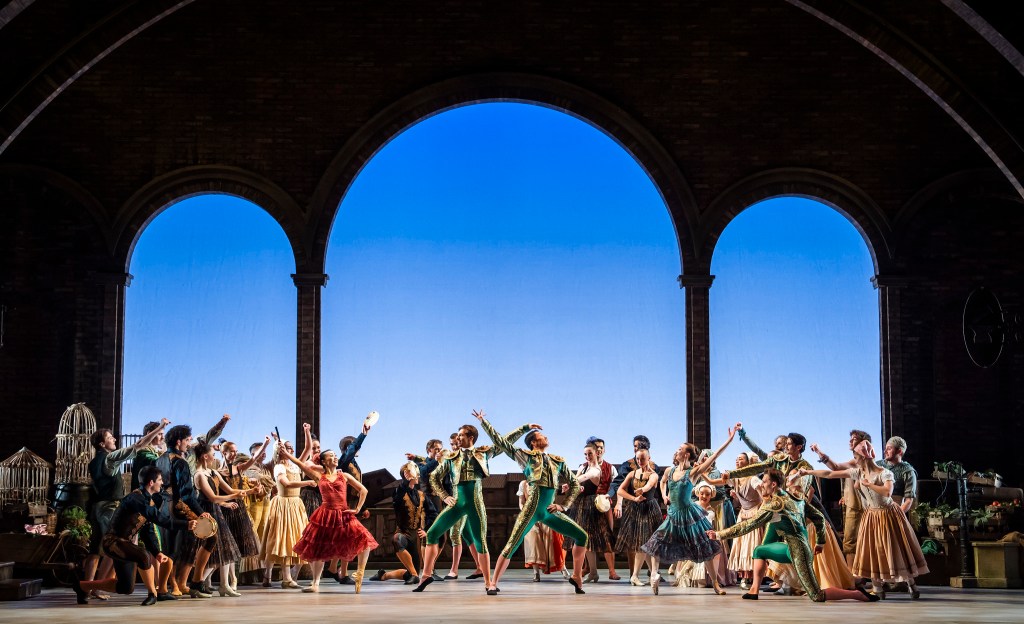
Eventually, we return to the town square, but it has transformed into a wedding celebration, decorated with flowers and bursting with colour.
Visually, the production is spectacular. Tim Hatley’s sets and costumes are astonishing
in their detail. Bright skirts swirl across the stage, matadors stride proudly, fans snap open with theatrical flair, and every costume seems carefully layered with embroidery
and texture. I would honestly place them among the most beautiful costumes I have ever seen on a stage.
The projections by Nina Dunn extend the world outward without overwhelming the dancing. Windmills turn, shadows stretch, landscapes unfold behind the performers. And then there are the small touches that make everything feel alive.
The choreography itself blends classical ballet with strong Spanish influences. Castanets click rhythmically, fans flick open and close like coded messages (fans were historically used in Spain to send secret signals), and the movement often feels like the joyful meeting point of classical ballet and flamenco.
Among the supporting characters, Lachlan Monaghan brings bold presence as the charismatic toreador Espada, partnering Samara Downs as the glamorous Mercedes. Their scenes inject swagger and confidence into the bustling world of the town square. At the centre of it all are Kitri and Basilio. Enrique Bejarano Vidal leaps with such height that you half-jokingly wonder whether he might have been a kangaroo in a previous life. Yet the jumps never feel like mere athletic tricks: they’re controlled, elegant, and musical. Beatrice Parma matches him with dazzling technique and charisma, radiating confidence in every turn and balance. At one point, he lifts her high above his head on a single extended arm and holds her there for several seconds while the orchestra swells beneath them. The audience collectively holds its breath. Then he does it again.
The ensemble dancers are magnificent, too. Birmingham Royal Ballet may not yet move
with the absolute razor-sharp uniformity of companies like the Bolshoi, Paris, or New York ballets. In large group scenes, there are moments when the synchronisation could be
tighter, when the lines could align just a little more precisely. But the company is clearly
moving in the right direction, and the energy and commitment on stage are infectious.
What really makes this production magical, though, is the attention to visual detail. Every corner of the stage feels thoughtfully designed. The costumes sparkle. The choreography balances technical brilliance with humour. Even the smallest characters feel purposeful. Ballet, like opera and theatre, is never just about the dancers. It’s about designers, musicians, technicians, craftspeople, and performers working together to build an entire world.
Sometimes critics focus too much on the material itself. Don Quixote, the ballet, is
undeniably long, with two intervals. Minkus’s score is charming but not exactly a Tchaikovsky hit machine. Certain scenes linger longer than necessary. But the real question is not whether the original material has flaws but what a company does with it.
Can they elevate it? Can they turn it into something magical? Birmingham Royal Ballet answers that question with a confident yes. By the time the final wedding celebration erupts in the flower-filled town square, the theatre is buzzing with applause and laughter. The entire stage glows with colour, music, and movement.
And if anyone still believes that nobody cares about ballet anymore, they should probably come and see this production.
Birmingham Royal Ballet: Carlos Acosta’s Don Quixote runs at Lowry (Lyric Theatre) until April 7 and tours the UK until April 25.
Photo: ©Tristram Kenton
 JADAR
JADAR 