★★★★☆
Based on Beaumarchais’ play La folle journée, ou le Mariage de Figaro, Mozart’s The Marriage of Figaro was first performed in May 1786 after extensive several edits were made to the revolutionary source material. Mozart’s work has lived on despite an initially rocky reception. His score ranges from mischievous to stirring with swelling orchestras and upbeat melodies creating a captivating operetta still revered to this day.
The story follows the antics of the Count and his household in a chaotic ‘Day of Follies’. Count Almaviva (James Newby) sets out a plan to advance on his assistant and young bride-to-be Susanna (Hera Hyesang Park). After informing her fiancé, Figaro (Liam James Karai), of his lechery, the couple dispatch devious schemes alongside the frustrated Countess (Gabriella Reyes) and the lusty young page, Cherubino (Hongni Wu). Meanwhile, Bartolo (Jonathan Lemalu) and Marcellina (Katherine Broderick) make plans of their own to scupper Figaro’s wedding. Will Figaro and Susanna be married? Or are the odds stacked against them?
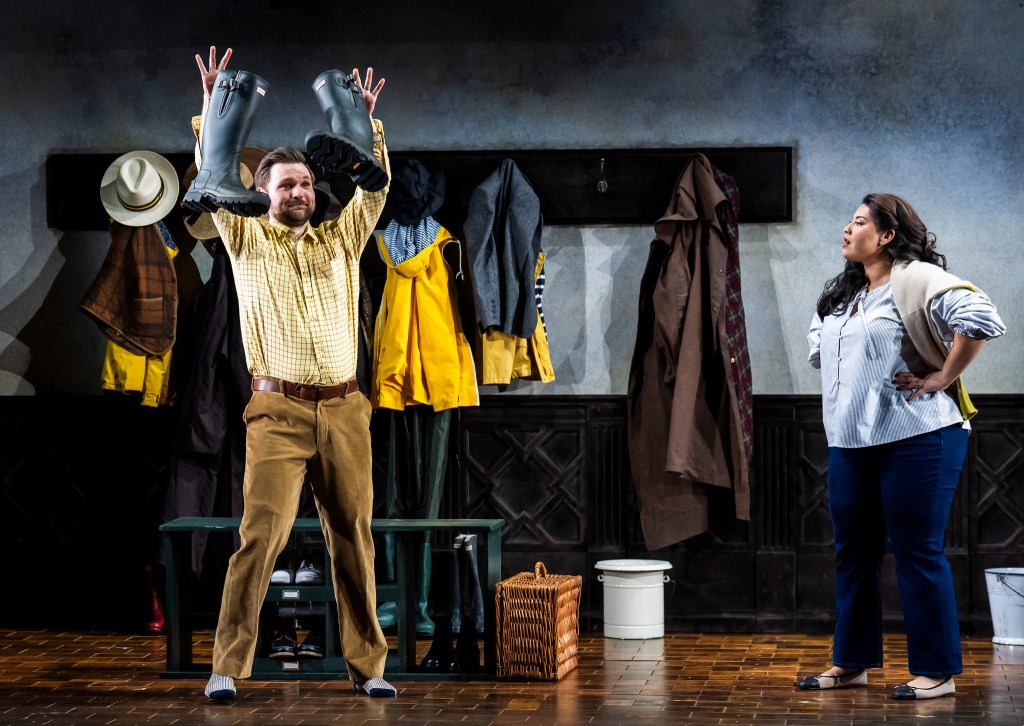
Opera North’s revival places designer Madeleine Boyd, transforming the original regal chateau into a modern-day English country house, complete with mobile phones, a quirky mixture of vibrant occasion-wear and everyday attire, and most importantly… dresses with pockets! The costuming isn’t quite as amusingly bold as the programme picture, but the funky patterns and neat splashes of colour perfectly reflect each character’s personality.
The country house eeks of antiquated charm despite its slightly dishevelled appearance. The boot-room is decorated with an array of fancy coats, hats and canes, while framed by washed grey walls, dark wooden panelling, and a grand window overlooking the staircase. The bathroom is similarly barren, with pops of yellow and green from the bath and wallpaper. An engaging split-screen effect isolates the masculine, maroon drenched billiards room from the colourful, half-decorated nursery next door, while the straw-covered stables feels a little incomplete, with disjointed structures and free spaces. All in all, Boyd’s design is inspired, drawing from contemporary colour schemes yet harkening to the past with crumbling, archaic structures.
Mozart’s adaptation toned down some of the more egregious condemnations of class and aristocracy to befit the period. Of course, the salacious Count remains but the heavy critiques are removed in favour of a farcical battle of the sexes and absurd misunderstandings and complications. Refreshingly, the opera is oddly empowering. Susanna and the Countess spend the majority of the show enacting their plans (with various levels of success), sharing a class defying womanly bond, and outsmarting the cheating Duke at every turn. The female cast also perform so many astoundingly glorious, soaring numbers, highlights including but not limited to, Susanna’s and Barbarina’s act 4 arias, Cherubino’s love song, and the Countess’ ‘Dove Sono’.
The Marriage of Figaro also avoids the misogyny I had expected from such an old opera, dipping into generalisations on both sides, coyly mocking both men and women for their silly predicaments rather than seriously critiquing either. When Figaro blindly accuses his wife of adultery, he spirals into hyperbolic imagery, depicting women as “witches”, “sirens”, “thorny roses” and “vixen” meant to trick men. “Here, we go again,” I thought, after hearing the usual, eye-rolling, female-hating speech. Yet, the opera surprised me, flipping the critique on its head when Susanna plans to teach presumptuous “foolish husbands” a “lesson”. Both characters are equally deluded in this scene, both expecting the other to cheat, leading to the realisation that both characters were being equally brash after they share a heart-melting embrace.
Indeed, MOF is delectably whimsical and light-hearted with shockingly effective comedy. The show’s lighter premise is a very welcome change in pace for someone used to dark tragedies. There’s a hilariously hammy use of physical comedy, with exaggerated facial expressions, terrible hiding places, disguises, cheesy dancing, silly conga lines, and even a handstand!
Other comedy centred around clever insults, trickery, mistaken identity, backfiring schemes, and childish pepper dusting and “kick me” sign pranks. Even the finale, an ensemble number, acts as both a warning and a mockery of the chaotic day – a well-rounded ending for the most bizarre opera on earth.
My main gripe comes from the show’s length as some moments linger a little longer than necessary, be it the repeating refrains or convoluted storylines. The jokes are effectively set up, and the action is very amusing, but sometimes I was sat wondering whether the scenes needed to be quite so long. Saying that, I did appreciate how the weighty run-time added to the show’s absurdity, each lie and scheme piling on top of the last, leading to panic and confusion before a cathartic release.
Opera North’s The Marriage of Figaro runs at Lowry (Lyric Theatre) until March 14 and tours the UK until March 28.
Photo: ©Tristram Kenton
 JADAR
JADAR 