★★★★☆
Crime and Punishment is a thinking sort of book. It is both conceptual (punishment) and action based (crime).
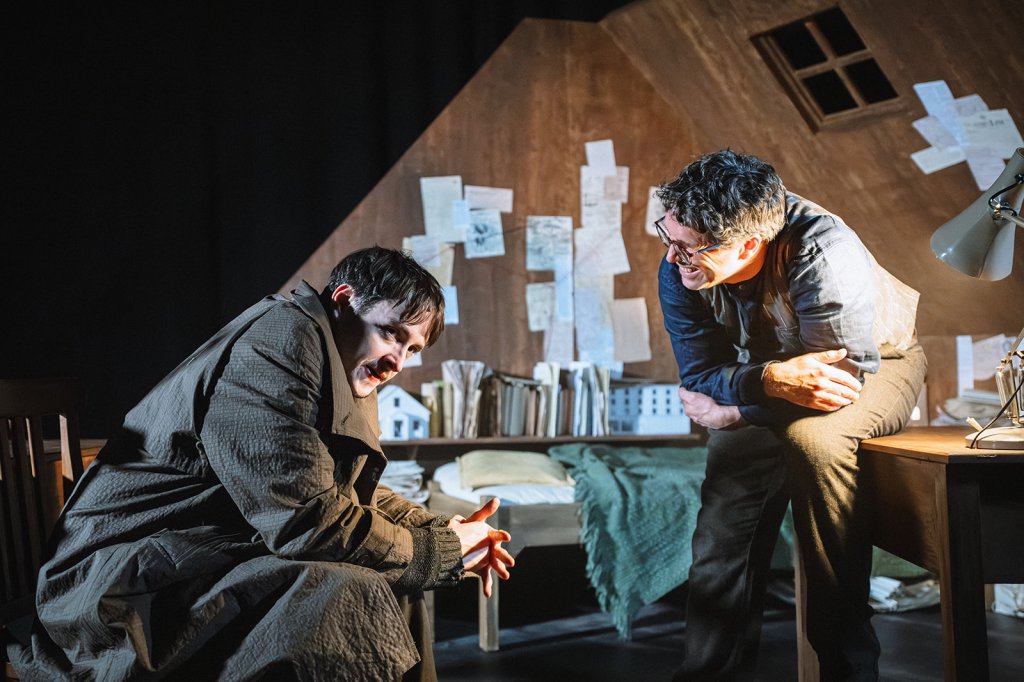
The play begins with a looping monologue aimed at the audience before being thrown into action. We see some ghosts, a sister’s unapproved fiancé, conniving, then killed, pawnbrokers and flashbacks as we encounter Rodion Romanovich Raskolnikov’s life, played by Connor Curren. There are two more actors, Trudy Akobeng and Niall Costigan, who play 8 characters between themselves, gender, age and morality bending between themselves. This adds an interesting touch, as the character of Rodion occupies a moral high ground, sort of playing versions of themselves and yet the actors around them, they actually move and occupy different characters who support the narration of the titular character.
The show began a bit conceptually – we see Romanov arise from under the covers of bed, and talk at length about concepts. And suddenly we are off to the pawnbrokers with him. Then back home, lulling mysteriously until we see he is in dire want of an axe, and I realise only right until the moment, that it is to kill the pawnbroker.
It is quite fast-paced, and the action’s meanings are sometimes only revealed at the moment of happening. The plotline of who is responsible for the murders creates layers of suspense for the audience, as we see Rodion badly, but somehow successfully, feign his innocence.
This play was quite a good introduction to (what I assume is present) a lengthy moralistic and conscious searching aspect of the book. The play’s focus is tight, on scenes of a wake, of street scenes, of a bar scene; even a horse accident is played out metaphorically quite effectively.
Another interesting aspect of the play is the use of lights, blindingly close to the actors (but really useful for an audience to see the emotions of the characters) and sort of street/stage lights which occupied the four corners. They would be turned on and off by characters, adding to a dark sense, literally and figuratively. There was great use of music too, ringing and bells, to evoke a sense of suspense and announcing of characters too.
The overarching narrative of the play, someone who kills two people, whether out of a moment of moral blackout, as suggested in the play, or an act of power, and its consequence, is ambiguous. I’m not sure if the play is wanting to show or suggest the binaries of motive but it does suggest the sort of dire straits the character inhabits as navigating the guilt of killing induces a paleness, shakiness and snappiness, which is remarked on, again and again, by friends, family, suspicious detective.
The killing does take a toll on Romanov, and the suffering is seen as punishment already so why go further and punish by prisons, by isolation? That is, if the person has remorse for their actions, which the play suggests they will, if they are encouraged to. Prison cannot be a stand-in for remorse, nor can a police system fullly understand motive, but can only punish action with enough evidence which is suggested to be a weakness of dealing with society’s murderous streak, in whoever it presents itself in.
Crime and Punishment tours the UK until April 4.
Photo: Andrew Billington Photography


 JADAR
JADAR 