★★★★☆
La traviata is another opera with an astonishingly long history. It was inspired by Alexandre Dumas the Younger’s 1848 novel and subsequent 1852 play La Dame aux camélias (The Lady of the Camellias) – a semi-autobiographical story about a young Parisian courtesan he’d encountered. Giuseppe Verdi’s La traviata decorated the story with lavish music oscillating between pomposity and emotive soundscapes. The opera’s famous ‘Drinking song’ becoming one of his most acclaimed pieces. It was first performed in 1853, premiering in Venice to critical mockery due to poor casting decisions. Despite this, it’s lived in history among some of opera’s finest pieces – another tragedy of course – but one with a poignant bittersweet embrace.
The story follows sickly young courtesan Violetta (Viktoriia Melnyk) as she falls in love with the doting bourgeois Alfredo Germont (Hovhannes Andreasyan). After his father (Iurie Gisca) interferes with their relationship, conflict ensues. But will the happy couple be able to resolve their issues before it’s too late?
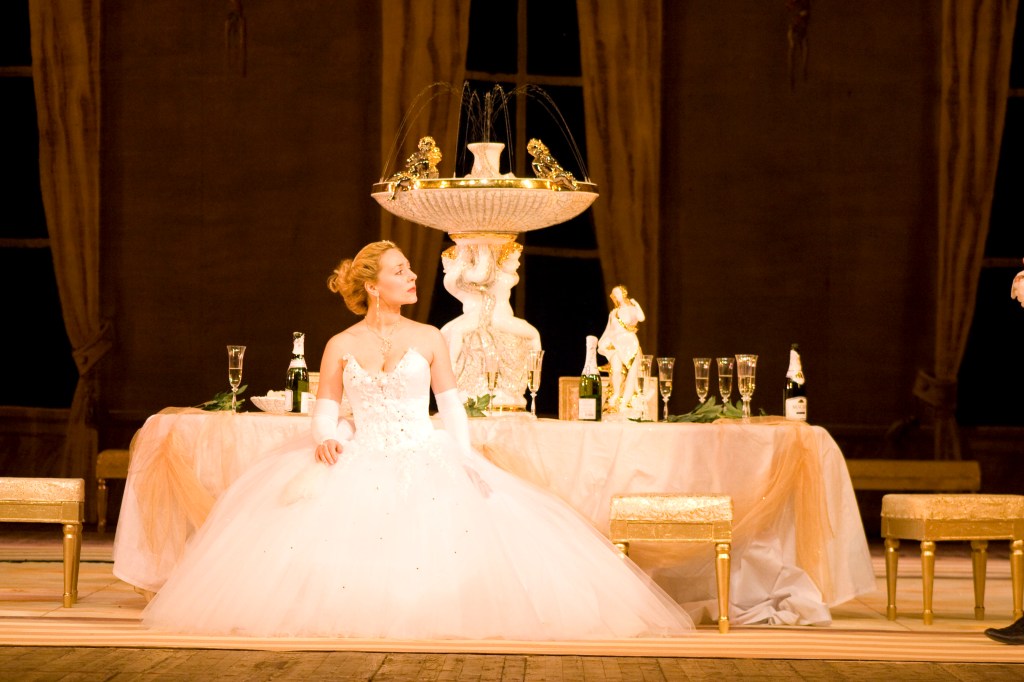
As usual, Kent’s sets have splendorous antiquated charm. The palatial architecture spreads across the stage like a vast watercolour painting, each set piece decorated with vases, statues, tables and a myriad of dainty flowers. Set changes leave a little to be desired since spaces sometimes felt a tad bare. For the most part, it’s an effective setting, although curtain crumples and holes in the mesh windows slightly disturb the otherwise well-crafted illusion.
Costuming is elegant with grand hoop-skirted dresses, bejewelled bodices, and floral hairpins. Others were dressed in a vibrant soirée of colour.
The opening moment was a tad awkward, lighting up the serenely poised Violetta draped over her chair for the opening before plummeting her back into darkness. That being said, it was a beautiful image.
My favourite opera/movie tradition returned with a Schrödinger’s cough and swoon hinting at Violetta’s inevitable decline. While a few moments were a tad melodramatic, the acting felt authentic, and the duo’s chemistry was palpable.
Viktoriia Melnyk was awe-inspiring as Violetta, her soaring soprano vocals and trembling vibrato constantly stealing the show. She paired excellently with the dulcet yet acrobatic vocals of Hovhannes Andreasyan as Alfredo.
Being an older opera, there are a couple of outdated phrases, one being “gypsy”. While archaic terms, I understand how difficult it can be to separate this rhetoric from the source material and historical accuracy.
Overall, I was surprised how engaging the story was. The story isn’t always action-packed yet the singers’ emotion and the stirring score ensured it never outstayed its welcome. Every scene felt emotionally charged, especially the moments of spine-tingling a cappella.
Violetta’s death scene was a poignant moment although a tad melodramatic again as she flops into her lovers’ arms (but that’s more a critique of the source material). This was followed by a few curtain mishaps; one leaving them open before the curtain call, and another crushing the conductor. Despite these momentary hiccups, the show went off without a hitch, breathing new life into the classic operatic tale.
Kent’s direction entertains audiences with some ravishing designs, a mellifluous ensemble, and a devoutly traditional approach (of course sprinkled with moments of spectacle). Her production of Madama Butterfly was my first introduction to opera, and I’m happy to say that this production feels just as accessible to newcomers and old fans alike.
One tiny side-note: the placement of the surtitles was a tad high. This allowed audiences to keep the action and text separate but it also made it tricky to keep track of fast-paced exchanges.
Ellen Kent’s Farewell Opera Tour runs at Opera House Manchester until March 26 and tours the UK until May 13.


 JADAR
JADAR 