Bizet’s Carmen is a cultural powerhouse of such magnitude that even those who have never set foot in an opera house are guaranteed to know its music. Its melodies have been repurposed for everything from luxury car commercials to classic phone ringtones for decades. The score is so deeply ingrained in the public consciousness that it has even been immortalised in a 1962 Tom and Jerry episode (‘Carmen Get It!’), making it one of the most widely recognised works in the classical repertoire. It is a gritty, realistic tale of passion and fate that demands a stage filled with the sweltering heat of Seville.
Unfortunately, last night at Manchester Opera House, that heat was nowhere to be found: I arrived full of excitement, having hummed the melodies all day, ready to be transported to the heart of Andalusia, but I ended up with the lukewarm dampness of a Manchester canal.
The opera centres on Don José, a soldier whose transformation from a man of duty to a man of obsession is triggered by the fiercely independent Carmen. It is a narrative of doomed love and fatalism, set against the backdrop of 19th-century Seville. As José’s jealousy spirals out of control, the arrival of the charismatic bullfighter Escamillo sets the stage for a finale that remains one of the most famous in the repertoire.
The cracks first appeared in the pit with the Orchestra of the Opera International, Kyiv. Under the baton of Vasyl Vasylenko, the ensemble sounded as if they were collectively sight-reading the score for the very first time during a particularly stressful rehearsal. They were off-key, off-tempo, and curiously muted. Virtually every section fell completely flat as the dusty plains of La Mancha, showing a lack of energy and a clumsiness that felt out of place for such a prestigious venue. The only saving grace was the oboe player, who provided the few moments of true instrumental clarity.
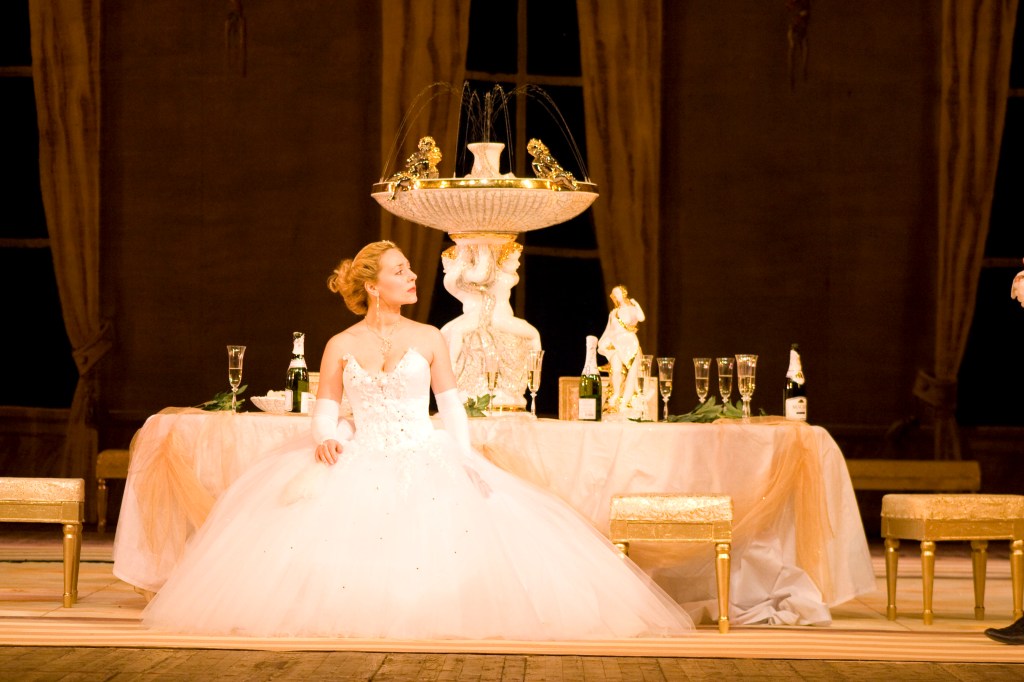
The stage design was similarly underwhelming and felt remarkably unrealistic. While Act 1 had a couple of things happening, the DIY ‘buildings’ were set at such an angle that the cardboard edges were glaringly obvious, instantly killing the illusion. The background was a painted canvas that wobbled precariously every time a performer accidentally bumped into it. At one point, Carmen knocked some flowers off a fountain—to her credit, she handled it with a bit of humour—but it was a silly mistake that really should have been fixed to avoid looking like a school play.
The transition to the tavern in Act 2 was equally uninspired, seemingly achieved by simply removing a door and placing a table and a few barrels in the middle of the stage.
Act 3’s ‘gypsy camp’ was the low point: the entire set consisted of two baskets with flickering orange fairy lights inside, offering about as much Spanish flair as a microwave paella.
Act 4’s bullring was the most visually effective set of the night, but even that was essentially just a backdrop; the lack of props meant it never felt like an arena but a bare stage.
To make matters worse, a total lack of coordination occurred between the first and second acts. Even though the house lights were never turned on to signal an interval, the ushers and the programme failed to inform the audience that the scenery break was just that: a break. Confused viewers began wandering out, and when the music suddenly resumed and Carmen began to sing to a half-empty room, a wave of panicked people came sprinting back to their seats in a frantic scramble, talking and shuffling with snacks and drinks in hand, while the performance was already well underway.
The acting was unintentionally comical throughout, frequently drawing laughter during the most serious scenes; it was a gritty tragedy that had devolved into an accidental farce. A consistent highlight in this department, however, was Anastasiia Blokha as Frasquita; her side-character performance was delightful and filled with the energy the rest of the production so
desperately lacked.
The lack of care on stage extended quite literally to the fabric of the show, as the costumes looked like they had been ordered in a panic from Shein. The soldiers and factory girls were draped in cheap-looking polyester, and the Toreador was missing the ornate outfit you’d expect from a matador, wearing a plain, budget version instead.
Even more baffling was the styling: why did every single girl have the same red flower in her hair, and why was every single one worn on the same side? It felt less like a vibrant Spanish crowd and more like a uniform
assembly line.
Carmen’s costume change for Act 2 even featured a glittery outfit that felt completely off-style for a traditional production.
Then there was the musical direction. The decision to cut the iconic children’s choir (‘Choeur des gamins’) and replace it with a single bugle was a massive blow to the charm of the piece.
As for the leads, Mariia Davydova has an absolutely gorgeous, velvety voice; I would happily listen to her recordings on repeat. However, she was much more effective as a vocalist than as an actress. Lacking the fiery sensuality the role is known for, she was about as seductive as a siesta: her choreography felt like a repetitive loop of hand-waves and hands-on-hips metronomic figure-eight sways rather than the magnetic, dangerous spark that makes Carmen
legendary.
She was paired with Hovhannes Andreasyan as Don José, who also possessed a wonderful, resonant voice that earned several well-deserved ‘Bravos’ and long rounds of applause. Their chemistry was a masterclass in mutual exclusion: they were like oil and water, occupying the same stage but refusing to mix. The only chemistry of the night was between me and the exit door.
Viktoriia Melnyk as Micaela, while looking more like Sleeping Beauty’s Aurora in
Disneyland, provided another of the evening’s few vocal highlights, though even her big Act 3 aria was hampered by technical confusion: either as a delayed afterthought or by total accident, the stage lights turned on two minutes into her aria, leaving it entirely unclear whether the error
was in the timing or the lights being turned on at all.
Finally, Iurie Gisca as the Toreador felt like a random guy who had wandered onto the set. While projecting machismo, vanity, and
pride is essential to the role, it does not mean the part should be sung at full throttle from start to finish. We were treated to a great deal of shouting, which seemed to be his only strategy for conveying the character’s signature swagger, suggesting he thought a matador’s main job was
simply to yell at the bull until it eventually gave up out of sheer exhaustion.
In the end, this production was saved from total failure only by the undeniable vocal prowess of the three leads: Daydova, Andreasyan, and Melnyk.
It is clear that while the on-stage talent
was significant, it spent the evening struggling to shine through a production that was visually uninspired and an orchestra that sounded as though it had quite literally fallen into the pit. Bizet deserved better, and the audience did too.
For a farewell tour, the real misfortune of this Carmen was just how long it took to say goodbye, making the final curtain feel less like a tragedy and more like a merciful release.
Ellen Kent’s Farewell Opera Tour tours the UK until May 13.
 JADAR
JADAR 