★★★☆☆
A Grain of Sand appeared to be a mixture of fictional retelling and testimonies taken from A Million Kites: Testimonies and Poems from the Children of Gaza by Leila Boukarim and Asaf Luzon. The production was created by Good Chance Theatre, directed by Elias Matar, and performed by Sarah Agha, who also co-developed the piece.
A Grain of Sand reads as a monologue given by an 11 year old girl, Renad, describing and detailing her survival of several bombings in Gaza. The text is a beautiful blended mix of monologue, prose and poetry which included the written memoirs and poems from dozens of children living in Gaza. There was a pervasive theme of storytelling and several pieces of Palestinian folklore to guide the narrative.
A Grain of Sand is one of the most important pieces of media I have consumed across the last several months. It is a piece for everyone to bear witness to. It is vital to think about these stories, to keep them alive, and to digest them properly. I believe consuming and interacting with this space is vital, which is why I would recommend the show.
The proceeds of the tour go directly to charity, and a lot of the major themes are explored appropriately. It left lots of audiences with hope that remembering and retelling stories is essential and connects us to something greater than ourselves.
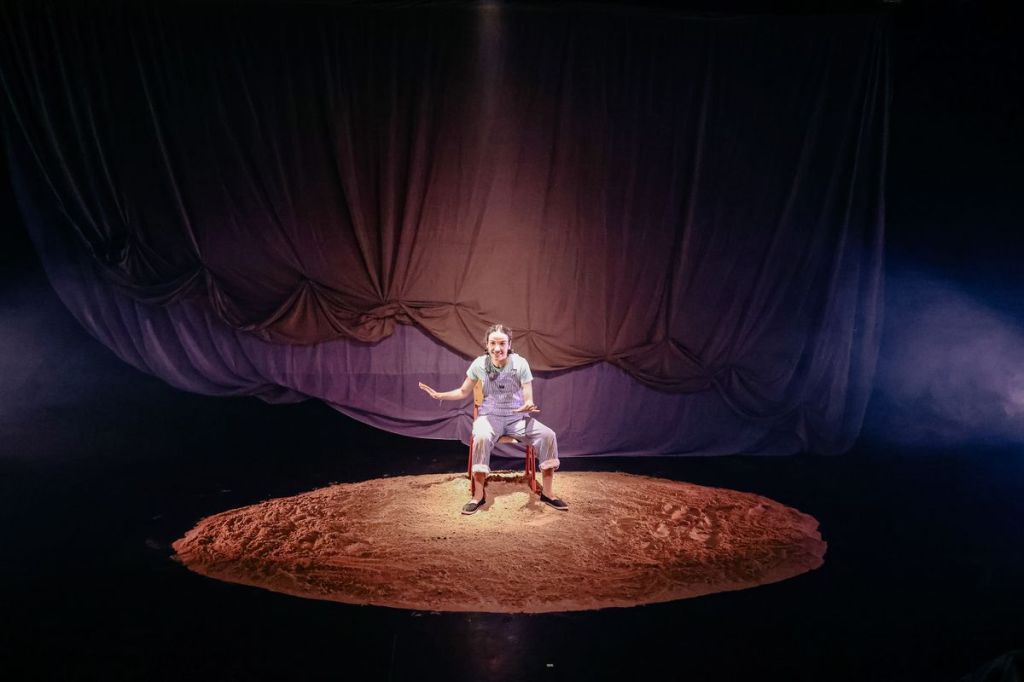
The production had a pile of sand and a single chair in the centre of the room with a curtain behind the performer. Sarah Agha was breathtaking. Her emotional capacity and ability to flip between emotions, characters and monologues was impressive.
This being said, I thought there was a slight disconnect in making this piece a stage show. I found the text itself to be incredibly well written, and beautifully spoken, but almost restricted by the format it was given in. In order to make the narrative flow in a more successful manner, further script development would be needed. Tightening up the general structure would make the arc of the story flow better.
The monologue flow was interrupted by the interjection of written testimonies several times throughout the piece, where Renad drops all characterization and delivers the poems verbatim. Contemporary theatre can feel inauthentic at moments and lose the power of portrayed emotions. This is largely how I felt during this show. I think the interjection of poetry in an expressionless manner can be an aid for audiences and for the performer to feel a lightened sense of emotion but I felt it was difficult to return to immersion in the narrative.
I also find it difficult to fully grasp a narrative when adults play young children but this could be playing with the idea of kids growing up too quickly. For me, it felt like the piece would be better taught, read or performed within the education system. I would argue for this play to be taught as a part of school curriculums. I felt the proposed theme of allowing children to hold on to their right to be children was almost fully developed but was missing the critical perspective of childhood hope. I understood the attempt but think the development comes in how we perceive the show afterwards.
I found the call to action at the end to disconnect me even further from the piece. I think the room was filled with activists wanting to see theatre of hope, to engage in that space with other pro-Palestine individuals. However, the call to action felt almost inaccurate to the room, asking us what we have done as opposed to what we can continue to do.
The piece was handled with a rare maturity in modern or contemporary theatre, with a care pack sent out to ticket distributors. This care pack included grounding exercises, links to donation websites, and explanations of the story. It was a true marvel og accessible theatre that I have not seen before. I was blown away by the care put into the show.
The standout moment was the end when Renad tells us to remember the names of the children, and projected behind her are hundreds of names and ages of children who were killed in Gaza. This was a show stopping moment and something so beautifully done.
I felt the use of contemporary theatre fixtures pulled me out of the story more than I would have liked but the overall dedication and passion is worth seeing this show. I believe a slight restructure of either the narrative of the script or a general shift away from the use of contemporary theatre fixtures would give this show the extra push.
A Grain of Sand runs at HOME (Theatre 2) until March 28 and ends its UK and Ireland tour at Smock Alley Theatre, Dublin, from April 7 to 11.
Photo: Amir Hussain Ibrahimi
 JADAR
JADAR 