Bryony Kimmings is a playwright, performer, documentary maker, and screenwriter from the UK inspired by female stories, social taboos, and dismantling power structures. As with all her previous works, Bog Witch follows a part of Kimmings’ real-life story—this time the journey of uprooting her and her son’s life to live in a tumbledown cottage in the wilderness to plug back into nature as a last-ditch attempt to be happy and sane.
I first saw Kimmings onstage almost 6.5 years ago when she brought the acclaimed I’m a Phoenix, Bitch to Manchester. That show, which documented her severe breakdown following a failed relationship and her child’s illness, is one of those rare performances that has stayed with me—haunted me, even. Having eagerly awaited her return, it is clear that Kimmings remains a threamaker with her own inimitable brand of storytelling. Like Javaad Alipoor, her work can’t really be compared to anything else; she seamlessly fuses live music, stand-up, performance art, and audience participation into a hybrid that feels both chaotic and meticulously controlled.
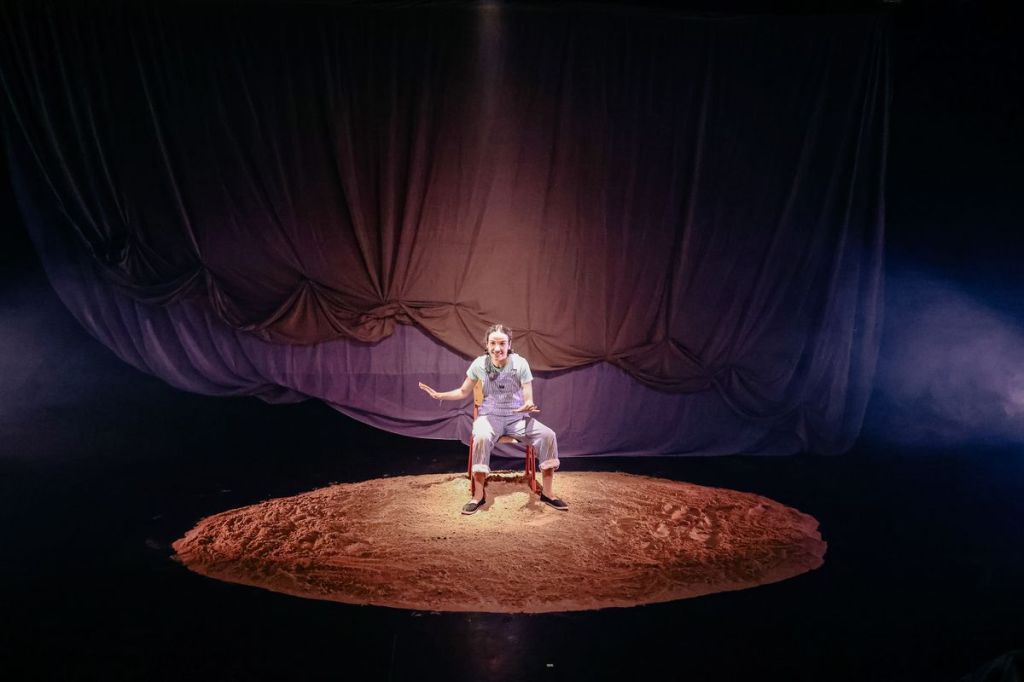
The story unfolds like a dark fairy tale, embracing camp and whimsy as a survival mechanism. Tom Rogers’ simple yet effective set is transformed into a forest-like labyrinth through Will Duke’s shadow projections, Nathan Fernée’s animations, and Guy Hoare’s bold lighting. Rogers goes full camp with country-chic costumes that physicalise Kimmings’ out-of-touch, out-of-place approach to the countryside, while Tom Parkinson’s folk-like compositions provide a sharp cabaret edge.
Yet, beneath the folk-horror aesthetic, the narrative is simultaneously unfathomable and relatable. While the specific circumstances are wild, the raw humanity of Kimmings’ performance makes the microcosm of her life feel universal, addressing the climate crisis and identity in a refreshingly roundabout way.
Central to this power is her commitment to the Bog Witc” persona – a transformation that feels less like a costume and more like a psychic survival tactic. She avoids the cliché of the peaceful rural retreat, leaning instead into the rot and the mud.
This grit is balanced by the interplay between Kimmings and her unseen son, Frank, which provides the show’s most tender undercurrent. The friction between the absurd, theatrical “witchiness” and the terrifyingly real responsibilities of solo parenting gives the play its unique, vibrating energy. It suggests that sometimes, to find sanity in a crumbling world, one must be willing to become a bit of a monster.
If there is a stumble, it is in the momentum. While dividing the year into four seasons is a neat narrative device, some sections go on a bit long (particularly Autumn). The play would be no less powerful if it shed some of its 90-minute runtime; a faster pace would transform this journey into a true emotional roller coaster.
Ultimately, Bog Witch is a messy, beautiful, and deeply courageous return to the stage. While it may occasionally linger too long in its own atmospheric shadows, the sheer audacity of Kimmings’ vision is undeniable. She remains a vital voice in British theatre, proving once again that the most personal stories are often the ones that speak most loudly to our collective anxieties. It is a wild, mud-flecked journey into the dark heart of healing – and even with its minor pacing flaws, it is a trip well worth taking.
Bog Witch runs at HOME (Theatre 1) until March 28 and tours the UK until October 1.
 JADAR
JADAR 