★★★★☆
Noël Coward‘s Private Lives has been performed countless times over the past century. We’re only a few months into 2026 and we’re already on to our second production of it in Manchester just this year. With something so classic and iconic (and arguably overdone), new directors must ask what they can do differently to avoid creating just another production that will soon be forgotten… The latest production puts it in the round.
Following on from the smash-hit success of Singin’ in the Rain and Road, the latter of which sold out before it even opened, the Royal Exchange Theatre, which is under new leadership, has decided to play it safer with this much-loved play (ahead of a bold new play about the IRA!). Whilst Singin’ in the Rain had literal rain onstage, and Road was an immersive production that spanned the entire venue, Private Lives is a more traditional production, which is actually a welcome change; the venue does not want to run the risk of appearing like it is chasing gimmicks and constantly trying to do something more shockingly innovative.
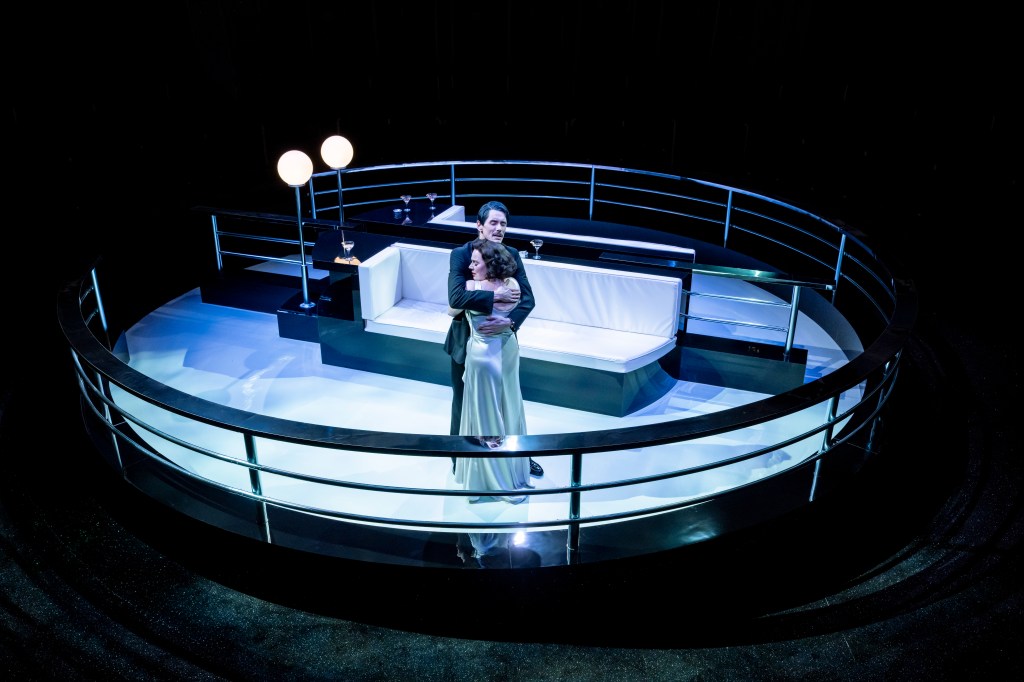
Private Lives explores the volatile, intense and destructive relationship between two divorced individuals, Elyot and Amanda, who discover they are honeymooning with new spouses (Sibyl and Victor, respectively) in adjacent rooms. The entirety of the first act takes place on the hotel balconies. Designer Dick Bird has split the Royal Exchange’s circular stage in half, with metal railings surrounding it. It’s an unattractive attempt at Art Deco but that might be deliberate, for it feels likes a clinical, pristine, over-polished façade which is soon going to get smudged. The black and white colour palette represents duelling dichotomies; the stage, as a whole, almost evokes a yin and yang. The stage is taken apart in Act 2 and transformed into Amanda’s opulent Parisian apartment, which works similarly as a façade – only this set actually gets wrecked!
The stage makes use of a revolve, which at first spins pretty slowly but gradually picks up pace, significantly in the second act; as emotions spiral, so does the stage. However, it would have been fun for the stage to spin even faster at the play’s most intense point, creating a feeling of nausea. The action, similarly, felt a little little restrained relative to other productions but it was still very funny. It is impressive how well the comedy has aged – well, most of it. The play has been criticised for being sexist but audiences today mockingly laugh at Elyot’s sexism rather than laugh along with him at the expense of Amanda.
The play has also received criticism for its flippant handling of domestic abuse. Earlier this year, we criticised HER Productions for leaving this injustice intact; we were surprised that a feminist production company did not successfully subvert it. I expected the Royal Exchange to similarly play it for laughs but was pleasantly surprised that they changed the tone during the domestic abuse scene in Act 2; it felt more serious and solemn, stunning (most of) the audience into silence.
Before the violence, a thunderstorm brews (sound design by Gregory Clarke), initially imperceptible but quickly growing more volatile, which excellently underscores the danger beneath the glamour. However, the seriousness of this scene feels a little out of place, for whilst domestic violence was mentioned and suggested previously, and whilst Elyot’s misogyny was there in abundance, the severity of it all ought to have been more strongly foreshadowed. However, McIntyre may have wanted this scene to feel like a bit of a twist, shocking the audience and forcing them to reflect on what they know, and perhaps also feel bad about previously being amused by the sprinklings of sexism and domestic violence. There are no real consequences to the violence with it seemingly being brushed under the carpet, but perhaps that is the point – and it does indeed reflect reality (and the title: private lives).
Private Lives could very much become boring, by virtue of just being a series of conversations. It wrests mostly on its performances. Jill Halfpenny is unsurprisingly captivating as the acidic, vicious Amanda; there is, refreshingly, a quiet vulnerability and brokenness behind her icy façade, but this could have been highlighted more effectively. Whilst she hits Elyot too, it is suggested that he hit her first, thus her hitting him can be seen as self defence, revenge, or justice. Steve John Shepherd holds his own against Halfpenny as the sleazy, sexist Elyot. His performance is deliberately cartoonish and caricaturish, for that is probably the only way that a modern audience can make much sense of such an outrageous man.
Whilst Halfpenny and Shepherd’s individual performances are strong, their chemistry, passion and fire for each other never quite ignites; this does not appear to be a raging romance. But again, McIntyre may want us to know that these two contemptable individuals are not compatible and are in fact mistaking each other’s mutual awfulness for compatibility.
Shazia Nicholls is similarly outlandish as the vapid Sybil, though it is suggested that she is smarter than she appears, perhaps weaponising hysteria to get her way, married to a sexist man, and living in a sexist society, that perceives women as emotionally unstable. Daniel Millar successfully brings charm and comedy to the straightest character of the bunch; he skilfully portrays Victor as a man so arrogant in his ordinariness. The cast is rounded off with Sara Lessore as the exasperated French maid, Louise, a criminally (but deliberately) underwritten character, who speaks to classism (and perhaps also a sprinkling of xenophobia).
Dick Bird’s costumes are period appropriate and pretty attractive, and there is some nice lighting by Johanna Town but it feels uninspired. Granted, that is probably what McIntyre wanted, pure realism, but the stage is literally spinning as emotions spiral, so some more exciting, perhaps even experimental, lighting would not have felt out of place. The production could also benefit from more physical comedy, such as when Amanda dramatically ducks when she first sees Elyot – but even that could have been handled with even more humour. Private Lives is at its best when it goes full farce but this production holds back in several ways. It does a decent job of making the dated play speak more strongly to a modern audience but it sometimes struggles to balance the tonal shifts and nuances in the play. It’s cool, clever and captivating – but not always entirely convincing.
Noël Coward‘s Private Lives runs at Royal Exchange Theatre until May 2.
Photo: Johan Persson

 JADAR
JADAR 