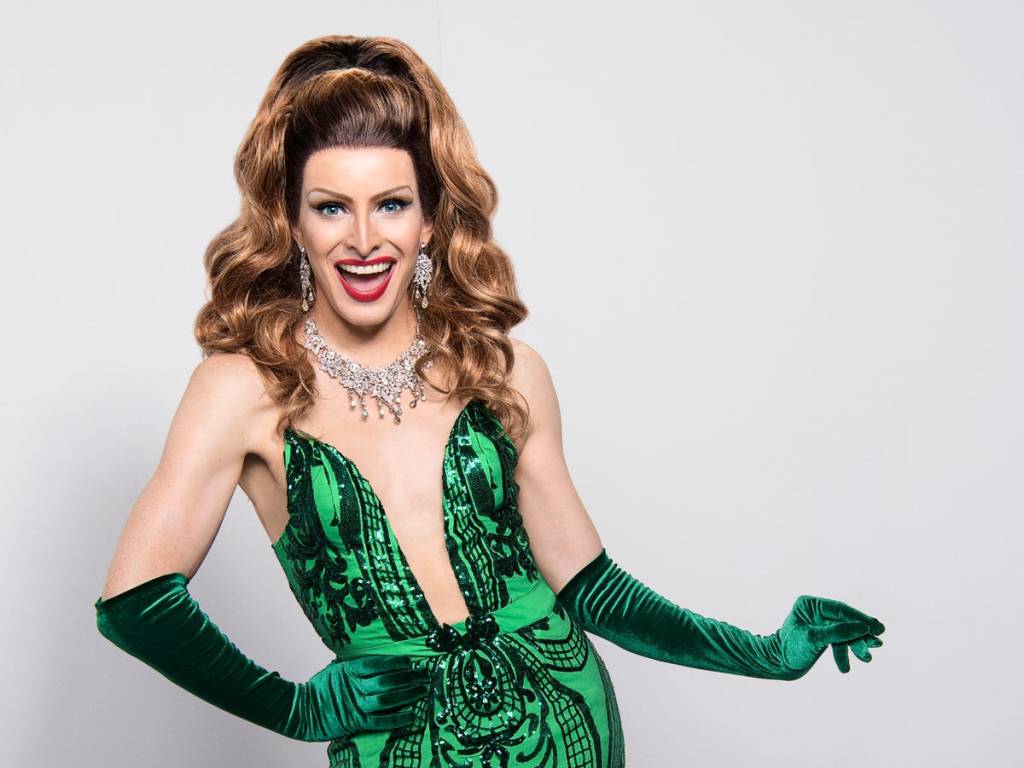
Inspired by The Wizard of Oz, Alice in Wonderland, politics, and surrealism, Trompe L’oeil questions if anything is quite what it seems. Ahead of its regional premiere in Manchester, we sat down with Manchester’s own Veronice Green.
Do you remember when you first realised you wanted to become a drag queen?
“There were several moments throughout my childhood but I think I’ve always been enamoured by the female form. I’ve always gravitated toward femininity; it’s something that feels inherently within me, and I love expressing it through my personality.
Growing up, I saw To Wong Foo, Thanks for Everything! Julie Newmar, and I was completely fascinated by it. The film opens with a pageant, and seeing all those different drag performers, all those styles and transformations, was awe-inspiring. From then on, I thought, ‘I’d love to try that myself one day.’
“But it took me a long time to find the courage. I worried about rejection, about losing career opportunities as an actor, and about alienating myself from casting directors. I also grew up in a fairly repressive environment, and even harmless interests can feel impossible to pursue when you’re afraid of judgment. As a child in the 1990s, LGBT life was still seen as something unacceptable in many spaces, so it took me a long time to get to that point.”
Was it difficult to step outside the life society expected you to live?
“Absolutely. Stepping outside the box of what society tells you is the ‘correct’ blueprint for life is hard. It’s only now, at 40, that I realise the way we were taught to live isn’t the same as the generation before us, or the generation before that. Every generation gets handed a new blueprint.
At a certain point, you realise that following the old rules doesn’t necessarily guarantee anything. I went to college, I worked hard, and I still didn’t get the promotions or outcomes I was told would come from doing everything ‘right.’ Society evolves, and sometimes the old formula simply doesn’t work anymore. That makes it easier to accept that you have to build your own path.”
You make your own dresses and create such a distinctive visual style. Where do you get your inspiration for costumes?
“Creativity has always been part of my life. My brother and I grew up in a very poor working-class family, so we didn’t have much money for toys or full collections of things. Instead, we created our own characters, our own stories, and our own little worlds. We had paper toys, and we’d invent these different ‘shows’ for them: superhero groups, sitcom-style characters, all sorts of things. My brother would draw them, and I’d colour them in.
“One of the characters we created was Veronica Green. Veronica Green actually started out as a villain in the stories my brother and I created. She was loosely inspired by my sister Veronica. We thought of her as a sort of Poison Ivy-style character, because Veronica is also the name of a plant, so ‘Green’ made sense. Over time, though, the meaning changed. My sister became one of my biggest inspirations. She’s dragged herself out of a poor working-class background, built a life for herself, and works caring for vulnerable young people who’ve had to be removed from dangerous family situations. She’s an incredibly compassionate person. So what started as this childhood supervillain became, for me, an homage to her. In a way, we turned the villain into a hero.”
In Trompe l’Oeil Musical you play the central character – Demi. What is the best thing about this character?
“Demi is fascinating because she’s really the audience’s eyes throughout the piece. The show explores absurdity and is rooted in the political and social landscape surrounding Trump’s first presidency, and Demi is the figure through whom the audience experiences that world. Her name is Demi as in Democrat, and she represents one side of the political spectrum. She’s trying to navigate this upside-down world while staying rooted in herself. She knows who she is but she’s been thrown into a reality that feels bizarre and disorienting.
“What I love most about playing her is that she allows me to guide the audience through all the opera, clowning, farce, and spectacle. It’s a crazy show but I also get to sing some wonderful songs, and I’m really looking forward to that.
“I won’t be making my own costumes for this particular show because there’s a full creative team involved. Veronica is playing a character within the production, and that character has her own arc, personality, and wardrobe. So, in this case, the costumes need to serve the character and the overall world of the piece. It’s another layer of acting, really. I’m Veronica, but Veronica is then playing someone else. It’s like a Russian doll of acting.”
The show seems mysterious and layered. How would you describe it to audiences?
“It’s not a typical musical by any stretch. I think of it more as a living piece of art. Yes, there’s spectacle, and yes, there are songs, but there are also hidden meanings and messages throughout the text. Each musical number has a surface-level story but there are deeper layers underneath. It’s the kind of show where you really do need your thinking cap on. It invites interpretation. Even within the cast, we’ve had long conversations about the meanings of certain characters, scenes, and songs, and there are always more layers to uncover.
“There’s something of The Wizard of Oz in the way the narrative unfolds but I think Alice in Wonderland is also a very strong reference point. It has that feeling of entering a world where you’re constantly asking, ‘Is this real? What exactly is happening?’ Which, to be honest, is also how the world feels right now.”
The show was originally based on Trump’s first presidency. Does it feel even more relevant now, a decade later, when Trump is back in the office?
“Absolutely. In some ways, it feels even more relevant now than it might have at the time it was written. The absurdity of political life, especially in America, has only intensified. When I spoke to the creator, Henry Parkman Biggs, I said that the show now feels almost prophetic because what we’re living through today is in some ways even stranger than the world it originally set out to examine. You wake up, read the news, and think, ‘Is this real?’ That feeling is very much built into the piece.”
How much political knowledge does an audience need in order to fully understand the show?
“It definitely helps if people recognise the key figures – Trump, his family, the people around him, members of his cabinet, and so on. If you know who those characters are, you’ll catch more of the references and the satire. But even if you don’t know every detail, I think the atmosphere and the emotional logic of the show still come across. The circus elements, the comedy, the darker undertones are all very accessible on their own. And yes, Putin is in the cast. I won’t spoil anything, but let’s just say that his portrayal is going to surprise people.”
How long does it take you to get ready for the stage?
“For this production, I’ll be doing my own make-up, but my wigs are being maintained professionally. If I’m really pushed for time, I can do my make-up in 45 minutes. But that’s just the makeup. Getting into costume depends on what the costume involves. Some outfits have the body shape built in, while others require corsetry, hip pads, and additional layers. So, the costume side can take anywhere from 15 to 45 minutes, and if I need to do nails as well, that adds more time. Altogether, getting fully ready can take anywhere from an hour and a half to three hours.
“And then, of course, at the end of it all, you have to take everything off again. A lot of drag performers will tell you that the best part of drag is taking it off at the end of the night. The wigs get itchy, the corset is tight, everything is hot, and once you peel it all off, it’s like you can breathe again.”
What’s the secret to walking and dancing in very high heels so naturally?
“Practice, practice, practice. I had plenty of practice as a child walking around in my mother’s heels, so I think that helped. For some people, it may come more naturally, but really, it’s just repetition and learning how your body moves in them.
“That said, walking in heels is only one of many skills drag demands. You have to be your own make-up artist, hairstylist, costume maker, photographer, editor, music producer, graphic designer, especially if you don’t have much money behind you. Drag teaches you an enormous number of skills you never imagined you’d need.
You’ve done reality television, theatre, live performance, singing, and your own gigs. If you had to choose one thing to do for the rest of your life, what would it be?
“Being on stage, without question. I love performing for people. Entertaining people has always been in my blood, and the fact that I get to do that in drag is an added bonus. There’s just something about being in front of a live audience that feels completely right to me.”
You can catch Veronice Green in Trompe L’oeil The Musical! at Contact from April 18 to May 2.
 JADAR
JADAR 